ABSTRACT: Fashion Students Learn Direct 3D Printing on Fabric

3D printing is an additive manufacturing process that has found its way into makerspaces, home studios and classrooms. The process is used predominately for rapid prototyping and small-scale production of objects. 3D printing can also be used directly on fabrics to enhance the surface, dramatically change the appearance, or add a built-in feature.

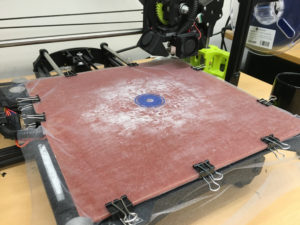
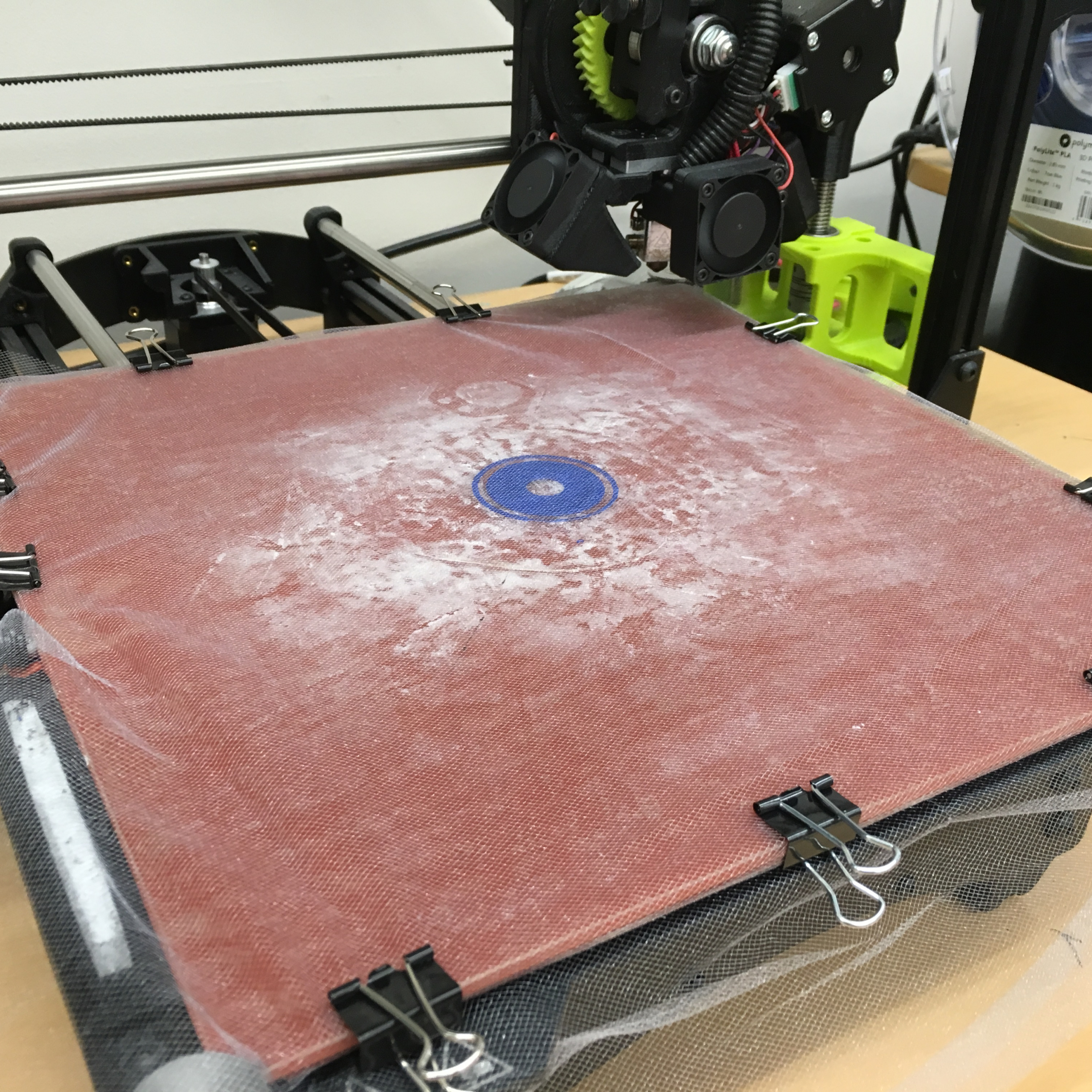
Nylon tulle has been placed over the first layer of PLA and secured to the bed with binder clips.

Sustainable manufacturing

3D printing is considered a sustainable manufacturing approach. It entails only applying materials where needed and, unlike traditional fabric printing processes, does not require excessive amounts of water. Sustainability and innovation are two sometimes seemingly opposing initiatives in the apparel industry. “Introducing Fashion Students to Direct 3D Printing on Fabric” presents educational project approaches to direct printing on fabric using a Lulzbot Taz6 printer and both rigid (PLA) filament and flexible (Ninjaflex) filaments. This project was developed in a college-level exploratory Apparel Technology course, but could be easily adapted to a high school classroom.

Student project features multiple PLA elements on stretch mesh for use in a specific garment location.

(No students in the Apparel Technology course had prior experience with 3D modeling software or 3D printing.)

Lori Wahl is an instructor in apparel, textiles and design in the Margaret Ritchie School of Family and Consumer Sciences at the University of Idaho. She teaches courses in technology, product development and design. Prior to this, Wahl worked in the West Coast apparel industry for 19 years, employed by Nike, Adidas, Hanna Andersson and as a freelance designer.

ACTE members can read Wahl’s article, “Introducing Fashion Students to Direct 3D Printing on Fabric,” in the April 2019 issue of Techniques — Making the Case for Family and Consumer Sciences. Not a member? Join! ACTE is the largest national education association dedicated to the advancement of education that prepares youth and adults for successful careers.

EXCERPT: A Whole School Approach to Access & Equity

Career pathway programs that blend quality career and technical education (CTE) and college preparatory academics offer a way to increase readiness, postsecondary attainment, career advancement and economic stability for youth of all genders, races, socioeconomic backgrounds and ability levels.

Introduce students to careers.

In 2009, SREB challenged states, districts and schools to expand access to curricula that blend college-ready academics with hands-on learning and introduce students to career options. Later that year, SREB partnered with key stakeholders to design 10 Advanced Career curricula that prepare high school students for industry and postsecondary credentials. Each four-course pathway was purpose-built to attract underrepresented students and spark interest in STEM careers through project-based assignments. AC can also help rural and urban schools and districts address access and equity.

Schools have found that AC helps students find a purpose for learning because its projects challenge them.

Advanced Career Pathways

  • Aerospace Engineering
  • Automated Materials Joining Technology
  • Clean Energy Technology
  • Energy and Power
  • Global Logistics >amp; Supply Chain Management
  • Health Informatics
  • Informatics
  • Innovations in Science and Technology
  • Integrated Production and Technology
  • Oil and Gas

Focus on quality instruction.

High-quality instruction is essential to school and student success. Schools implementing SREB’s improvement frameworks use project-based learning to infuse CTE with high-level math, science, language arts and problem-solving skills that prepare students for the modern workplace and continued learning.

The frameworks also provide tools and practices that enhance the quality of instruction. They help students connect what they learn in the classroom with career and college goals. Effective schools create an organizational structure and schedules that give teams of academic and CTE teachers time to co-plan instruction, design standards-driven assignments and share effective instructional strategies.

Increase access >amp; equity for all.

In urban, suburban and rural settings, SREB’s school improvement frameworks provide a structure that empowers schools to expand or improve access to high-quality programs. With support, we can create pathway programs that expand opportunities for all.

Dale Winkler is vice president of the Southern Regional Education Board. Email him.

Scott Warren is division director of Making Schools Work at SREB. Email him.

ACTE members can read the full article, “Increasing Access >amp; Equity: A Whole School Approach,” in the March issue of Techniques. Not a member? Join! ACTE is the largest national education association dedicated to the advancement of education that prepares youth and adults for successful careers.

Teaching Strategies: Certification Test Prep

For career and technical education (CTE) teachers, spring brings with it a focus on certification test preparation. This can be a daunting task. Consider how a teacher might approach supporting student review sessions. You might hear a teacher announce, “You have 45 minutes to study today. Use this time now to review your notes quietly.”

Is it effective? On the surface, it seems to be a good use of time. Students need to perform well. Time is needed for review. However… Students’ attention spans begin to slip around the 15 minute mark (Medina, 2014). Rather than becoming frustrated when students struggle with quiet review, get creative.

Here is an approach you can take: Structure meaningful test prep lessons in which students talk through questions and concepts and, as a result, engage in deeper thinking. Use the following strategies together to help students identify their knowledge gaps.

Socratic Circle

In a traditional Socratic circle, students are seated in a circle without the teacher. They are challenged with open-ended questions or hypothetical scenarios, and instructed to discuss. This exercise helps students to talk through scenarios and situations — to explore possibilities and think deeply — without constant acknowledgement from a teacher.

Early childhood education students were given the following instructions, “We have studied eight leading theorists this year. Discuss each person’s contribution to understanding and rank them by importance to preschool development.”

Students then learn to collaborate and struggle through awkward moments. According to Tony Wagner (2015), agility and adaptability are as important as collaboration and critical thinking for success in 21st century workplace. Engaging in conversation that is challenging, open for exploration but also outcome-based, will push students to construct deeper meaning for themselves.

Forced Agreement

When you want students to arrive at one correct answer, use the forced agreement strategy alongside your Socratic circle. Design this session to follow a think-pair-share lesson. Students are accountable to think on their own, and then they must “pair” together, with forced agreement, to “share” a single correct answer. With the full class group, expand on and discuss those areas where students disagreed.

Because our session was deliberately designed as test prep, students were given three difficult questions to answer. Students were instructed to answer individually and then deliberate together. When the table agreed to one response, and had a strong defense for that response, they signaled the instructor with a thumb in the air.

While each table of students collaborated, the instructor facilitated. More importantly, the instructor listened and checked for understanding, identifying which students grappled with difficult concepts.

The Strategy in Action

https://youtu.be/skJbGwU55aA

How long will it take?

20–30 minutes, depending on the number of students present

What’s the gist?

When your goal is to prime students for deeper retention of key concepts and theories, arrange students in a circle. Students engage in discussion about the question or scenario given. Students use constructive criticism to make judgments and come to sensible conclusions together. The teacher serves as only a facilitator. The goal is for the teacher to never intervene in the dialogue.

Add the forced agreement piece when you are moving toward a specific desired answer. This is a great tool to engage students in modeling and reflection.

Structuring Success for Your Students

Educators must be cognizant of how many students struggle with study and test prep skills. Given that certification testing covers a vast array of standards, terms, concepts and processes, structuring powerful study sessions is crucial.

By doing so, teachers avoid the habituation of routine studying and help students deepen their own understanding by engaging in continual productive talk themselves. Further, by focusing on strategies that are metacognitive in nature, students can identify the areas in which they are still weak.

Sandra Adams is a teacher and instructional coach with the Career Academy, Fort Wayne Community Schools. She co-wrote the ACTE-supported book But I’m NOT a Reading Teacher!: Literacy Strategies for Career and Technical Educators with Gwendolyn Leininger. Contact her to learn how you can implement theses certification test prep and other innovative teaching strategies in your CTE classroom.

REFERENCES
Medina, J. (2014). Brain rules: 12 principles for surviving and thriving at work, home and school (2nd ed.). Seattle, WA: Pear Press
Wagner, T. (2008). The global achievement gap: Why even our best schools don’t teach the new survival skills our children need — and what we can do about it. New York, NY: Basic Books.
Kokomo Area Career Center & Bona Vista Host Sock Hop & Roll

Attendees danced and had fun at the Sock Hop and Roll.On Dec. 14, 2018, Bona Vista and Kokomo Area Career Center, in Kokomo, Indiana, hosted the Sock Hop >amp; Roll. The event was designed by Keegan Paul, a career center student and Bona Vista intern, to offer “adults with disabilities a fun night of dancing, snacking and socializing.” The event was a success! Success that is due, at least in part, to collaboration among career and technical educators — and with business and community partners.
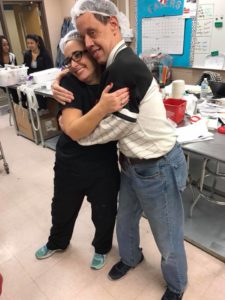
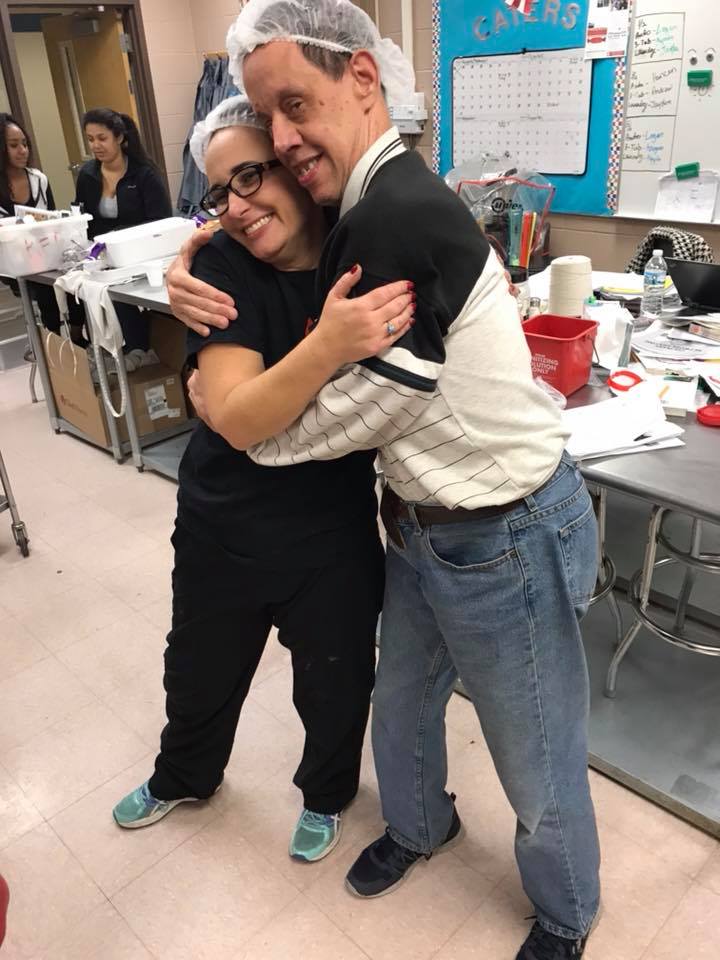
Shelley Rust gets a big hug.“My Kokomo Area Career Center students learn to work together with people from all walks of life. These experiences will serve our culinary arts students well in any situation,” said Shelley Rust, culinary arts instructor and past president of Indiana ACTE. “Watching my students interact with the Bona Vista students fills my heart with joy.”
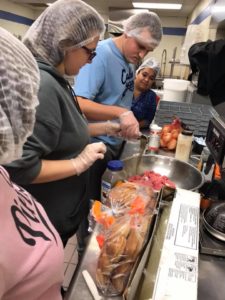
Culinary arts students prepare food for the event.The event offered a unique opportunity for career and technical education students to gain real-world experience and have some fun, too. Culinary arts students developed recipes and conducted tastings with Bona Vista Bistro clients to create the menu. Students in the Kokomo Area Career Center’s cosmetology program styled hair and makeup for the guests, while media marketing students played paparazzi. Those enrolled in the certified nursing assistant program volunteered to provide aid to attendees as needed.
For Keegan Paul, the Sock Hop >amp; Roll was especially memorable. He told the Kokomo Perspective what it meant to him: “He said he’s never forgotten how much fun he had at [a sock hop], and by planning one, he hoped to create lasting memories for others.”

This story originally appeared in the Kokomo Perspective in December 2018.

Do you have news?

Member Connected News is a new regular column on PAGES, a Techniques blog. Here is where we highlight the buzz about career and technical education. If you have something exceptional (or exceptionally cool) to share about your program, school, school district or organization, send it in! You might be featured next!

CTSOs Engage Students: Technology Student Association Members Learn to Lead in a Technical World

The Technology Student Association (TSA) is one of the oldest membership organizations dedicated to STEM education in middle and high schools in the U.S. TSA now is 250,000+ student members strong with 100 percent likely to graduate from high school.

Member Cyra Gallano sees her term as a Colorado TSA officer as one of the most significant and meaningful experiences in high school. “TSA is a community full of amazing people — not only advisers who believe in your capabilities, but peers who motivate and inspire you to develop as a student and a leader.”

“TSA has given me the ability to show my passion for STEM and IT — and truly apply what I learn in the classroom through various events,” said Daniel Rivkin, a Colorado TSA state officer. “Without my experience in TSA, I would not know who I am as a person and where I see myself in the future after high school and after college.”READ MORE

Technology Student Association

To learn more about how CTSOs engage students in CTE, ACTE members can read the February 2019 issue of Techniques online today.

CTSOs Engage Students: HOSA Inspires Skilled, Competent, Qualified Advocates

HOSA–Future Health Professionals is not just a club or organization, rather a valuable instructional tool for empowering health science students to play an active role in their learning. HOSA emphasizes values essential for students to be successful in the real world, namely excellence, teamwork and care.

HOSA offers more than 60 competitive events across health science, health professions, emergency preparedness, leadership, teamwork and recognition. All competitions encourage engagement with current and standard health practices. Competitions deepen opportunities for hands-on experience engaging members in the health community, as competitors are encouraged to connect with health professionals in preparation. READ MORE

HOSA–Future Health Professionals

To learn more about how CTSOs engage students in CTE, ACTE members can read the February 2019 issue of Techniques online today.

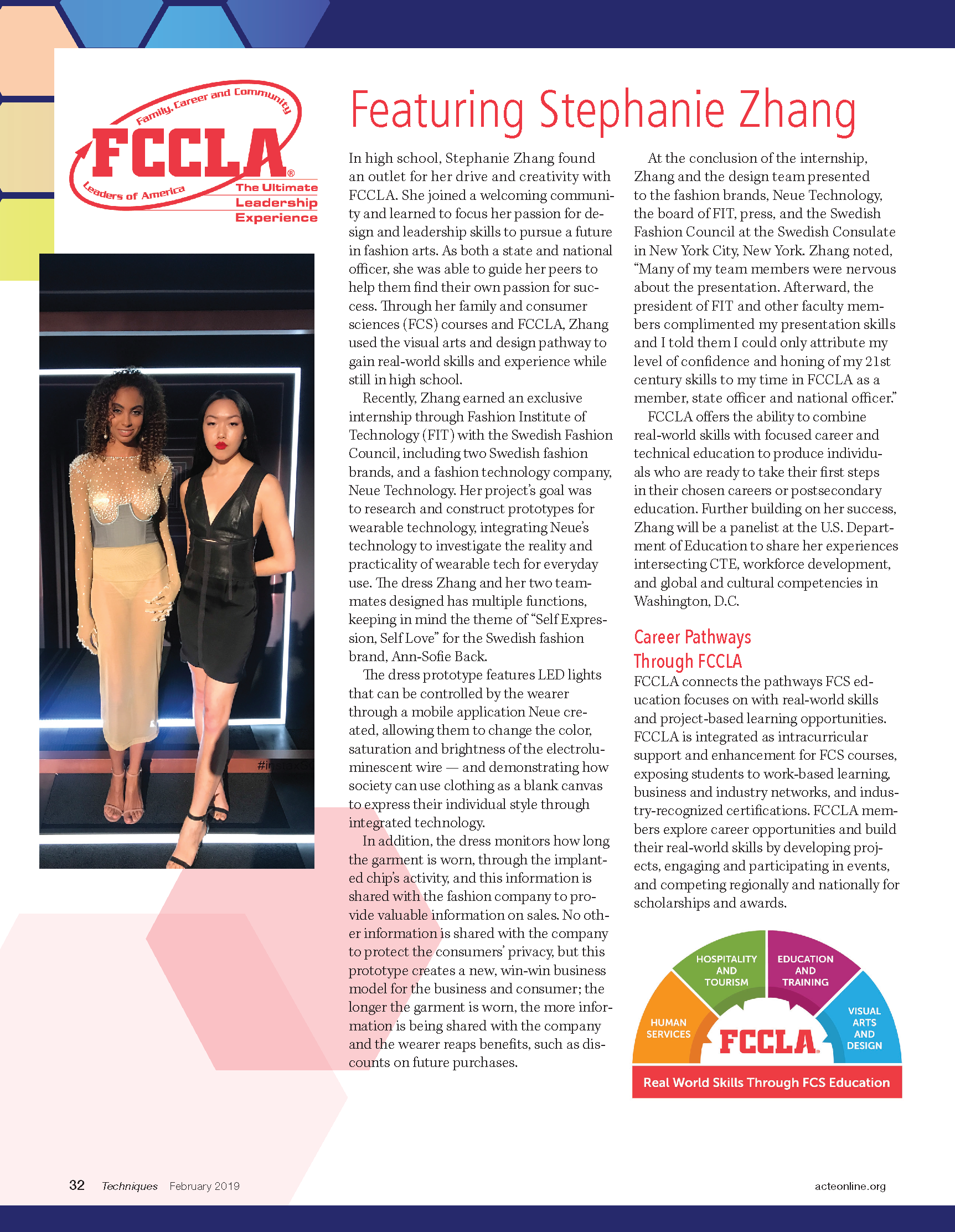
CTSOs Engage Students: FCCLA, Featuring Stephanie Zhang

Stephanie Zhang found an outlet for her drive and creativity with FCCLA. She joined a welcoming community and learned to focus her passion for design and leadership skills to pursue a future in fashion arts. As an officer she guided her peers to help them find their own passion for success. Through family and consumer sciences, and FCCLA, Zhang gained real-world skills and experience while still in high school.

Recently, Zhang earned an exclusive internship through Fashion Institute of Technology with the Swedish Fashion Council, including two Swedish fashion brands and a fashion technology company, Neue Technology. Her goal was to research and construct prototypes, to investigate the practicality of wearable tech for everyday use. READ MORE

Family, Career and Community Leaders of America

FCCLA, Featuring Stephanie Zhang. Read Techniques February 2019 issue, page 32, to learn more.

To learn more about how CTSOs engage students in CTE, ACTE members can read the February 2019 issue of Techniques online today.

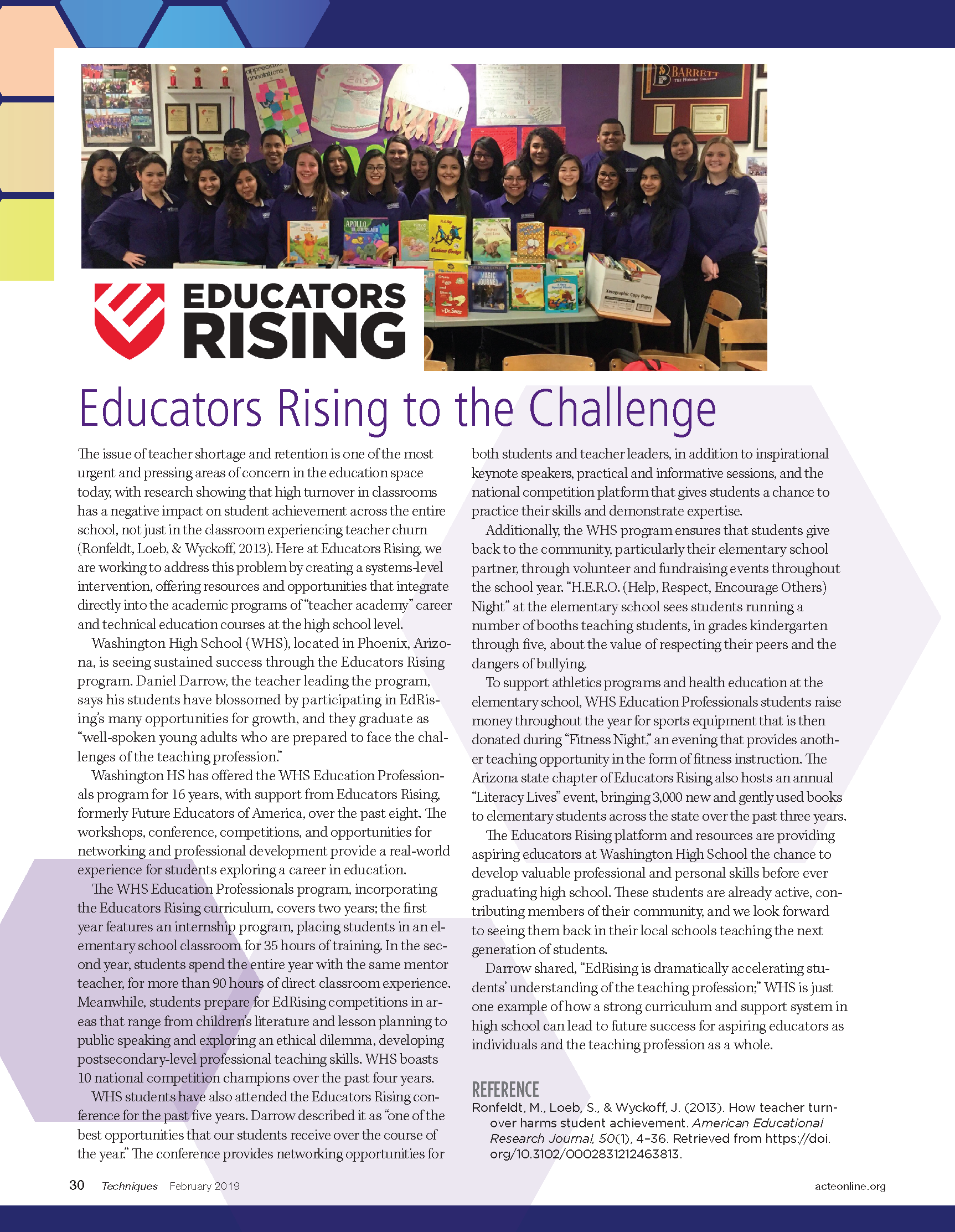
CTSOs Engage Students: Educators Rising to the Challenge

The issue of teacher shortage and retention is an urgent concern today. Research shows that high classroom turnover has a negative impact on student achievement. Educators Rising works to address this problem by offering resources that integrate with CTE at the high school level.

Washington High School, in Phoenix, Arizona, is seeing sustained success through Educators Rising. Daniel Darrow, the teacher leading the program, says his students have blossomed. They graduate as “well-spoken young adults prepared to face the challenges of the teaching profession.” WHS has offered the WHS Education Professionals for 16 years with support from Educators Rising, formerly Future Educators of America, over the past eight. Workshops, competitions and other professional development events provide real-world experience for students exploring careers in education. READ MORE

Educators Rising

Educators Rising to the Challenge: Read Techniques February 2019 issue, page 30, to learn more.

To learn more about how CTSOs engage students in CTE, ACTE members can read the February 2019 issue of Techniques online today.

CTSOs Engage Students: DECA Brings the Classroom to Life

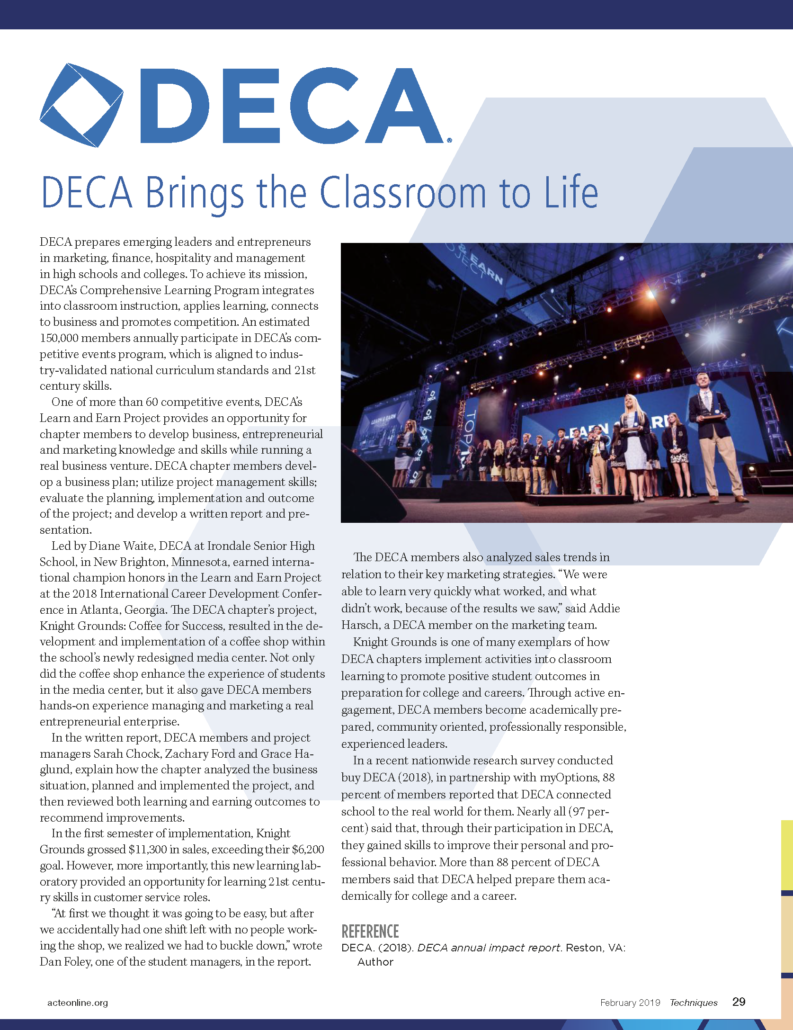
DECA prepares emerging leaders and entrepreneurs in marketing, finance, hospitality and management in high schools and colleges.

The DECA chapter at Irondale Senior High School earned international champion honors at the 2018 International Career Development Conference. Their project, Knight Grounds: Coffee for Success, launched a coffee shop at the school’s newly redesigned media center. The coffee shop enhanced students’ experience in the media center. It also gave DECA members
hands-on experience managing and marketing a real entrepreneurial enterprise.READ MORE

DECA

DECA Brings the Classroom to Life. Read Techniques February 2019 issue, page 29, to learn more.

To learn more about how CTSOs engage students in CTE, ACTE members can read the February 2019 issue of Techniques online today. And be sure to come back to PAGES each Monday, Wednesday and Friday through February, when we’ll feature a new CTSO.

Engaging Students in CTE

Happy CTE Month!

Part of engaging students in CTE is not only talking about it throughout the school year, but also showing students the benefits of CTE and how it can prepare them for college and careers after high school. I start each school year by recruiting students for my own CTSO, DECA. DECA itself “prepares emerging leaders and entrepreneurs for careers in marketing, finance, hospitality and management in high schools and colleges around the globe.”

Everything Career and Technical Education does is to prepare students; prepare them for college, prepare them for careers, prepare them for life. I think that is one reason why I love CTSOs so much! Students receive that hands-on learning in and outside the classroom. There are so many choices students have in CTE. All they need to do is choose a career path and CTE probably has it covered!

To engage students and use them as advocates for CTE, DECA ordered t-shirts this year that say “I AM CTE.” Teachers and students in CTE classes wear their shirts every Thursday during the month of February to get other students talking and recruit for our programs. Business students’ shirts are royal blue, Family and Consumer Science are red, Healthcare is green, Industrial Tech is Gray, Welding is black, and Agriculture is yellow. We plan to reorder shirts for new CTE students every year so this can be an ongoing campaign for Pea Ridge High School.

DECA also participates in Chapter Campaigns to engage in CTE. We work on them in class with our curriculum to then hand over to DECA for our State Conference. Currently, to advocate for CTE Month, DECA has hidden DECA diamonds around the school. Each diamond has a prize written on the back ranging from a free coffee to 50% off a single item from our school-based enterprise. This not only engages CTE students, but students around the high school. When students turn in their DECA diamonds to redeem their prizes, it gives our CTE students a chance to discuss CTE and how important these courses are.

I will never forget when I had a set of parents come up to me my second year of teaching and thanked me for DECA and everything we do. Their son, who had not quite found his niche in high school, discovered it his freshman year when he joined DECA. This student found new friends and discovered new opportunities he otherwise never would have had by engaging in DECA.

THAT is what CTE and CTSO’s do for our students.

# # # # # #