ACTE offer several online professional development opportunities:
ACTE’s webinars happen twice monthly. They cover best practices in CTE and are free to everyone. Topics include Equity Through Remote Learning and Making Work-based Learning Meaningful.
The CTE Learn online network includes 150+ credit courses. Stay up-to-date with your professional development.
Xello and ACTE produce a student career development series. Publication briefs, online lessons and webinars explore topics within ACTE’s High-quality CTE Program of Study: Student Career Development.
Welcome to our new series, COVID-19 Innovations. Here, we chronicle the innovative ways that career and technical educators continue to engage students as lifelong learners and prepare them for rewarding careers, even as the COVID-19 pandemic has upended the 2020–21 school year.
During COVID-19, Rachel Conover of Indian Valley Vocational Center in Sandwich, Illinois, has provided her students with choices. Conover’s culinary arts students demonstrated learning in various ways, including videos, photos and written reflections, using CTEfolio.
Brockton and Somerville school districts in Massachusetts are also piloting CTEfolio. This image shows one of many customizable challenges for Somerville students.
Documenting skills digitally
CTEfolio presents a digital portfolio of student knowledge, skills and experiences. Developed by CAST, a nonprofit education research and development organization, CTEfolio aligns with the principles of Universal Design for Learning (UDL). UDL is a framework for designing accessible and rigorous learning environments for all.
Through CTEfolio, students curate evidence that demonstrates their learning in one central location. Conover offers feedback directly on student work, and students make improvements based on her input. Learners have access to CTEfolio for five years after graduation, and employers can gain access to see evidence of student competencies.
Supporting students with disabilities
Tools like CTEfolio are particularly useful for learners with individualized education plans, Conover said. Students with disabilities can struggle to effectively navigate multiple digital platforms. She described how digital portfolios help students that struggle with verbal communication, memory, anxiety and organizational skills. In CTEfolio, students learn how to assemble and display learning and skills to instructors and potential employers. Built-in accessibility features — text-to-speech, speech-to-text, dictionary and translation — help achieve this goal.
Do you have a COVID-19 innovation to share?
ACTE wants to hear about the innovative ways you are coping with the impact of the pandemic on CTE and career development. Please fill out this short form, and you could be featured in this series. For additional ideas on remote, blended and socially distanced in-person learning for CTE, check out ACTE’s comprehensive guide High-quality CTE: Planning for a COVID-19-impacted School Year and CTE distance learning lesson plan resources.
Welcome to our new series, COVID-19 Innovations. Here, we chronicle the innovative ways that career and technical educators continue to engage students as lifelong learners and prepare them for rewarding careers, even as the COVID-19 pandemic has upended the 2020–21 school year.
Instructors at Nassau Technical Career Center (NTCC) — a shared-time center that offers career and technical education (CTE) programming for learners in grades 9-12 on the campus of Florida State College of Jacksonville in Yulee, Florida — faced many challenges in fall 2020. Among them was getting students to wear face masks properly. Teachers shared that instructional time was being used to enforce mask-wearing policies.
Design and development
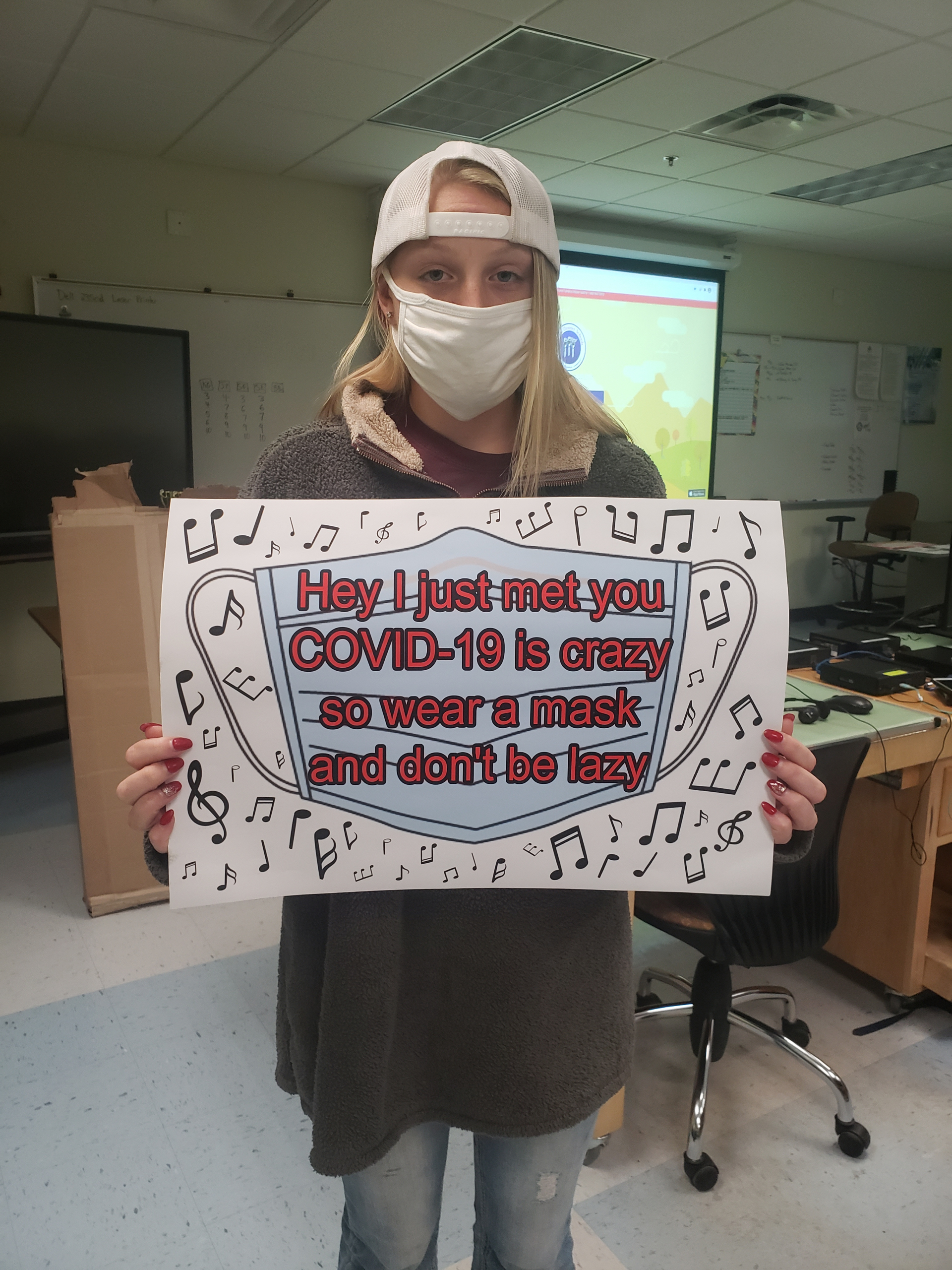
NTCC’s entrepreneurship and marketing teacher partnered with digital media teachers in Nassau County to promote proper mask wearing.
Entrepreneurship and marketing students researched successful business slogans and developed key phrases to promote proper face mask usage. Digital media learners studied graphic design principles and used Adobe software to design posters and flyers. Upon receiving finished artwork, the entrepreneurship and marketing students assisted with the printing and distribution of campaign materials.
A sense of ownership
Now more students across the district are aware of the importance of proper mask wearing. In addition, the learners that actively participated in the campaign have a sense of ownership and pride. Now, they advocate for proper masking.
Do you have a COVID-19 innovation to share?
ACTE wants to hear about the innovative ways you are coping with the impact of the pandemic on CTE and career development. Please fill out this short form, and you could be featured in this series. For additional ideas on remote, blended and socially distanced in-person learning for CTE, check out ACTE’s comprehensive guide High-quality CTE: Planning for a COVID-19-impacted School Year and CTE distance learning lesson plan resources.
Welcome to our new series, COVID-19 Innovations. Here, we chronicle the innovative ways that career and technical educators continue to engage students as lifelong learners and prepare them for rewarding careers, even as the COVID-19 pandemic has upended the 2020–21 school year.
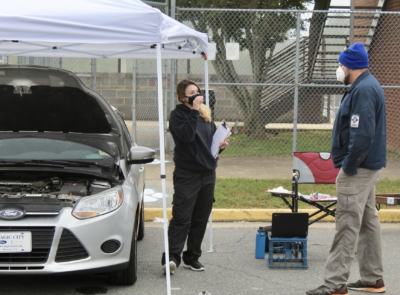
Career and technical educators have shown creativity and flexibility in the face of campus closures and social distancing requirements. In fall 2020, the career and technical education (CTE) department at Rockbridge County High School (RCHS), in Virginia, collaborated to provide students, as much as possible, with a genuine CTE experience. RCHS faculty supplemented virtual instruction with an outdoor CTE classroom along with prepackaged materials for hands-on practice.
Open-air learning
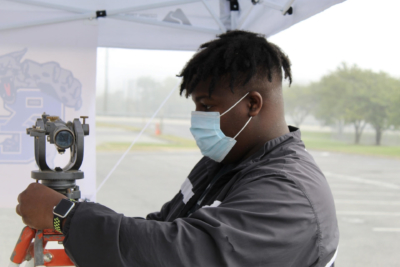
While RCHS delivered most instruction remotely, students in certain CTE programs could sign up to work one-on-one with their instructor: automotive technology and auto body, building trades and construction technology, manufacturing and electronics. In addition, aerospace technology students flew drones. Family and consumer sciences learners carved pumpkins.
The outdoor, socially distanced setup enabled students to complete performance assessments and check off competencies. Those learners who chose not to participate in the open-air classroom participated in virtual learning and assessment.
To comply with safety regulations, learners completed health screenings and had their temperatures taken at check-in. All students and instructors wore masks at all times. Workstations were sanitized after each use, and some learners also wore gloves.
Going mobile
Throughout the fall, educators worked to ensure that all learners who chose to participate in the outdoor classroom had transportation. RCHS hoped to take the classroom mobile, traveling to locations around the community with equipment loaded on trailers. However, rising case rates and colder weather resulted in the closure of the outdoor classroom in mid-November.
Do you have a COVID-19 innovation to share?
ACTE wants to hear about the innovative ways you are coping with the impact of the pandemic on CTE and career development. Please fill out this short form, and you could be featured in this series. For additional ideas on remote, blended and socially distanced in-person learning for CTE, check out ACTE’s comprehensive guide High-quality CTE: Planning for a COVID-19-impacted School Year and CTE distance learning lesson plan resources.
Woodworking teachers faced a challenge that might sound familiar to many career and technical education (CTE) teachers: how to make it work while distance learning. The answer: with strong support from industry. The Society of Wood Manufacturing (SWM) and its members donated materials, supplies and funding to benefit CTE students in California. SWM reallocated budget and resources to help as many teachers and students as possible. They identified three specific areas for support:
Procuring wood materials for students
Securing tools and supplies for students
Assisting teachers to prepare materials and toolkits
Woodworking industry answered the call to support CTE in California.
SWM, a chapter of the Association of Woodworking >amp; Furnishing Suppliers (AWFS), requested donations of materials and supplies from AWFS member companies. Industry responded quickly and generously. In total, SWM collected and distributed about $60,000 in donated wood materials and supplies from the woodworking industry. In addition, SWM awarded 19 $500 grants to California woodworking teachers to use towards distance learning supplies.
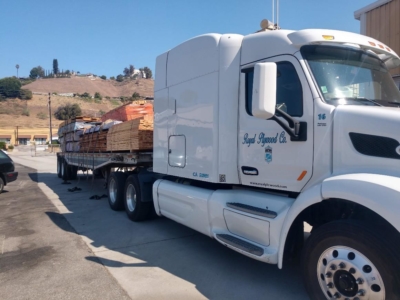
AWFS member company Royal Plywood of Cerritos, California, contributed more than $50,000 in materials. Donations arrived on two flatbed trucks; they included laminated panels and multiple species of hardwood. They also shipped materials from Roseburg Forest Products in Oregon. “We are thrilled that we could help out the local high school students by donating some of the materials we have in stock,” said Dave Golling, vice president of business development at Royal Plywood. We think this is a great program and will make a real difference for the woodworking teachers and students.”
SWM offered hands-on support for career and technical educators.
Saúl Martín, president of SWM and vice president of manufacturing at Architectural Woodworking Company (AWC), volunteered to cut and distribute wood materials for the teachers. He worked with several different instructors to help develop and send home woodworking kits for students. He then cut more than 20,000 pieces of poplar for students to use. Martín opened AWC to the teachers on three separate Saturdays to let them load as much free wood as they could take.
“SWM wanted to do something that would impact as many woodworking students as possible,” said Martín. “The teachers really needed some help from industry to boost their woodworking programs.”
About AWFS
The Association of Woodworking >amp; Furnishings Suppliers (AWFS), founded in 1911, is a nonprofit organization that wholly owns and produces the biennial AWFS Fair. The largest trade association serving the entire home and commercial furnishings industry, AWFS has more than 400 members, including manufacturers and distributors of machinery, hardware, software, tooling, lumber, components, wood products and supplies for the woodworking industry including cabinet, furniture, millwork and custom woodworking products.
ACTE’s CareerTech Virtual VISION 2020 featured live keynote presentations and hundreds of sessions, covering CTE innovations, timely topics and specific CTE subject-matter areas.
Gain full post-event access to Virtual VISION.
Conference materials and sessions are now available for 24/7 on-demand viewing at your convenience at regular attendee rates. Enjoy premier professional development via full access to all Virtual VISION sessions! Register for full access.
Moore Norman Technology Center‘s programming >amp; software development program was selected to attend a two-day virtual event experience, culminating NASA’s App Development Challenge (ADC).Teams will present their apps to NASA leadership during the event. And participants will have the chance to meet with industry leaders.
MNTC team members include seniors from Norman High School (NHS), Norman North High School (NNHS) and Moore High School (MHS):
Katrina Ashpaugh, NHS
Travis Bode, NNHS
Dylan Decoster, MHS
Julian Lautzenheiser, NNHS
Lauren Smith, MHS
Christian Zacher, NNHS
Oklahoma software development students selected by NASA for unique approach to wayfinding.
The NASA review team said MNTC’s app has a unique approach to the wayfinding visualization and in the illumination feature. They also appreciated the extra effort for accessibility for those with color blindness when using color data sets within the app. Additionally, NASA applauded Moore Norman’s work with online coding communities for beta testing and community outreach for app improvements.
Culminating event teams selected include:
Academies of Loudoun, Leesburg, Virginia
Bell Creek Academy High School, Riverview, Florida
Bishop O’Connell High School, Arlington, Virginia
Falcon Cove Middle School, Weston, Florida
McNeil High School, Austin, Texas
Middlesex County Academy, Edison, New Jersey
Moon Millers: Millburn High School, Millburn, New Jersey
Moore Norman Technology Center, Norman, Oklahoma
Team Equinox: Gilman School, Baltimore, Maryland
Whitney High School, Cerritos, California
What is the App Development Challenge?
NASA presents technical problems to middle and high school students, seeking contributions for future exploration missions. According to NASA STEM, “Students take part in the Artemis Generation endeavors to land American astronauts, including the first woman and the next man, on the Moon by 2024.
NASA Technical Advisor Dr. Bryan Welch said, “The capabilities and the apps varied across the teams. Every team brought a unique aspect to their app that we found to be creative, intuitive and useful. Myself, and several of my reviewers found it inspiring.
ADC engages students in CTE through real-world application.
For this particular ADC, students worked to develop an app that visualizes the South Pole region of the moon. It was developed in collaboration with NASA’s Space Communications and Navigation (NASA SCAM) team.
NASA Education Specialist Jamie Semple said, “The SCAM team needed an app that will visualize the moon’s surface for future mission planning and training activities and must also contain a path for exploration and identify communication checkpoint links.”
Students from across the U.S. began work on their apps on Sept. 30 and submitted solution videos online by Nov. 18. And NASA may use one of their apps in the future.
MNTC Programming >amp; Software Development Instructor Rachel Hurt said, “I am always in awe of what my students achieve when they pull together and work to succeed. As our group finished their interview with NASA’s leadership team, I knew that our work helping them sharpen their programming and soft skills was paying off.
“These high school seniors took the knowledge of programming they’ve learned and used it in a real-life scenario. I am extremely proud of these students, and I am extremely proud to be part of an organization that does so much to promote student success.”
“Our team felt honored and proud to be selected as one of the finalists for the NASA ADC,” said Lauren Smith, app team spokesperson. “The obstacles we faced being virtual this year granted us some unique opportunities to hone our skills in self-discipline, team communication and working in a virtual environment.”
A dream began in 1999 when I took a job at Clinton Technical School in Clinton, Missouri. I became a career and technical education (CTE) teacher in the same building where I was once a CTE student.
As a student, I studied business law and accounting, becoming a state competitor in FBLA as a senior in 1993. Just six years later, in 1999, I took a marketing education position down the hallway. Later, I worked as a teacher and administrator at the Career and Technology Center in Fort Osage, Missouri. And, since 2011, I have served as director of Northland Career Center in Platte City, Missouri.
In each of these amazing places, CTE provided me with a purpose in my career. It has been my calling, to watch students learn and grow while finding their pathways into the real world.
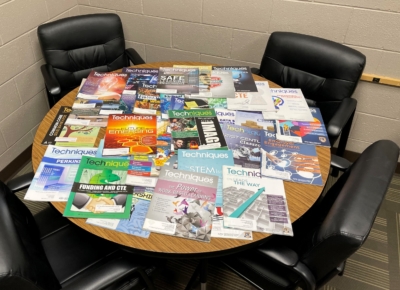
Over these past 22 years, I have maintained a passion for learning and innovation. And my most trusted sources for CTE-specific professional development have been the Association of Career and Technical Education (ACTE) and Techniques magazine. I have had the privilege of being a Missouri ACTE member, an ACTE member, and a subscriber of my favorite professional magazine, Techniques, for all 22 years of my career.
Techniques is valuable.
I commend ACTE for its work with the Southern Regional Education Board (SREB) and Advance CTE. By attending ACTE national conferences and reading Techniques, I learned about SREB’s Technology Centers that Work (TCTW) initiative and Advance CTE’s career clusters. Techniques and ACTE provide members like me with meaningful and relevant articles that ignite effective instruction and school improvement.
As Techniquesturns 25 in 2021, I celebrate the impact this publication has had on my career and on the careers of many of my colleagues. In each of my roles in CTE, I have turned to Techniques for a variety of reasons.Consistently, I knew I could find inspiration and innovation in facilitating CTE instruction and leadership.
Techniques is versatile.
The versatility of Techniques for CTE educators is unmatched. Innovative instruction, CTE funding, marketing, work-based learning, experiential learning, career pathway development, and leadership. These are only some of the many concepts that educators can read about in print or on the digital site.
Techniques offers additional benefits in my life, outside the classroom. Additionally, Techniques has helped expand my knowledge of career pathways available for my children, who possess very different skill sets and interests.
In my own educational advancement, I have resourced many Techniques articles in written work. In fact, in a paper I wrote during the final stages of my Education Specialist degree, I cited 19 articles from various issues of Techniques, including from my favorite issue of all time — Changing the Image of CTE(2011).I also have recommended issues for other CTE educators pursuing their own research. Techniques is NCC’s go-to publication when seeking stories of CTE success from across the country.
Techniques turns 25.
Along with all of my personal and professional appreciations for Techniques, it is important to note the broader impact: Techniques turning 25 aligns with a rebirth of CTE. Techniques has helped guide the shift to a whole new world of CTE in 2021. CTE is now having its moment in the spotlight, and Techniques has been a catalyst in changing its image.
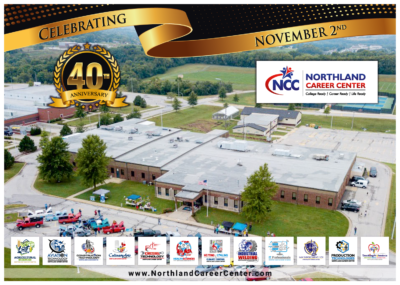
Amid these exciting times for CTE, this anniversary year for Techniques happens to occur during a unique time in our society. This past fall, Northland Career Center celebrated 40 years. And we celebrated as best as we could during a pandemic, showcasing the past, present and future of our organization.
Best wishes to Techniques as they celebrate an anniversary during these unusual times. The past offers history and tradition. The present offers insight and direction, and the future offers an important connection to tomorrow for CTE educators. Cheers to the next 25 years, Techniques!
Brian Noller is director of Northland Career Center. Prior to this role, he served as a marketing teacher and DECA adviser at Clinton Public Schools >amp; Fort Osage School District, also as assistant director and summer school director at Fort Osage Career >amp; Technology Center. Noller has dedicated a commitment to CTE. He is married to Anita Noller and together they have two children, Camden (11) and Delayna (8). Email or reach out on Twitter.
The United States is facing a crisis in its supply chain. At a time when Americans are relying on quick and efficient delivery more than ever, our nation’s already struggling transportation system experiences even greater strain. More than 70% of freight in the U.S. travels by truck (Costello, 2019). And this problem threatens to slow our supply chain to a crawl. ATA Chief Economist Bob Costello said the industry will need to hire 1 million new drivers over the next 10 years.
Explore careers in trucking.
Careers in trucking present a unique opportunity for young people to enter the skilled workforce. According to Bruce Evans, executive vice president of talent analytics at Emsi, which provides labor market data to professional who specialize in workforce development, truck driver is the most posted job in the U.S.
Those who wish to obtain a commercial driver’s license (CDL) must be 18 years old and must also pass an exam. Most people do this by attending a CDL course (lasting four to six weeks) at their local technical community college or a driving school.
The newly formed Next Generation in Trucking Association establishes high school programs to meet this huge need.
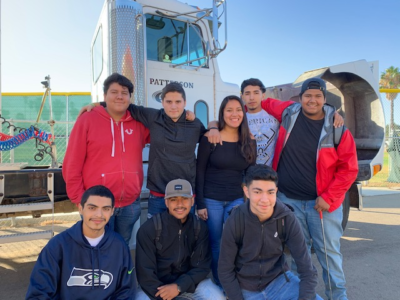
Only six high schools in the U.S. offer CDL driver programs. One of those can be found at Patterson High School in Patterson, California. The program, which was created in 2016 by teacher and former truck driver Dave Dein, has grown steadily over the last four years. Dein helped create Next Gen Trucking, which provides turn-key curriculum and partnerships for free and discounted resources. Next Gen also helps foster key partnerships for advisory boards and apprenticeship programs. Dein sees a true change is happening in his students.
Meet Javier
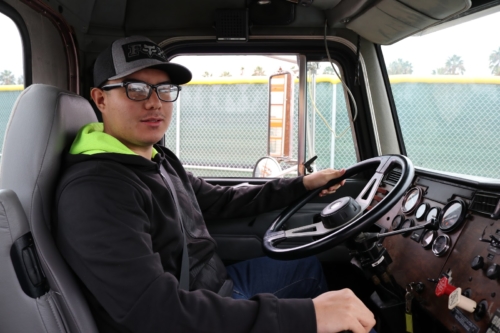
Javier was a student at Patterson High School. He had parents who loved him and a little brother that looked up to him, but he wasn’t succeeding in the traditional school programs offered to him. During his senior year, Javier learned of the CDL program. He enrolled, and he thrived.
Javier exemplifies the importance of career and technical education in high school.
And his brother? He just passed the CDL test!
Logistics
The Patterson High School program was specifically designed to meet the needs of the digital generation.
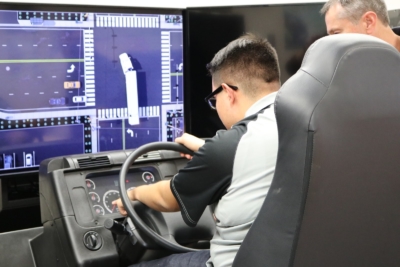
Abundant use of technology and interactive, relatable lessons solidify student engagement. PHS incorporates the use of two state-of-the-art driving simulators built by Advanced Training Systems. Here, students learn not only the basics in operating a commercial motor vehicle in a safe environment, but receiving training on how to react in emergency situations, something that cannot be replicated using a real truck.
Additionally, PHS switched from a standard textbook to leverage digital, personalized environment to teach required federal standards. Since partnering with transportation curriculum provider Instructional Technologies, Dein has seen an increase in student retention levels.
Students are trained in the proper way to perform industry-specific body movements, to prevent workplace injuries, using an online program called Worklete.Students interact through the use of real-world applications and practice movements throughout the week to create muscle memory.
The PHS program has grown from teaching the basics to providing a comprehensive overview of the trucking industry. Students explore technological and safety advances that are changing the landscape of the industry.
What’s next?
With comprehensive curriculum and a program in place, the next step for trucking is its own CTE pathway. The plan will be to begin working with students in their sophomore year, offering a basic Class C driving class with an emphasis on trucking. Juniors would learn the basic operation of a truck, involving how to shift a 10-speed transmission and proper identification of vehicle parts. As seniors, students not only elevate and perfect their skills, but would also take on a leadership role in assisting in the training of the underclassmen.
Truck driving falls under the warehousing and logistics career pathway in California. Elsewhere, relevant career pathways include heavy equipment, construction or diesel mechanics. These are all professions in which a CDL is an asset or required. Students with a CDL will be highly marketable and ready to begin an in-demand career in trucking.
CTE programs in trucking must continue to grow so that the items you depend on arrive on time. We face an obstacle with nationwide implications, and the trucking industry is ready to partner with career and technical education programs to fill a pipeline of qualified drivers. Learn more.
Lindsey Trent works for Ryder. She also serves on the board of the Kentucky Trucking Association, Fairdale High School Advisory Board and started the Next Generation in Trucking Association. She resides in Kentucky with her husband and two kids and loves to golf, travel and read.
Dave Dein has served in public education for the last 22 years while simultaneously pursuing his passion for trucking. He has accumulated more than 700,000 safe driving miles. Dein is also the founder of Faith Logistics, an outreach truck driving school that trained rehabilitated inmates. In his free time he enjoys long distance backpacking in search of his next adventure. Contact them.
The transition to remote learning has left educators reeling. Being asked to design lessons, learn new technology, all while educating your own children and simultaneously trying to stay connected to family and friends in the middle of a pandemic is a herculean task. For career and technical education (CTE) teachers, the loss of balance is even further compounded. Why? Because CTE curriculum is often dependent on access to specialized tools and large machines
Imagine trying to teach woodworking without a lathe, or automotive without a lift. Imagine trying to teach biotechnology without a pipette, or HVAC without access to a soldering table.
It’s hard to picture — let alone do.
The truth is, CTE teachers can’t replicate the experience of hands-on learning in industry-specific lab spaces. What they can do is this:
Get back to basics.
CTE students learning in a remote environment can still learn something essential.
They can still learn how to learn.
After all, in the real world, CTE students must be able to acquire new knowledge. Today’s CTE students will soon be plumbers, electricians, cosmetologists, news anchors, entrepreneurs, engineers and doctors. They will all encounter novel situations that require deeper understanding and the independent discovery of answers.
The following strategies are designed to help CTE teachers develop curriculum, projects and lessons that guide students to take ownership of how they learn.
Think about the barriers.
Before you design a lesson plan or an activity, pause and think about what barriers students might experience as they try to learn in a remote environment. For example, some students only have one computer at home. Plan virtual “office hours” with tons of advanced notice; offer alternative options for students to connect with you.
If you haven’t heard from a student in a while, don’t ask why before considering the barriers. Ask yourself, “How can I design the lesson to better engage this student?” Connect with the student’s counselor for advice on outreach strategies.
You might also develop an assignment that asks students to think about barriers they and their peers may be experiencing. Encourage them to be as honest as possible. Waking up might be a barrier if they are constantly staying up later than they would normally due to a lack of school-based scheduling.
In remote learning environments many educators are leveraging video resources. If you choose to do so, make sure you don’t unintentionally create more barriers. Render all videos so they include closed captioning. That way students who are hearing impaired can access the learning. Captioning will also benefit students in noisy environments and enriches the learning experience for all.
Focus on the goal.
Student engagement may increase in remote learning environments if educators place a strong focus on making sure they are truly assessing the learning goal. For example, it might seem natural to ask students to write an essay response to the following question: Describe how you use a tool safely. But, if that is the only option you provide for students to demonstrate learning, what are you assessing really?
A student might know how to use the tool safely, but they might not be able to access a computer for writing, or they may not feel confident in their writing skills. What if you provided students with options for demonstrating their understanding? Can you still assess the learning goal of safety…
If the student makes a video explaining how they would use the tool?
If they draw a poster and submit a photograph of it?
Ask students to describe their learning goals. Consider creating an assignment that asks students to answer the following question: What are the three most important things you would like to learn with the remaining time in the school year? Use these answers to drive your unit development and activity planning.
Keep it relevant.
Students learn best when they feel the materials, tools, units or concepts are relevant or authentic. During the COVID-19 pandemic, keep it relevant by focusing on themes and tools students can access at home. Here’s an idea from Abraham Ewing, a CTE woodworking and manufacturing teacher at ConVal High School, in Peterborough, New Hampshire.
Share your home projects.
Ewing sends daily videos to students. He teaches woodworking students about estimating wood costs, project design, drawing, planning and more as he builds raised beds in his own backyard. “When I call home to talk and share what students are learning about building raised beds, most of the parents seem really excited because they want their kids to build them too.”
Ewing recommends teachers stay flexible and be ready to improvise. “For my manufacturing class I bought my own 3D printer. I use it for visuals in my class videos and I showed them how local people were using 3D printers to make masks for hospitals.”
Consider asking students what projects they are working on at home. Could students create short how-to videos detailing the projects they are working on? If they can’t work on projects at home, ask students to draw or make a video of what project they would like to do at home. How can you use students’ interests to increase engagement and make the material relevant?
If I had to craft an essential question for this time in education, it might be:
How can CTE educators design remote learning so lessons are accessible, relevant and engaging?
While the answer will look different for each teacher, and will largely depend on support, student population and subject area, the common denominator will be the need to develop strategies that bring us all back to the heart of learning.
>nbsp;
Before working at CAST, Amanda Bastoni, Ed.D., was an accomplished CTE director and teacher with 20+ years of experience in K-12 educational leadership, journalism and business. She has a proven record of achievement including being named the 2019 New Hampshire CTE Leader of the Year. During her time in education, Amanda has focused on increasing equity and access for special populations in CTE. Email her.



 Welcome to our new series, COVID-19 Innovations. Here, we chronicle the innovative ways that career and technical educators continue to engage students as lifelong learners and prepare them for rewarding careers, even as the COVID-19 pandemic has upended the 2020–21 school year.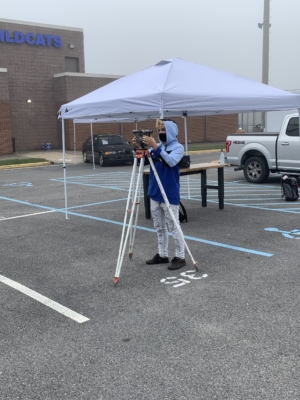

 Woodworking teachers faced a challenge that might sound familiar to many career and technical education (CTE) teachers: how to make it work while distance learning. The answer: with strong support from industry. The Society of Wood Manufacturing (SWM) and its members donated materials, supplies and funding to benefit CTE students in California. SWM reallocated budget and resources to help as many teachers and students as possible. They identified three specific areas for support: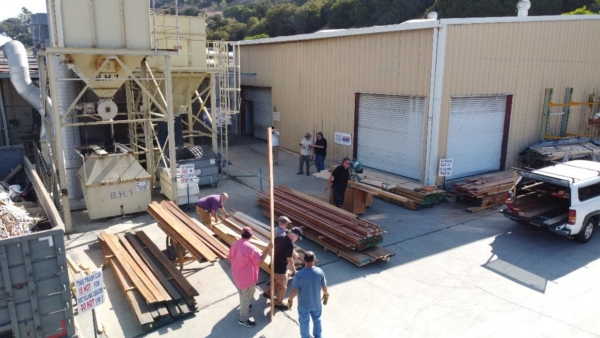
 ACTE’s CareerTech Virtual VISION 2020 featured live keynote presentations and hundreds of sessions, covering CTE innovations, timely topics and specific CTE subject-matter areas.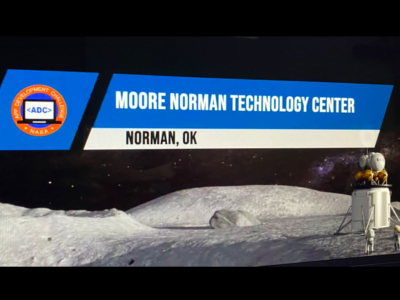
 The United States is facing a crisis in its supply chain. At a time when Americans are relying on quick and efficient delivery more than ever, our nation’s already struggling transportation system experiences even greater strain. More than 70% of freight in the U.S. travels by truck (Costello, 2019). And this problem threatens to slow our supply chain to a crawl. ATA Chief Economist Bob Costello said the industry will need to hire
 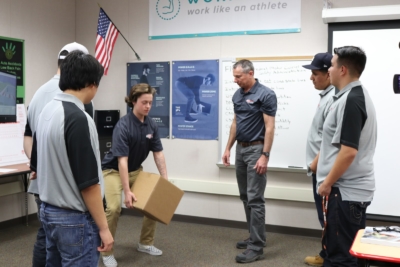 Students interact through the use of real-world applications and practice movements throughout the week to create muscle memory.
 Lindsey Trent works for Ryder. She also serves on the board of the Kentucky Trucking Association, Fairdale High School Advisory Board and started the Next Generation in Trucking Association. She resides in Kentucky with her husband and two kids and loves to golf, travel and read.