Perkins Implementation Resources
Overview
The Carl D. Perkins Career and Technical Education Act, as amended by the Strengthening Career and Technical Education for the 21st Century Act in 2018 (Perkins V), is the primary piece of federal legislation impacting CTE programs around the country. The most recent amendment was signed into law on July 31, 2018 as Public Law 115-224. Below you will find several general resources to help you understand the law.
- Full text of the Perkins Act
- Perkins V Funding Distribution Chart
- FY 26 State Allocations
- Department of Education Perkins V Resources
Perkins Statistics
- In FY 2026, the federal government allocated approximately $1.4 billion in Perkins Basic State Grants to states to support the development and improvement of CTE programs (OCTAE).
- CTE programs served over 8.6 million secondary CTE participants and 3.3 million postsecondary CTE participants in 2023-24 (OCTAE). Participants are students who take at least one course in CTE.
- These 2023-24 totals include 3.8 million secondary CTE concentrators, or students taking 2+ courses in the same CTE program area, and 1.8 million postsecondary CTE concentrators, or students earning 12+ credits in a CTE program area (or less if the program is shorter) (OCTAE).
- 97% of secondary CTE concentrators graduate from high school, among other positive outcomes for CTE students (OCTAE).
Perkins 101
This series describes, in an easy-to-understand manner, the components of Perkins V legislation to anyone new to the purpose, importance and impact of this federal law.
- Perkins 101: Introduction to the Carl D. Perkins Career and Technical Education Act (February 2025)
- Perkins 101: Federal Funding (February 2025)
- Perkins 101: Accountability (February 2025)
- Perkins 101: Comprehensive Local Needs Assessment (February 2025)
History of CTE in Federal Policy
- CTE Policy Past, Present, and Future: Driving Forces Behind the Evolution of Federal Priorities (April 2017): This article uses a social policy analysis approach to trace the history of federal CTE policy throughout the 20th century and the beginning of the 21st century. Through this overview, we demonstrate how federal CTE policy has repeatedly evolved and responded to changing economic and social needs, while also incorporating policy flexibility that has led to variation in program implementation on the state and local levels.

Perkins Official Guide
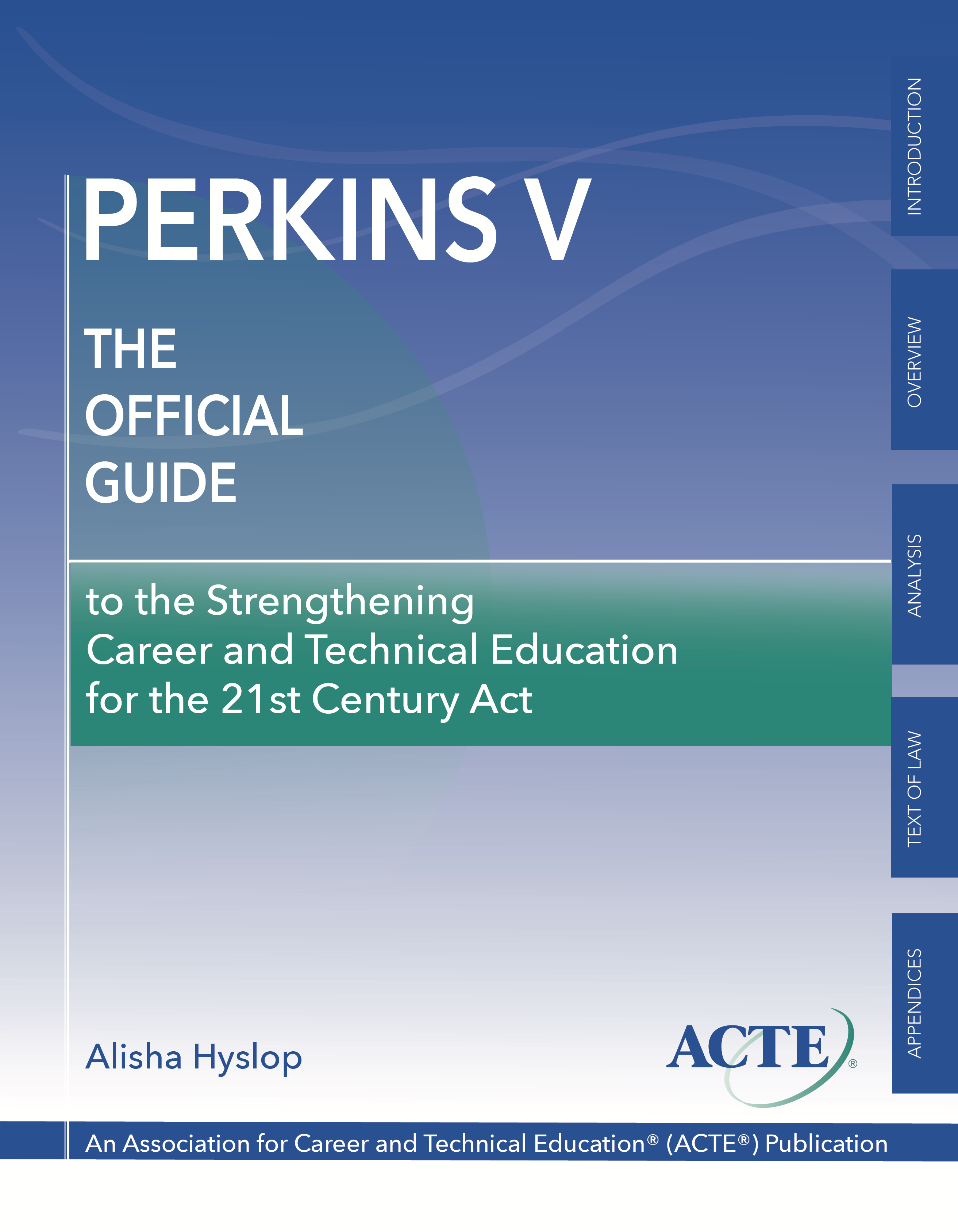
Perkins V: The Official Guide to the Strengthening Career and Technical Education for the 21st Century Act (October 2018): This comprehensive book includes background and overview of the new law; highlights of changes that will have the greatest impact on your programs; a complete side-by-side showing key differences between IV and V; section-by-section summary and analysis; summary and relevant sections of other federal legislation referenced within Perkins V for clear crosswalking; the complete text of the new law; and an index for easy reference.
Bulk Order Special: $34.95 each for 5 or more copies for Members
ACTE Members: $41.95 / Non-Members. $44.95
Implementation Resources
Comprehensive Local Needs Assessment & Accountability
- ACTE’s Quality CTE Program of Study Framework Self-evaluation: A Tool for the Perkins V Comprehensive Local Needs Assessment (November 2021): This brief describes how the ACTE Quality CTE Program of Study Framework™ and its companion self-evaluation instrument can help local CTE leaders evaluate their programs and complete key portions of the CLNA.
- Lessons in Collaboration and Innovation: The Impact and Promise of the Comprehensive Local Needs Assessment
(January 2022): This report, developed with Advance CTE, describes state perspectives on successes and challenges during the first comprehensive local needs assessment and examples of CLNAs driving transformation on the local and regional levels. - Maximizing Perkins V’s Comprehensive Local Needs Assessment & Local Application (March 2019): This tool provides an overview of how to get started on your local needs assessment and helps you translate the language in the law into concrete, actionable steps for conducting a rigorous local needs assessment that meets Perkins V requirements.
- Collecting and Analyzing Data for the Secondary Program Quality Indicators in the Carl D. Perkins Career and Technical Education Act of 2006 (December 2022): This publication, released by the Department of Education was produced through a contract with Manhattan Strategy Group and was part of a project on which ACTE consulted. It outlines key data considerations related to the three Perkins secondary program quality indicators.
Special Populations
- Maximizing Access & Success for Special Populations in CTE series (December 2023): This series of briefs and webinars, developed with Advance CTE, addresses how to support each of the nine Perkins V special populations and other underserved learner groups.
- Engaging Families and Communities to Support Special Populations in CTE (September 2021): This report describes strategies for communicating with, collaborating with and supporting CTE learners’ families and communities, particularly for learners and communities who have been historically underserved.
- With Learners, Not for Learners: A Toolkit for Elevating Learner Voice in CTE (August 2021): This toolkit, created with Advance CTE, provides CTE leaders with actionable resources, guidance and tools to ensure CTE learner voices are elevated and heard in order to improve CTE policies and practices.
- Special Populations Repository (March 2025): This repository provides practitioners with various resources, guides, and toolkits on how to best serve students in special population groups as defined by Perkins V.
Teacher Pipeline
- Career and Technical Education Leadership Series: Landscape of CTE Leaders (December 2021): This publication shares data on CTE leaders, such as numbers of administrators, preparation and responsibilities.
- Staffing Outside the Box: Strategies for Addressing CTE Teacher Shortages (August 2024): This report, sponsored by eDynamic Learning, explores considerations and provide examples for addressing CTE teacher shortages in the short and medium term through such methods as bringing industry experts into the classroom, sharing faculty across subject areas and institutions, and providing virtual learning opportunities.
- CTE Educator Pipeline Toolkit: This toolkit contains various resources to help CTE practitioners raise awareness of the CTE educator shortage with their students and other CTE stakeholders. Resources include social media messages, graphics, relevant data points and promotional videos.
- State and Local Strategies for Diversifying the CTE Educator Workforce and Recruiting Diverse Educators: A Database of Organizations Representing Underserved Populations (January 2024): This report, created in partnership with Advance CTE, presents common challenges to diversifying the CTE educator workforce, identifies promising practices to overcome these challenges, and provides actionable strategies and recommendations for local and state leaders. Read the full report or the executive summary and explore the companion database of organizations that CTE leaders can connect with to recruit educators from under-represented populations to teach in CTE.
- Teach CTE Repository: This repository continuously highlights promising programs and practices around the CTE educator pipeline. The entries are collected from reports, articles and other resources that provide background about this critical issue and reveal promising programs and practices. We hope to share more about proven strategies as that knowledge becomes available. Disclaimer: No materials presented in the repository should be presumed to reflect the positions or policies of ACTE. ACTE does not guarantee the accuracy or applicability of the information represented in this repository. In addition, ACTE does not endorse any program, practice or organization present in this repository. The information present is strictly for informational and educational purposes. Contact ACTE to offer additional submission suggestions for the repository.
Employer Engagement
- Cheat Sheet: Opportunities for Employer Involvement in CTE (October 2019): This brief, developed with Advance CTE and Business Leaders United for Workforce Partnerships, describes the many ways that employers can partner with education institutions.