

ACTE Turns 100!

Join us for ACTE's Centennial Celebration at CareerTech VISION 2026, happening Dec. 2-5 in New Orleans. Experience the premier event for CTE professionals with hundreds of sessions, inspiring presenters, a bustling Expo and unforgettable centennial celebrations!


Share your CTE stories & experiences.

Link

Share a piece of CTE history & help bring our centennial story to life.

Link

Shop the centennial collection!

Link

100+ Years of Excellence

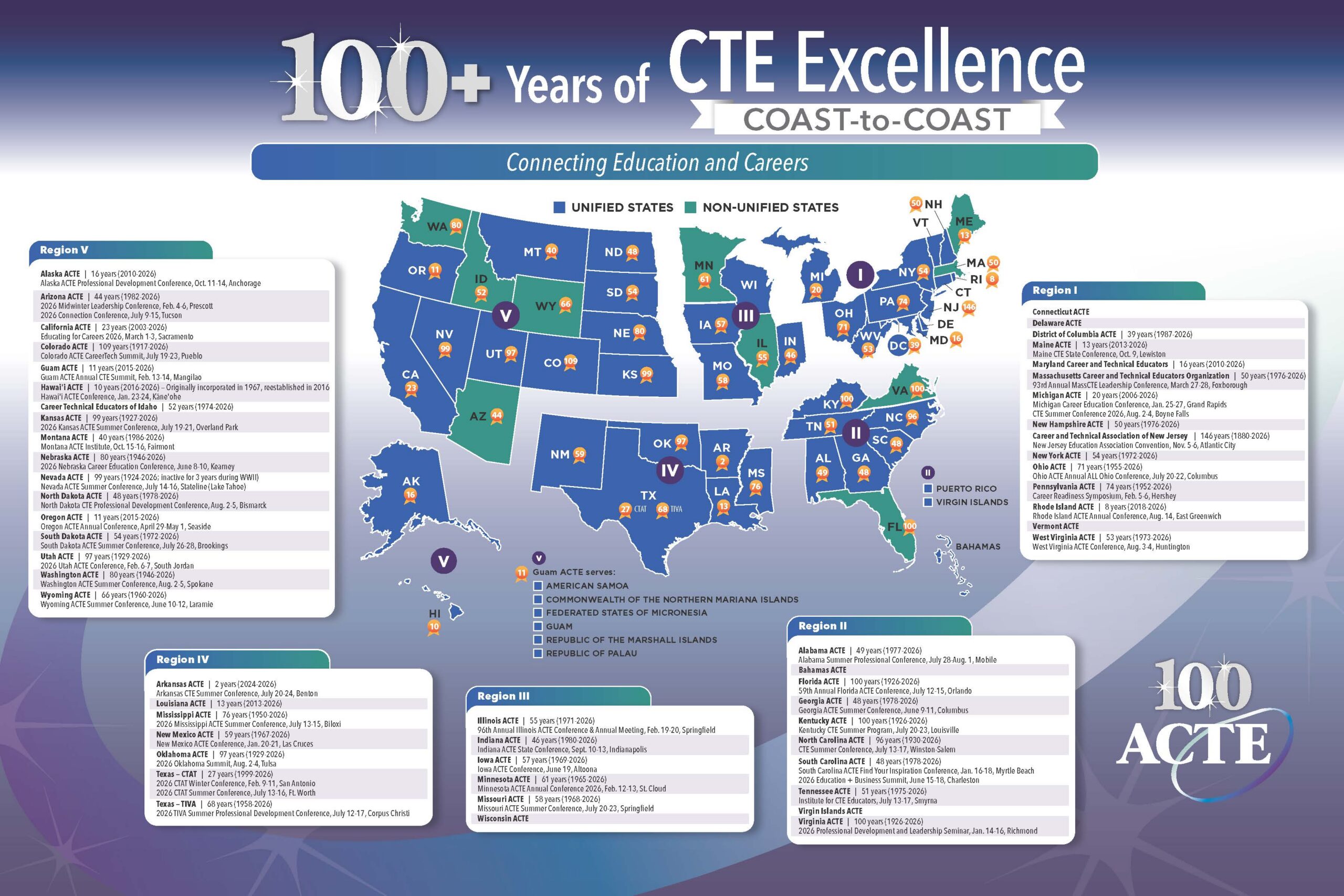
Celebrate more than 100 years of career and technical education excellence. This U.S. map highlights state organization anniversaries and 2026 state conferences nationwide, showcasing how CTE connects education and careers and helping you find key events in your state.

Download Full Map

Read “ACTE: From 1925 to the Present Day."

Celebrating the CTSOs

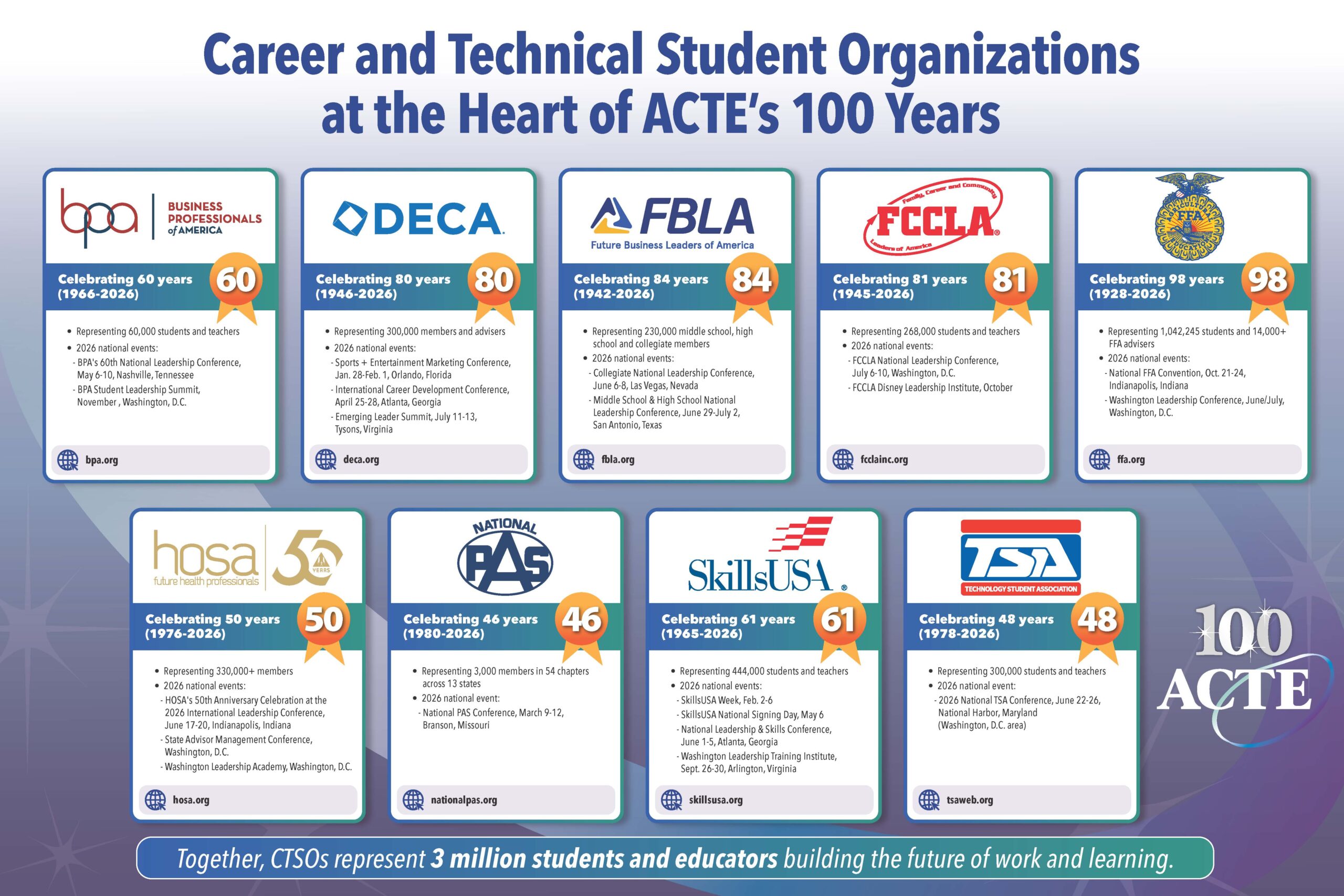
Career and Technical Student Organizations engage more than three million students, empowering them to build the future of work, leadership and learning.

Download Full Infographic

100 questions, over 100 weeks celebrating ACTE's centennial!

Our History

1917

1926

1936

1946

1956

1963

1968

1976

1984

1990

1994

1998

2006

2011

2018

2020

The federal role in CTE began 100+ years ago with the Smith-Hughes National Vocational Education Act of 1917. This legislation marked the first federal investment in secondary vocational education, providing funding to the states for agriculture, home-making and trade and industrial education.

The AmericanVocational Association was created from the National Society for Vocational Education and the Vocational Education Association of the Middle West.

The George-Deen Act of 1936 appropriated $14 million per year in federal funds and broadened their use to include teacher education and training for marketing occupations.

Federal dollars for vocational education were more than doubled to $29 million per year in the George-Barden Act of 1946, which added funding for two student agriculture related organizations (Future Farmers of America and the New Farmers of America) and set limits on equipment spending.

The George-Barden Amendments of 1956 included funding for area vocational centers and added practical nursing and fishery occupations to the list of eligible education programs.

Vocational education was expanded to “persons of all ages in all communities” in the Vocational Education Act of 1963. Funding for states was now authorized by student population rather than by field of study, including money for academically and economically disadvantaged and disabled students.

The Vocational Education Amendments of 1968 was the first vocational legislation to officially reference postsecondary students. It extended set-aside funding for students from specific populations.

Equal opportunities for women and girls were promoted in the Vocational Education Amendments of 1976.

Vocational legislation was renamed after Carl D. Perkins, a representative from Kentucky and education advocate, with
the Carl D. Perkins Vocational Education Act of 1984.

Contemporary vocational education began to take shape with the Carl D. Perkins Vocational and Applied Technology Education Act Amendments of 1990, which embraced accountability, as well as secondarypostsecondary alignment, academic integration and business partnerships

The School-to-Work Opportunities Act of 1994 linked work-based and school-based learning, supported by partnerships
with industry. It expired in 2001.

The Carl D. Perkins Vocational and Technical Education Act of 1998 continued the 1990 Act’s focus on alignment and integration. It created the reserve fund in states and modified state authorizations so that 85 percent of funding would reach local agencies.

In the same year, the American Vocational Association was renamed the Association for Career and Technical Education, reflecting a change from job-specific vocationalism to skill-based, rigorous career education.

The term “vocational education” was also retired. Perkins IV introduced programs of study as a new unifying concept for CTE, with $1.3 billion supporting two funding streams— the Basic State Grant and Tech Prep.

While still written into legislation,
federal funding for Tech Prep was terminated.

The Strengthening Career and Technical Education for the 21st Century Act (Perkins V) continued the prior law’s focus on programs of study and made important updates to afford states and local recipients more flexibility, prioritize stakeholder engagement and data-driven decisionmaking through a new comprehensive local needs assessment, streamline accountability measures, reduce Secretarial authority, enhance efforts to serve special populations and encourage innovation through a competitive grant program.

States submitted Perkins V four-year plans and local recipients submitted four-year local applications, including the results of the first comprehensive local needs assessments. Full implementation of the legislation began in the 2020–21 school year.

In addition, CTE educators demonstrated creativity and flexibility in the face of challenges resulting from the COVID-19 pandemic.


AVA/ACTE Artifact or Not?

Choose whether the following item is an ACTE artifact or not!

ACTE's Centennial Planning Committee

Learn more
# # # # # #