CTSOs Engage Students: FBLA-PBL Students Compete Among the Best

Every summer the best and brightest FBLA-PBL members convene at the National Leadership Conference to compete in business-related competitions and chart their future career paths.

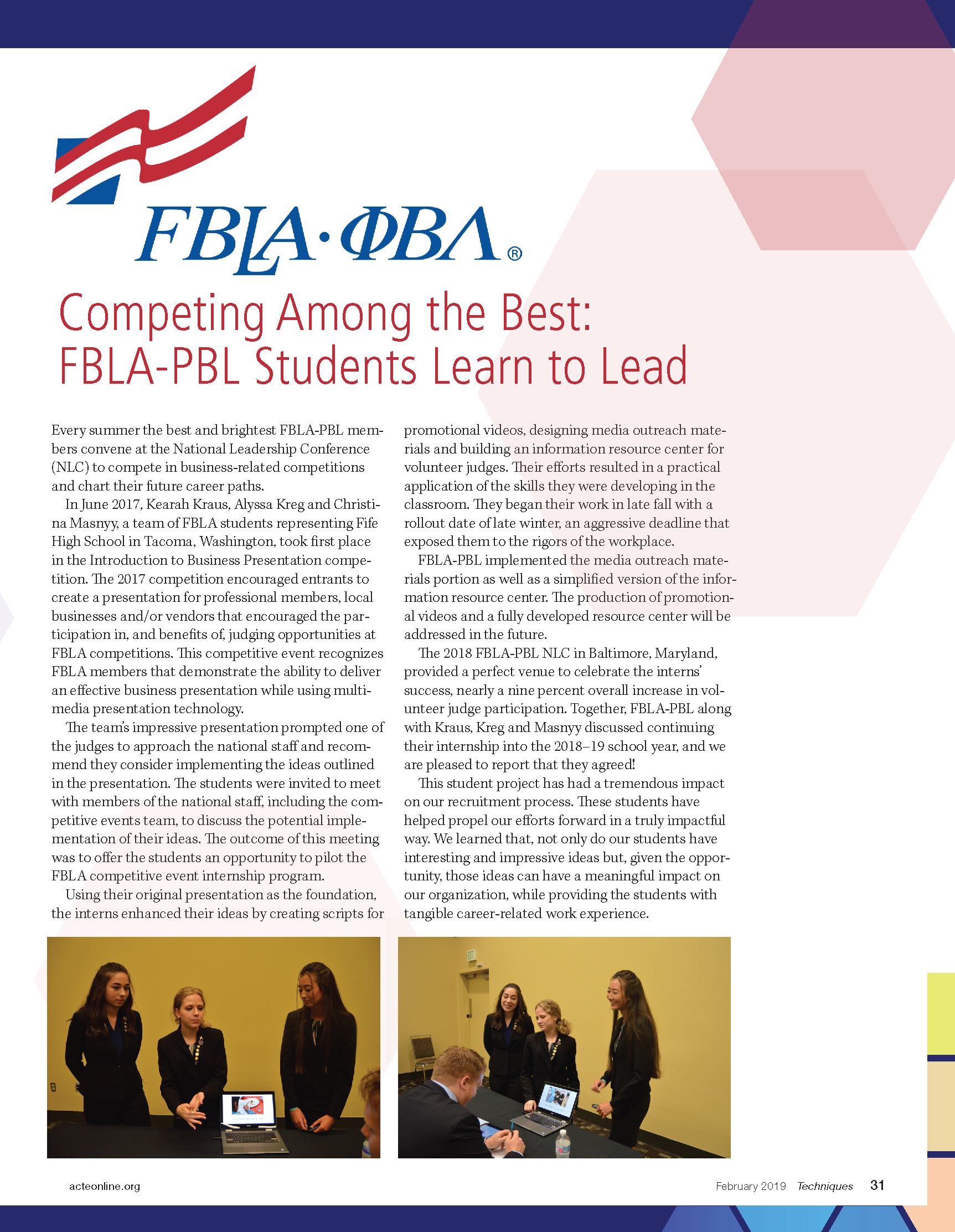
In June 2017, Kearah Kraus, Alyssa Kreg and Christina Masnyy, a team of FBLA students representing Fife High School in Tacoma, Washington, took first place in the Introduction to Business Presentation competition. This competitive event recognizes members that demonstrate the ability to deliver an effective business presentation with the aid of technology. READ MORE

Future Business Leaders of America-Phi Beta Lambda

To learn more about how CTSOs engage students in CTE, ACTE members can read the February 2019 issue of Techniques online today. And be sure to come back to PAGES each Monday, Wednesday and Friday through February, when we’ll feature a new CTSO.

CTSOs Engage Students: SkillsUSA Students Practice Personal, Workplace and Technical Skills

Career-ready starts here.

SkillsUSA’s bold mission is to empower its members to become world-class workers, leaders and responsible American citizens, while improving the quality of our nation’s workforce. Members put the mission into action as they carry out chapter activities and practice personal, workplace and technical skills grounded in academics.

SkillsUSA’s Chapter Excellence Program fosters the development of these skills by benchmarking chapter programming and providing recognition. This year’s top three winners came from Georgia, North Carolina and Arizona. READ MORE

SkillsUSA

To learn more about how CTSOs engage students in CTE, ACTE members can read the February 2019 issue of Techniques online today. And be sure to come back to PAGES each Monday, Wednesday and Friday through February, when we’ll feature a new CTSO.

CTSOs Engage Students: Business Professionals of America, Servant Leadership, Service Learning & Inspiring Agents of Change

Leadership is about service.

Robert Greenleaf taught us that good leaders must first become good servants. We are given opportunities every day to extend our hand. With more than 45,000 members across the country, Business Professionals of America (BPA) is committed to developing and empowering rising student leaders to discover their passion and change the world.

Many people know BPA as a CTSO focused on business, marketing, finance and IT. There is also a strong leadership development component that puts an emphasis on service to others. READ MORE

Business Professionals of America

To learn more about how CTSOs engage students in CTE, ACTE members can read the February 2019 issue of Techniques online today. And be sure to come back to PAGES each Monday, Wednesday and Friday through February, when we’ll feature a new CTSO.

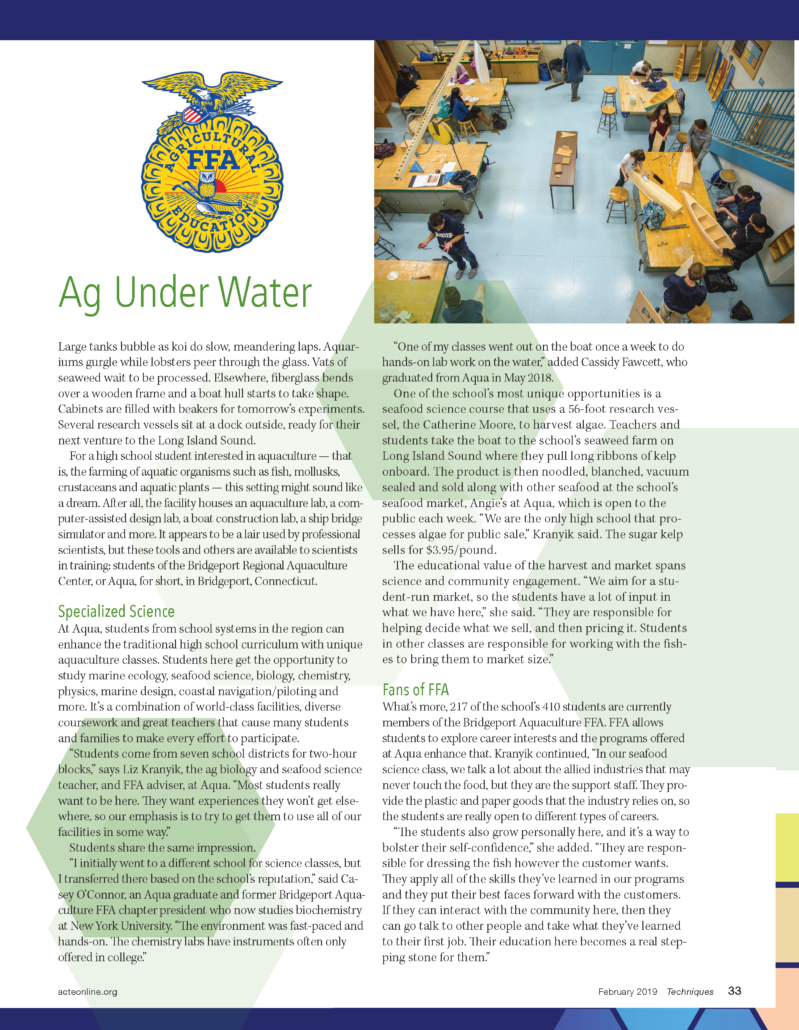
CTSOs Engage Students: Discover Ag Under Water

“Career and technical student organizations (CTSOs) enhance student learning through contextual instruction, leadership and personal development, applied learning and real-world application.”

So defines the mission and purpose of nine CTSOs by the National Coordinating Council for Career and Technical Student Organizations (NCC-CTSO) (2018). Educators and invested stakeholders offer unique opportunities for students to develop the skills for success in careers of their choosing. CTSOs engage students in CTE via activities, programs and competitive events. Students gain experience in leadership roles at local, state and national levels as they network with their peers and potential future employers at events such as ACTE’s CareerTech VISION.

Over the next three weeks on PAGES, a Techniques blog, you will hear from the CTSOs themselves. Learn more about the work of these nine organizations as they enhance student learning to increase global competitiveness.

Let’s begin in Bridgeport, Connecticut.

National FFA Organization

To learn more about how CTSOs engage students in CTE, ACTE members can read the February 2019 issue of Techniques online today. And be sure to come back to PAGES each Monday, Wednesday and Friday through February, when we’ll feature a new CTSO.

REFERENCES
National Coordinating Council for Career and Technical Student Organizations. (2018a). About. Retrieved from http://www.ctsos.org/about-us/.
National Coordinating Council for Career and Technical Student Organizations. (2018b). CTSOs. Retrieved from http://www.ctsos.org/ctsos-2/.

Career Aspirations Out of this World: Rachael Mann Interviews Aaron Shepard

Aaron Shepard inspires others and models boldness; he is determined to break the status quo. Too often, we are encouraged to take the safe path and spend a lifetime wondering, “What if?” Aaron took that road, at first, but soon he realized there is never a better time to follow your dreams than now.

Tell me about your current role as a student and NASA intern.

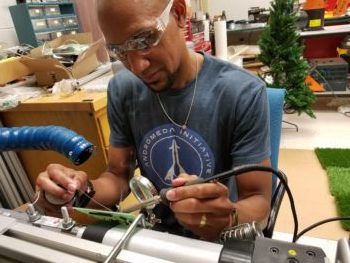
I study electrical engineering at Clemson University. Right now, I’m working on my master’s degree in robotics and intelligent systems, designing flexible robots that can grab satellites in outer space. In summer 2018 I interned at NASA Langley in Hampton, Virginia. As part of a joint project with Uber, our team built virtual reality simulators for a flying taxi service that Uber plans to offer in the 2030s. I worked primarily as a project manager, but I also helped wire and program the simulator. In addition, our team got to see a lot of the facilities and equipment that helped humans reach the moon during the space race.

How old were you when you realized you were interested in space?

I’ve been into space for as long as I can remember. When I was little, my grandma and I would watch hours of “Star Trek” together. The first time I watched a shuttle launch was during fourth-grade science class. The moment I saw the rocket boosters roar to life I knew that I wanted to be an astronaut or, at the very least, work in the space industry.

It was during my freshman year of high school that NASA announced they were canceling the shuttle program. Like many people, I thought this meant the end of space exploration. I tried to “grow up” and find a “realistic” career. I went to college, graduated with a chemistry degree, worked in pharmaceuticals. I even got into medical school. No matter what I did, space was always on my mind. At 25 years old I decided to leave medicine for engineering and take one last shot at fulfilling my childhood dream.

How did you learn about the NASA internship?

In my first year at Clemson, I applied for a research fellowship from NASA’s National Space Grant College and Fellowship Program; Space Grant provides funding assistance and scholarships for students pursuing STEM careers. Aaron Shepard is pursuing a graduate degree in engineering at Clemson University. He hopes to pursue a career as a civil servant with NASA.I got the fellowship and spent that summer working in a lab at school on my satellite capture robot. The next year, I applied for multiple internships at NASA and was contacted (and selected!) by the coordinator for the Aeronautics Academy at Langley.

What has been your most meaningful accomplishment to date?

Just to get my foot in the door at NASA is a big accomplishment for me. I knew that I was taking a huge risk when I changed careers. Making that decision wasn’t easy at all. There were plenty of times I didn’t feel 100 percent confident about my choice, but I still got up every day and did what I needed to do at school and work. I never gave up on my dreams, and now they are starting to become my reality.

What is the best piece of advice you have ever received?

Begin every day with a task completed. Whether it’s making my bed or finishing responses for a written interview, my days feel more productive when I start by accomplishing something small.

What advice do you have for students enrolled in career and technical education classes?

Don’t procrastinate! Success in education comes down to deadlines and learning time management. If you have a week to do an assignment, do small sections of it each day instead of everything the night before. Working this way is more efficient, and it helps you retain what you’ve learned.

Who has had the biggest influence on your life?

My dad wanted to be an aerospace engineer but he never pursued his dream because he didn’t think he was smart enough. He regretted not following his passion, and his story is what inspired me to follow mine.

What advice do you have for educators trying to inspire students to pursue STEM-related careers?

The media tends to typecast “STEM people” as smart and socially awkward white males, like Sheldon from “The Big Bang Theory.” It’s hard for individuals who don’t identify with those traits to see themselves in STEM careers. If teachers want to inspire more students to pursue science and engineering, I think it’s crucial that they share more stories in the classroom about the diverse people that make up the STEM fields.

Thank you for inspiring us, Aaron! To learn more about Aaron and his space journey, follow him on social media @spacecadetshep, email him or check out his TEDx Talk.

Seize the opportunity to take your own career out of this world!

ACTE and NASA HUNCH have teamed up to present the CTE Month 2019 and NASA HUNCH video challenge. This year’s theme, “Working Out of This World,” encourages students to produce short videos featuring careers, products or services that could be used in future space missions. The deadline to submit is Feb. 1.

Teaching Strategy: Peer Video Critique

“I wish students would give each other valuable feedback about what they are learning.”

If that sounds familiar, you might want to try this strategy.

The gap in reading skill levels is an issue nearly every CTE teacher faces. Walk into any given classroom, in any given program area, and it is likely you will find students whose ability levels vary between the seventh and 12th grade. CTE teachers must structure learning so that all students can learn equally, despite these differences. Fortunately, technical vocabulary presents a viable solution. When low-level readers and struggling learners focus on building expertise with technical vocabulary, they are able to close achievement gaps and pass certification exams.

The Catch

There’s a catch, and one in complete sync with the popular learning retention theory. Technical vocabulary terms are likely to be forgotten when the information is received via auditory and passive means (A. Raymond, personal communication, Oct. 4, 2012). In contrast, when students are actively saying the terms in context repeatedly, they are deepening the neural connections and vastly increasing the chances that the terms will be retained.

A solution: Leverage peer feedback >amp; embrace technology.

The Peer Video Critique strategy is leveraged to foster peer feedback between students while embracing their love of technology. When students create short video segments and critique them with a “critical friend,” they learn the art of descriptive and directive feedback. In most learning situations, students are given evaluative and corrective feedback. Both methods are end result-oriented. In contrast, however, descriptive and directive feedback teach students to be actionable. They learn to ask questions and discover the worker’s thought process rather than focusing on the work produced (William, 2011).

The Strategy in Action

https://www.youtube.com/watch?v=179A98fgSd0>amp;t=5s

How long will it take?

20–40 minutes, depending on the number of students and how many practice video sessions students need before mastering.

When should I use the Peer Video Critique teaching strategy?

  • During a unit of study, to reinforce technical vocabulary usage
  • When you need students to demonstrate a deeper understanding of processes and how concepts relate to one another

As demonstrated in the video above, the Peer Video Critique strategy provides an excellent platform for students to think critically. Encourage them to use if-then statements as they describe a process.

What’s the gist?

It’s an active learning strategy that allows Gen Z students to collaborate via video on iPads and/or iPhones.

How It Works

  1. Partner students and provide a device for each group.
  2. Provide students with simple written directions.
  3. Allow teams space in the lab to practice the process and revisit their notes as needed until they feel comfortable to begin recording. Some students will go through several practice rounds, and that’s okay! This allows the teacher to pause and work directly with struggling students to clarify misunderstandings.
  4. With two videos created per team, one per person, encourage them to watch, compare against the directions and critique each other. As students finish at different times, you can have completed teams work to provide feedback to other teams. In some cases, students will want to view one another’s videos — which can be a great way to facilitate class discussions.
  5. Once students each have developed a strong critique, videos are submitted to the teacher via email or uploading to a private classroom YouTube channel.

Example: Peer — Video Observations

Task: You will be working with a partner to explain the four furnace operations that we have learned. Each person will create one BEST video explanation with performance. Here is your list of objectives:

  1. You need to sound like a professional plumber/HVAC installer — not a DIYer.
  2. Name the four key parts of the furnace as you run through the process.
  3. Explain how each of the parts operates.
  4. When you talk about the process, use at least two if-then statements.
  5. Discuss why the order of operations is important.
  6. Follow and discuss PPE and safety practices.

Choose who goes first. Practice, and then create your video. Watch the video together to check-off the six points above. Redo the video until it is perfect. Switch roles… Repeat.

Final Thoughts

A few days following the activity shown, students were assessed on the content with an exit slip. Raymond (2012) would not be surprised to find that students had retained the information quite well. All students scored above 75 percent on this particular assessment. By incorporating video and descriptive feedback, the teacher was able to create a sense of urgency often missing in the classroom. The teacher created a learning environment where students engaged in both active learning and metacognition. As they perfected their videos, they reflected on what they did and did not know. The power of this lesson lies in the reflective, focused and shared thinking.

Sandra Adams is a teacher and instructional coach with the Career Academy, Fort Wayne Community Schools. She co-wrote the ACTE-supported book But I’m NOT a Reading Teacher!: Literacy Strategies for Career and Technical Educators with Gwendolyn Leininger. Contact her to learn how you can implement the Peer Video Critique and other innovative teaching strategies in your CTE classroom.

REFERENCES
William, D. (2011). Embedded formative assessment. Bloomington, IN: Solution Tree Press.

Indiana HS Prepares Students for Success in Pharmacy Technology

It’s no secret: Healthcare workers are in high demand. Ten of the top 20 fastest-growing occupations nationwide are in health care; certified nursing assistants, physical therapists and nurse practitioners are among the most sought-after (United States Department of Labor, 2018).

Across the country, CTE instructors are doing great things in the classroom to prepare students for in-demand careers. They’re collaborating with industry and workforce development representatives; they’re securing certification opportunities; and they’re providing unique hands-on learning experiences that engage today’s youth in high-demand, high-skilled, high-paying jobs. The pharmacy technician program at the Area 31 Career Center at Ben Davis High School in Indianapolis, Indiana, is one such example.

Student engagement at work

“Indiana has put a tremendous focus on developing partnerships between secondary and postsecondary and industry, and it is those partnerships that have enabled us to create programs that meet industry demand,” said Patrick Biggerstaff, director of career and technical >amp; adult education and Area 31 Career Center Programs at Ben Davis High School and past president of Indiana ACTE. “Early college pathway programs like these give students the chance to develop employability skills and knowledge, understand the opportunities available to them, and earn credentials that move them to the head of the pack when applying for jobs.”

The Early College Career Center was established as a partnership between Vincennes University and Wayne Township to address those industry needs. The career center not only gives students the opportunity to earn a high school diploma as they learn industry-needed skills but, as of four years ago, offers associate degrees in pharmacy technology (and also in culinary arts, precision machining and aviation maintenance).

According to the U.S. Department of Labor, demand for pharmacy technicians is growing more than 10 percent faster than demands for other occupations (United States Department of Labor, 2018). In Indiana, local job opportunities reflect that trend.

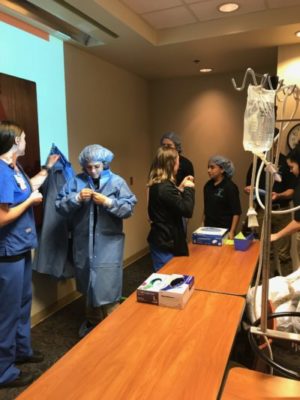
Indiana pharmacy tech students gain hands-on experience through business and community partnerships.

“The pharmacy technician program is a high-value program in this state, and our community partners understand that,” said Biggerstaff. “They see the need to develop this pipeline of their future workforce and make sure they’re invested so they, too, can help guide decisions and curriculum needs to make sure we’re aligned with industry needs and preferences.”

Those community partners include Walgreens, CVS and local hospitals, which support the program by conducting mock interviews, guest teaching, offering job shadowing opportunities, and providing financial support for student exams and study materials. Pharmacy technician students are also able to experience classroom and simulated lab activities, hospital and retail practicum experiences; in the nation’s only high school lab accredited by the American Society of Health-System Pharmacists, students gain further advantage in the eyes of potential employers, such as IU Health West Hospital in Indianapolis.

Real-world, on-the-job training

Students from 11 high schools in three Indiana counties come to the career center to take courses during the regular school day. In 2018, the program recognized its second cohort of high school students graduating with associate degrees. According to Jessica Lamb, pharmacy tech instructor, these students are often “direct admits” to pharmacy schools — meaning they will bypass the need to complete general education credits before applying for admission to the major.

Jessica Lamb, pharmacy technician instructor at Area 31 Career Center

“These students can use their degrees as stepping stones for a lot of different career paths, and they’re leaving high school with a vast majority of college finished,” said Lamb. “In the meantime, people from local businesses are knocking down our doors asking for these students. The last six who worked in a local long-term care facility were offered jobs — all six.”

Offers like that reveal the necessity of programs like these, which combine classroom learning experiences with real-world, on-the-job training opportunities. At the Area 31 Career Center, students spend the first year in the classroom and the second year developing clinical experience.

Local and regional partnerships ensure that students receive credible, industry-relevant learning opportunities: Area pharmacists run labs and practice scenarios, while local employers often host mock interviews and teach lessons. Each student in the cohort has the chance to participate in work-based learning opportunities, like those coordinated each year at IU Health West Hospital.

“They conduct actual simulations as though they were in an in-patient or retail pharmacy,” said Amy Hurst, pharmacy technician supervisor at IU Health West Hospital. “They play the role of pharmacist, technician; they simulate sterile compounding… They get to understand the reality of being a pharmacy technician.”

According to Hurst, such experiences are valuable not only for the practical, hands-on job training opportunities they provide but for the excitement and interest they generate.

“Once the students see and experience for themselves what goes into being a pharmacy technician, they get excited and start asking questions. You can see the light bulbs go off,” she said. “That connection is what’s important. These kids are the future of pharmacy.”

A March 2018 report by the U.S. Chamber of Commerce Foundation and Burning Glass Technologies showed increasing gaps between employer needs and available workers; in fact, unfilled health care occupations represented the most “dramatically expanding” skills gap in their research (Restuccia, 2018, p. 12). By engaging students with relevant, real-world learning opportunities in addition to addressing academic and employability skills, CTE programs like the one at Area 31 Career Center at Ben Davis High School can help address those gaps.

“One of the challenges right now, across our country, is looking at how best to address the skills gap and workforce demand going forward,” said Biggerstaff. “There’s so much data out there showing that secondary CTE programs are meeting needs and engaging high school students in ways that are meaningful and helping to change their life trajectories.”

Emily Kuhn is the communications specialist for Realityworks, Inc, a Wisconsin-based company that creates innovative learning tools for skills training.

REFERENCES
U.S. Department of Labor, Bureau of Labor Statistics. (2018). Fastest growing occupations. Occupational Outlook Handbook. Retrieved from https://www.bls.gov/ooh/fastest-growing.htm.
Restuccia, D., Taska, B., >amp; Bittle, S. (2018). Different skills, different gaps: Measuring >amp; closing the skills gap. Retrieved from: https://www.burning-glass.com/wp-content/uploads/Skills_Gap_Different_Skills_Different_Gaps_FINAL.pdf.
Fish! A Remarkable way to boost Morale and improve results By Stephen C. Lundin, PH.D. Harry Paul, and John Christensen

Team morale in any industry is an important part of any organization.  In the event that morale is low in an organization employees are going to be less likely to be happy at their place of employment. Fish!  provides leaders with four main concepts of the book choose your attitude, play, make their day, and be present.

Attitude is very important in any particular situation.  Individuals have to choose how they are going to approach certain situations as they arise.  In the section about choosing your attitude, there were two key points.

  1. Personal accountability and productivity
  2. Bring your best self to work
    1. Choosing to love your work.

In the section about play there were five key concepts that leaders need to keep in mind while attempting to boost morale.

  1. Happy people treat others well.
  2. Fun leads to creativity.
  3. The time passes quickly.
  4. Having a good time is healthy.
  5. Work becomes a rewards and not just a way to rewards.

The third section is titled as make their day.  This section had a focus of providing people with memories they have participated in.  For example, team members are going to remember an experience they had rather than just a simple email of gratitude.

In the fourth and final section of the book focuses on being present.  There were four main characteristics of being present.

  1. Show consideration to team members.
  2. Truly listen to others and do not allow yourself to be distracted.
    1. Do not read/answer emails while listening to others.
  3. Be engaged in your work.
  4. Take time to “smell the roses.”

Today we are in a world of multi-tasking unfortunately this does not give us the opportunity to be present with those who need us the most.  For example, when someone comes in your work space to approach you about an issue give them your undivided attention.

Overall Fish! gives leaders an opportunity to focus on four main areas of growth in order to boost morale of the team!

Techniques Year in Review

As the year 2018 draws to a close we’re taking a look back at the articles in Techniques that made us think, helped us learn, and inspired pride in our profession as career and technical educators. Helping “Young Minds Take Flight” and “Filling the Educator Pipeline,” Techniques addresses the issues ACTE members care about most, providing input you can trust when making decisions for your classrooms, programs and school systems — in print and on the web.

  • Russell Peterman wrote about his personal experience to follow a passion and how he has leveraged that passion to help “Young Minds Take Flight” in the January 2018 issue of Techniques.“Dan Weyant, a high school engineering teacher for Georgetown Independent School District, contacted me with an idea: He wanted, and had obtained approval to start an engineering class, to build a flying airplane in the school’s new CTE lab. If only I had had that opportunity when I was young!”
  • In February 2018, Ozarks Technical Community College went “Up, Up and Away! Using Comic Books for Program Promotion,” encouraging excitement and engaging students through career and technical education.“Once considered juvenile, the medium [comic books] is now considered mainstream, acceptable entertainment. As a self-proclaimed comic book evangelist, [Techniques contributor Craig W. Schutt] pronounced the once-beleaguered funny book an effective and engaging tool for instruction and promotion.”
  • Patrick Cain, assistant superintendent for Enterprise City Schools in Enterprise, Alabama, understands that to educate the workforce of tomorrow, we must begin today. “WeeCat Industries: Educating the Future” appeared in Techniques in March 2018.“The heart and true success of any CTE program lies in its ability to prepare students for success. In Enterprise City Schools, in southeast Alabama, leadership, teamwork, critical thinking and positive work ethic transformed the instructional framework of WeeCats Preschool into the emerging WeeCat Industries.”
  • With an eye toward the future, the April 2018 issue of Techniques gave readers an inside look at the work that must be done: “Building America’s Skilled Technical Workforce.”“In response to the broader need for policy information on this important issue, an expert committee convened by the National Academies of Sciences, Engineering and Medicine prepared a study outlining the structure, scope, challenges and opportunities for building a more agile and skilled technical workforce.”
  • CTE spells success! Most especially, perhaps, in the May 2018 issue of Techniques themed “CTE Success Stories.” One such story, of Zachary Flowers’ “Survival on the Horizon,” you should hear from the source:“How does one become a successful teacher? Are they born into it? Do they happen to take the right classes and get lucky? Does it take a lot of work, dedication and continued education? These are all questions I, Zachary Flowers, have asked myself more than once… The only thing I know at this point is that meeting and learning from others in my field can only help me.”

Summer break was a breath of fresh air. Techniques took a brief hiatus and we launched our PAGES blog to offer expanded opportunities for engagement and even more stories of CTE success.

  • With the start of each new school year, Techniques arrives again at VISION. (Did you catch our word play on the September 2018 cover?) Inside, CTE professionals provide a glimpse of the value to be found at ACTE’s CareerTech VISION.Osceola Technical College Principal Thomas Ott wrote on “Transformational Leadership in the First and Second Year” (>amp; gave a presentation of the same name at VISION 2018), “There are many ways to change the trajectory of an organization. The most effective depend on what that institution needs and if leadership is willing to listen and be flexible when it comes to implementing change.”
  • Technology is ubiquitous. And CTE educators everywhere are leveraging technology and its concepts to reach students where they are: online. One such educator, a computer science instructor in Georgia, wants readers of Techniques in October 2018 to know you can “Run Your Classroom Like a Software Development Incubator.”“Where Agile programming teams work to solve problems by developing software for clients, this is not a software development company in Silicon Valley. It’s my classroom. Excited teams gather at programming tables around the room, ready to engage in student-led development meetings, taking on projects that build practical applicability.”
  • And, finally, we have come to the end of the year with Techniques‘ November/December issue. The CTE teacher shortage is an issue we all face — not only for the future of our programs but in the development of a skilled workforce. Recruitment programs such as “iTeachU” at South Dakota State University build upon national and state efforts to fill the educator pipeline.“Statewide recruitment efforts are underway to recruit the next generation of CTE teachers in South Dakota… In addition to the traditional means of recruiting, SDSU implemented iTeachU in 2011. The one-day, annual event on campus is a join effort between the agricultural education and family and consumer sciences education faculty, and introduces participants to a career in teaching while simultaneously providing a glimpse into college life.

ACTE members can read full issues of Techniques online.

A Resource for Understanding Character Traits

A large part of leadership is understanding, reflecting on and enhancing your personal character traits, as well as those of your employees and potential leaders
within your organization. Aligning jobs, tasks and goals to dominate character traits can help an individual or organization become more productive and successful. Alternately, aligning professional development opportunities to less prominent traits will help develop well rounded leaders and employees.

Providing information and resources for the development of character traits is the mission of the Via Institute. “The VIA Institute on Character is a non-profit organization dedicated to bringing the science of character strengths to the world through supporting research, creating and validating surveys of character, and developing practical tools for individuals and practitioners.”

Through the VIA institute website, leaders can take a survey that will rank and describe the character traits that they exhibit. Survey participants will receive a report with descriptions of each trait. The website then provides a deeper look at each trait which includes identifying the key concepts that support the trait, ascribing a motto to the trait and offering suggestions to practice/develop the trait. Additional research regarding how character traits can be used for personal and professional growth, a variety of tools and resources and links to online courses can also be found on their website.

These materials align with the research and recommendations of writers such as John Maxwell, Shawn Achor and Kim Cameron and can be a beneficial addition to the professional development of current and prospective leaders.

>nbsp;

Resources:

https://www.viacharacter.org/nas/content/live/acteonline/Character-Strengths-Survey

http://www.actionforhappiness.org/media/52486/340_ways_to_use_character_strengths.pdf

# # # # # #