Techniques Year in Review: 2019–2020

The school year is wrapping up and you know what that means?! Summer reading season! Read Techniques. ACTE’s flagship publication addresses the issues ACTE members care about most, providing input you can trust when making decisions for your classrooms, programs and school systems — in print and on the web.

Articles published in Techniques are crafted to inspire and enrich the career and technical education (CTE) experience for all.

Find a comfortable spot in the shade and read Techniques.

In January 2019, business and community partnerships took center stage. Nicole Carter wrote “Colorado Partners Educate a Strong, Prepared Workforce.”

To meet the need for a more equipped labor force, communities, local businesses and national industry companies have come together to partner and support the growing requirement for skilled trades workers. …Widefield and Peyton School Districts purchased a 46,000-square-foot building known now as the Manufacturing Industry Learning Lab (MiLL) National Training Center.

Overall, the ultimate goal of the partnership is to promote a stronger and more consistent workforce in Colorado.

The February 2019 issue of Techniques focused on engaging students through CTE. In a centerpiece on career and technical student organizations (CTSOs), readers will “learn more about these nine organizations as they enhance student learning to address workforce development challenges and increase global competitiveness.”

A 21st century education for 21st century students

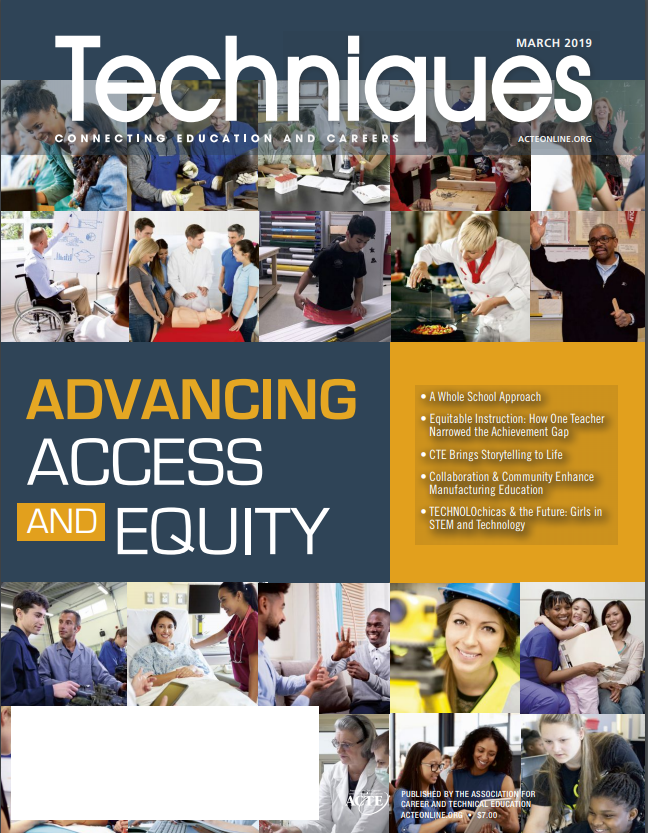
Dale Winkler and Scott Warren, of the Southern Regional Education Board, strongly recommend a whole school approach to increasing access and equity. Their article appeared in Techniques in March 2019.

We believe that career pathway programs that blend quality CTE and college-preparatory academics offer a way to increase readiness, postsecondary attainment, career advancement and economic stability for youth of all genders, races, socioeconomic backgrounds and ability levels.

States are using career pathways as an essential element of college and career readiness initiatives that satisfy the requirements of the Every Student Succeeds Act and Perkins V.

We made the case for family and consumer sciences in April 2019. With innovation at the forefront, Lori Wahl introduced fashion students to direct 3D printing on fabric. 3D printers are a versatile tool that can do more than print figures, parts and things. “While used predominantly for rapid protoyping and small-scale production of objects, 3D printing can also be used directly on fabrics to enhance the surface, dramatically change the appearance, or add a built-in feature.”

The future is bright! The future of career development, that is. Monica Amyett explored the important role of instructional coaching for CTE teachers in her article for Techniques in May 2019. “Quality teacher professional development is essential to the outcome of student achievement. In their careers, teachers must be challenged with new ideas in order to foster a classroom culture of student engagement that will lead to achievement.”

At the end of yet another school year, Techniques took a break.

Dear reader, will you share your experience from ACTE’s CareerTech VISION 2019? Leave a comment below. Techniques’ September issue gave association members a sneak peek at the innovative professional development to be undertaken in Anaheim, California. Consider Shannon Sheldon’s work on “Supporting the Gender Expansive Student.”

Students who blur the lines between masculine and feminine are considered to be gender expansive (Baum >amp; Westheimer, 2015; Murchison, 2016.) Pushing the boundaries of what is generally accepted as appropriate is not a new concept; at one time it was considered unacceptable for a female to wear pants to school.

But what about students who choose to express their gender outside of the norm? As educators, how can we make all students, regardless of gender identity or expression, feel welcome, included and supported in our classrooms?

October 2019 asked, “What is postsecondary success?” And our leaders in CTE answered.

Nzingha Williams, a fellow in the Postsecondary Leadership Success Program at ACTE – Sponsored by ECMC Foundation, wrote, “Postsecondary success is about the holistic success of the student and the institutions that serve them. Students come with a variety of different goals and aspirations. We must be able to help students achieve their goals. We also must be able to serve the economy and make sure that industries have enough skilled labor. True success comes when there is an intersection between our students, livable wage and economic mobility.”

California is stepping it up, shifting instructional focus from STEM to STEAM. So wrote Elizabeth McKinstry for the November/December 2019 issue of Techniques. Read more about how the Antelope Valley Unified School District has integrated art and engineering. “As the engineering students were tasked to train their classmates on equipment and use of tools, both groups improved their communication skills. Engineering students, typically focused on optimal and acceptable solutions, began to view their projects through a creative and emotional lens.”

Assessing the future of work

Ah, 2020. What a ride it’s been. The January issue of Techniques laid the foundation for developing effective work-based learning experiences. Consider the following from the Educational Development Center on “The Future of Work.”

A major transformation is taking place in America’s workplaces. The National Science Foundation calls it the Future of Work at the Human-Technology Frontier (Mervis, 2016) — a future that is driven by combinations of machine learning, artificial intelligence, the “internet of things” and robotics. Today’s students will need new sets of skills, knowledge and dispositions to succeed in workplaces. The CTE community is already giving students a head start in preparing for the future of work. But one key challenge involves predicting the multiple directions in which the workplace is heading and reconfiguring CTE to keep pace.

What has happened since the passage of the Strengthening Career and Technical Education for the 21st Century Act? What steps are being taken toward implementation? In February 2020, CTE professionals from around the country answered these questions and more. Heather M. Jones, a FACS teacher in Virginia, wrote, “Perkins V’s expansion to include middle grades CTE presents opportunities for those launching new initiatives and expanding existing programming. New funding streams create opportunities to reach more students earlier, educate them about future career options, and help dispel long-held myths about CTE in our schools and communities.”

A commitment to high-quality CTE

Data and Program Improvement is element No. 12 in ACTE’s Quality CTE Program of Study Framework. Gene Bottoms asserted our students’ voices are the key to program improvement. “Students can provide valuable insight into CTE courses. Consider the following data from surveys conducted on two groups of students. Their responses demonstrated that students can discern the type of rigorous CTE assignments that will prepare them for good jobs in the 21st century economy.” Read the March 2020 issue to learn more.

On land, out of this world… and in the watery depths as well. CTE offers opportunities for career success in and around the water. In April 2020, Techniques featured model programs in diverse pathways such as agriculture, STEM, health science, transportation and more. Emily Kuhn wrote “The Future of Hydroponics.” “To grow food (and economies) in and around cities, water-driven indoor farming methods like hydroponics are expanding rapidly, creating a favorable job outlook for students interested in what’s becoming an emerging industry of high-tech greenhouses, vertical farms, hydroponics and aquaponics.”

Learning is a lifelong process. In these unprecedented times, the traditional forms of instruction are being challenged. We’ve all been forced to rethink our strategy for teaching our students, and also for delivering quality professional development in CTE. While the majority of our May issue was developed prior to the COVID-19 pandemic, consider the following words from Nancy Trivette, ACTE’s board of directors president.

Our personal, social and professional interactions will be shaped as a result of the pandemic of 2020. Working, teaching and learning from home, just weeks ago, was uncommon for many of us. Today, as I write this, it is a reality for most, if not all of us. Everything we know, have done and will do in the future may be different. It is 2020, and our everyday lives have been reinvented and will continue to be reinvented at a speed that is hard to imagine. It is a time of change and a bit of uncertainty. However, it is also a time of great opportunity to change the way we teach, learn and do business! What will not change is the need for quality career and technical education.

ACTE members can read full issues of Techniques online.
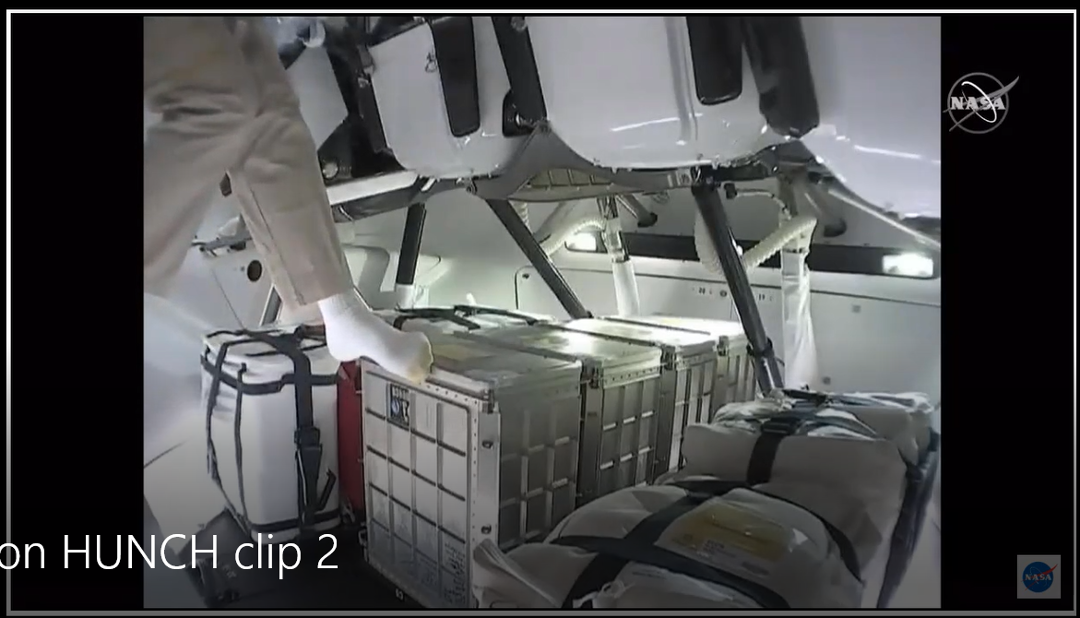
NASA HUNCH Students Send Hardware into Space

Four single stowage lockers made and signed by NASA HUNCH students, onboard Crew Dragon (May 31, 2020)

Ready for launch! High school students across the nation contributed flight hardware to the historic Launch America event. SpaceX Crew Dragon sent astronauts to the International Space Station (ISS) from the historic 39A launch pad at Kennedy Space Center on Sunday, May 31. And with them went four single stowage lockers (SSLs) designed by NASA HUNCH (High School Students United with NASA to Create Hardware) program participants.

Manufacturing students have made 70 flight-ready single stowage lockers (SSLs) over the past four years. Four of these SSLs carried supplies to the ISS; supplies included liquid cooling ventilation garments, crew shoes and an exercise harness for the astronauts.

In recognition of their dedication and skills, students and instructors were encouraged to sign their names on top of the single stowage lockers.

Do you have Member Connected News?

Member Connected News is a space designed for ACTE members to bang the proverbial drum. Has your CTE program reached an important milestone? Current or former student achieved something noteworthy? Fill out the form, and you might be featured next.

CTE Students Make Their Voices Heard in Sticker Design Competition

The people have spoken! Two career and technical education (CTE) students at Nevada’s Carson High School won first place in a local competition to design “I Voted” stickers.

As the coronavirus (COVID-19) pandemic closed schools, many graphic design students found themselves at home without access to standard software. Some students didn’t have computers. Patricia Ababio, graphic design instructor at Carson High School, was not deterred.

“We brainstormed a solution,” said Ababio. “Students created thumbnails of their designs using pencil and paper. They created what they considered sticker designs, that voters would be both proud to wear and that would reflect the character of the American voter. It was a great way for us to participate in a terrific contest, even while staying home, for Nevada.”

Flyer advertising Carson City’s 2020 primary election features first-place sticker designs submitted by Victor Clavel and Alondra Mata Izquierdpo.

The competition, open to Carson City students in grades nine through 12, received more than 200 entries. A selection panel of local and state officials determined two first-place winners. An additional eight entries were identified for honorable mention.

Do you have Member Connected News?

Member Connected News is a space designed for ACTE members to bang the proverbial drum. Has your CTE program reached an important milestone? Current or former student achieved something noteworthy? Fill out the form, and you might be featured next.

The Spaces You’ll Go: An Interview with Author Rachael Mann

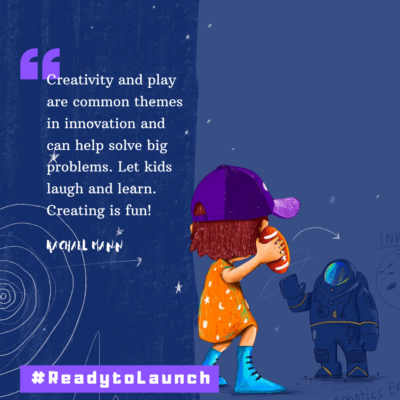
It was a stellar experience for attendees at ACTE’s CareerTech VISION 2019. The event kicked off with an opening general session address from former NASA astronaut Garrett Reisman, and we launched Rachael Mann’s new book, The Spaces You’ll Go, which takes children and parents on a lighthearted romp through out-of-this-world careers for little big dreamers.

To prepare for VISION and her book launch, Rachael Mann sat down with PAGES, a Techniques blog, for an interview about The Spaces You’ll Go and the importance of dreaming big.

Who are the characters in The Spaces You’ll Go?

Cas — short for the constellation Cassiopeia — is the main character, along with her sidekick Kanga Blue. Kanga Blue is a stuffed toy by day and a life-sized robot Kangaroo during her dream phase. Together, they dream of the exciting things they may someday do related to space exploration.

What do you hope that children will get out of this book?

My hope is that children and adults alike will be inspired to dream bigger, aim higher, and believe that they can do whatever they dare to dream.

Why is your book important?

The Spaces You’ll Go is meant to empower young people to believe that they can do and be anything. Dreams always come before reality and when you encourage little dreamers to look beyond the planet we call home, you expand their horizons. They begin to see opportunities and occupations that do not exist yet. Our world needs dreamers, explorers and innovators, people who ask, “How can we?”

That is why it is important to give kids the freedom to discover what they love, what they are curious about, what they do well and what the world needs. At the intersection of these points lies their destiny.

For what kind of future are we preparing the next generation? How can we?

We are not only preparing kids for careers that do not exist; we are preparing them for lives that could quite literally be out of this world! That being said, the intent of this book is to let kids be kids… to spark wonder…. to inspire young people to imagine and visualize where and what their future will be.

What was your favorite book as a child?

The Little Engine That Could. This book sits on my nightstand still today! As a child, I had a condition called in-toeing and femoral anteversion, and I wore leg braces. As a result, I was typically the last child picked for teams in gym class. I found the story to be relatable and empowering.

What was the most surprising thing you learned in creating The Spaces You’ll Go?

I have wanted to write a children’s book for a long time and was surprised by the unique challenges of writing The Spaces You’ll Go. The total word count for a children’s book is less than that of one page in my first book, The Martians in Your Classroom. Initially, this seemed as if it would make for a much easier book to write, but, I discovered, the smaller the word count, the more each word counts!

In addition, the task of explaining complicated ideas in simple — and fewer — words is not easy, I also discovered that the audience for a children’s book isn’t necessarily children. The audience is the parents, grandparents, librarians, teachers and others first, and then the children.

I have had many people tell me that they have always wanted to write a children’s book. My advice after writing The Spaces You’ll Go is this: Do it! Put your words on paper and see where they lead. Enjoy the journey, and allow yourself to remember what it means to be a child and to dream and wonder. The process itself is as rewarding as the outcome.

Draw on the power and pull of space to get your kids interested in STEM at a young age. I hope this book serves as a launchpad to inspire wonder about the universe we live in, one we are only just beginning to understand.

Purchase a copy of The Spaces You’ll Go for the little big dreamers you know, available now in ShopACTE online.

For bonus resources, please visit rachaelmann.co; follow the author on social media @RachaelEdu. Join the conversation using hashtags #ReadytoLaunch and #SpacesYoullGo.

Rachael Mann is an author, educator and keynote speaker who is passionate about preparing today’s youth for the future. She speaks regularly on the topics related to STEM, career and technical education, space, education, and disruptive innovation.

Member Connected News: Washington High School Students Compete at DECA International Career Development Conference

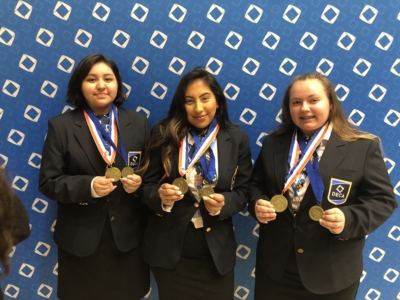
In April 2019, DECA students from Lakewood, Washington’s Clover Park High School competed at the DECA International Career Development Conference in Orlando, Florida. In recognition of their hard work and determination, Kitti Wheeler, ACTE member and Clover Park marketing teacher, wrote:

“We are a new DECA Chapter and we had just opened our student store the year before. This was the first opportunity for us to compete in the school-based enterprise event. As a new adviser, I didn’t know how to prepare my students to compete at this level. Not to mention, my students had numerous extenuating circumstances — including personal illness and a parent’s terminal cancer diagnosis. These events caused two of my three team members to miss a lot of school and presented significant barriers, making it more challenging to work together and compete.

“I requested an extension and, to my surprise, we were granted one extra day. When I received word that we qualified to compete, I was in disbelief. Actually, I’m still amazed because we placed in the top 10! Proud doesn’t describe how it felt to watch my students receive award medallions on stage in front of 20,000 people. As a result our student store earned Gold Certification.

“This is truly a Cinderella story. Every time I think about our accomplishment, I get goose bumps.”

When asked about what motivated their success, the Clover Park High School students responded, “Teamwork and [Ms. Wheeler’s] belief in us.”

Wheeler, who was recently named the WA ACTE Teacher of the Year, concluded, “I learned a huge lesson to never underestimate what my students can achieve.”

Do you have news?

Member Connected News (MCN) is a new regular column on PAGES, a Techniques blog. Here is where we highlight the buzz about career and technical education. If you have something (program news, event news, award news or a note of appreciation) to share, we want to hear about it. Fill out the form and you might be featured next.

Cooks and Camo in Bartlett, Illinois

Students enrolled in upper-level culinary classes at Bartlett High School participated in Cooks and Camo, a competition-style event sponsored by the Illinois Army National Guard. Competitors were challenged to create an entree and dessert items inspired by military field rations, known as meals ready to eat (MRE).

“The students did a great job turning MREs in to unique (and tastier) meal creations,” said Kari Laga, a family and consumer sciences teacher at Bartlett High School, in Bartlett, Illinois.

Do you have news?

Member Connected News is a new regular column on PAGES, a Techniques blog. Here is where we highlight the buzz about career and technical education. If you have something (program news, event news, award news or a note of appreciation) to share, we want to hear about it. Fill out the form and you might be featured next.

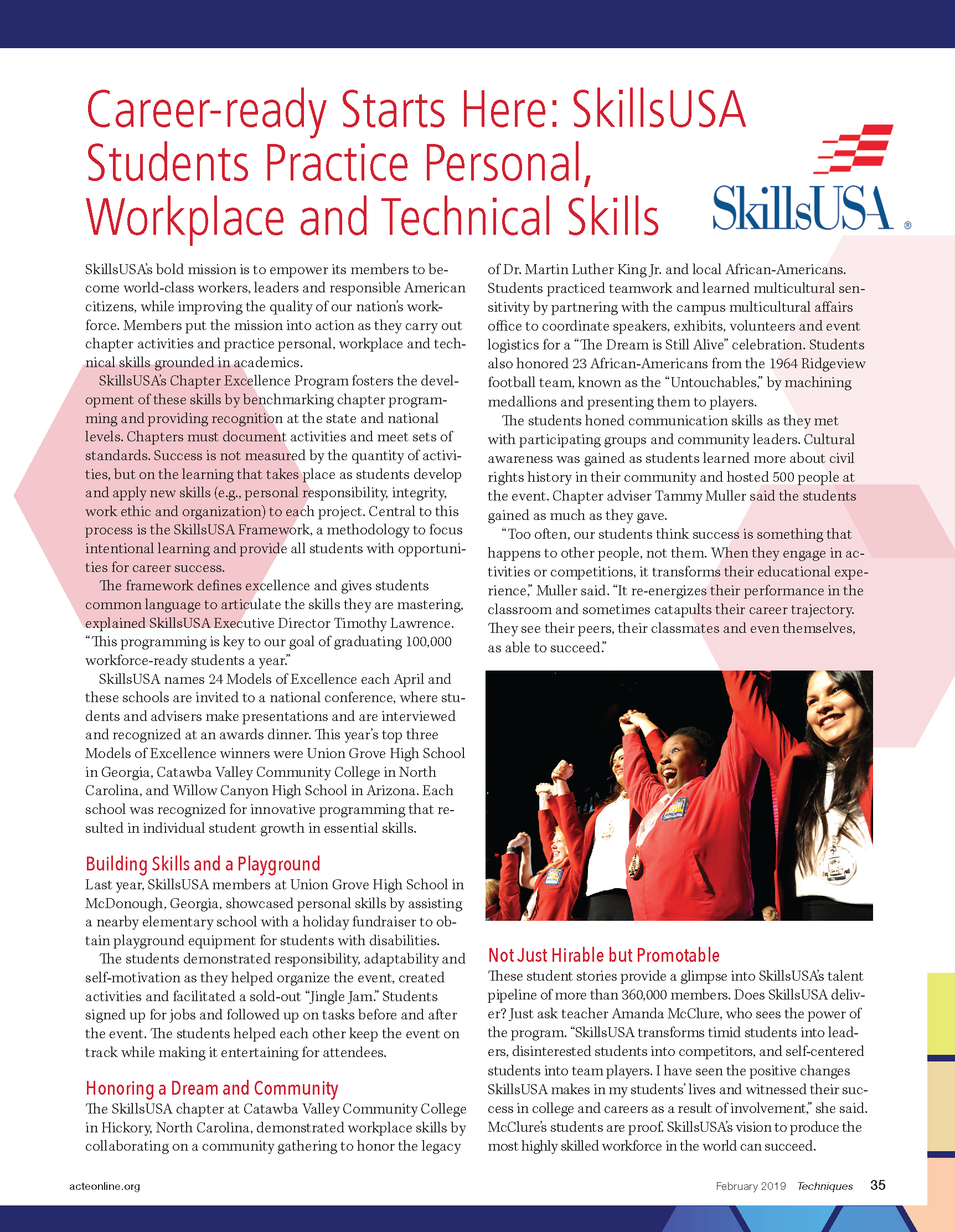
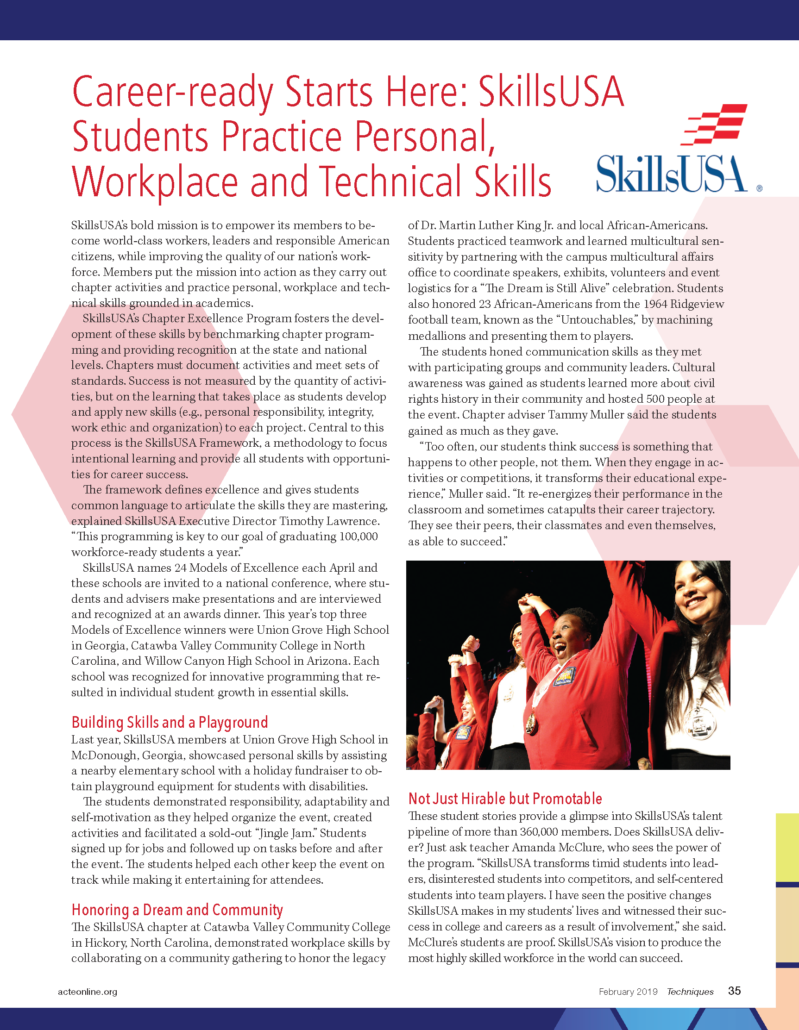
CTSOs Engage Students: SkillsUSA Students Practice Personal, Workplace and Technical Skills

Career-ready starts here.

SkillsUSA’s bold mission is to empower its members to become world-class workers, leaders and responsible American citizens, while improving the quality of our nation’s workforce. Members put the mission into action as they carry out chapter activities and practice personal, workplace and technical skills grounded in academics.

SkillsUSA’s Chapter Excellence Program fosters the development of these skills by benchmarking chapter programming and providing recognition. This year’s top three winners came from Georgia, North Carolina and Arizona. READ MORE

SkillsUSA

To learn more about how CTSOs engage students in CTE, ACTE members can read the February 2019 issue of Techniques online today. And be sure to come back to PAGES each Monday, Wednesday and Friday through February, when we’ll feature a new CTSO.

Techniques Year in Review

As the year 2018 draws to a close we’re taking a look back at the articles in Techniques that made us think, helped us learn, and inspired pride in our profession as career and technical educators. Helping “Young Minds Take Flight” and “Filling the Educator Pipeline,” Techniques addresses the issues ACTE members care about most, providing input you can trust when making decisions for your classrooms, programs and school systems — in print and on the web.

  • Russell Peterman wrote about his personal experience to follow a passion and how he has leveraged that passion to help “Young Minds Take Flight” in the January 2018 issue of Techniques.“Dan Weyant, a high school engineering teacher for Georgetown Independent School District, contacted me with an idea: He wanted, and had obtained approval to start an engineering class, to build a flying airplane in the school’s new CTE lab. If only I had had that opportunity when I was young!”
  • In February 2018, Ozarks Technical Community College went “Up, Up and Away! Using Comic Books for Program Promotion,” encouraging excitement and engaging students through career and technical education.“Once considered juvenile, the medium [comic books] is now considered mainstream, acceptable entertainment. As a self-proclaimed comic book evangelist, [Techniques contributor Craig W. Schutt] pronounced the once-beleaguered funny book an effective and engaging tool for instruction and promotion.”
  • Patrick Cain, assistant superintendent for Enterprise City Schools in Enterprise, Alabama, understands that to educate the workforce of tomorrow, we must begin today. “WeeCat Industries: Educating the Future” appeared in Techniques in March 2018.“The heart and true success of any CTE program lies in its ability to prepare students for success. In Enterprise City Schools, in southeast Alabama, leadership, teamwork, critical thinking and positive work ethic transformed the instructional framework of WeeCats Preschool into the emerging WeeCat Industries.”
  • With an eye toward the future, the April 2018 issue of Techniques gave readers an inside look at the work that must be done: “Building America’s Skilled Technical Workforce.”“In response to the broader need for policy information on this important issue, an expert committee convened by the National Academies of Sciences, Engineering and Medicine prepared a study outlining the structure, scope, challenges and opportunities for building a more agile and skilled technical workforce.”
  • CTE spells success! Most especially, perhaps, in the May 2018 issue of Techniques themed “CTE Success Stories.” One such story, of Zachary Flowers’ “Survival on the Horizon,” you should hear from the source:“How does one become a successful teacher? Are they born into it? Do they happen to take the right classes and get lucky? Does it take a lot of work, dedication and continued education? These are all questions I, Zachary Flowers, have asked myself more than once… The only thing I know at this point is that meeting and learning from others in my field can only help me.”

Summer break was a breath of fresh air. Techniques took a brief hiatus and we launched our PAGES blog to offer expanded opportunities for engagement and even more stories of CTE success.

  • With the start of each new school year, Techniques arrives again at VISION. (Did you catch our word play on the September 2018 cover?) Inside, CTE professionals provide a glimpse of the value to be found at ACTE’s CareerTech VISION.Osceola Technical College Principal Thomas Ott wrote on “Transformational Leadership in the First and Second Year” (>amp; gave a presentation of the same name at VISION 2018), “There are many ways to change the trajectory of an organization. The most effective depend on what that institution needs and if leadership is willing to listen and be flexible when it comes to implementing change.”
  • Technology is ubiquitous. And CTE educators everywhere are leveraging technology and its concepts to reach students where they are: online. One such educator, a computer science instructor in Georgia, wants readers of Techniques in October 2018 to know you can “Run Your Classroom Like a Software Development Incubator.”“Where Agile programming teams work to solve problems by developing software for clients, this is not a software development company in Silicon Valley. It’s my classroom. Excited teams gather at programming tables around the room, ready to engage in student-led development meetings, taking on projects that build practical applicability.”
  • And, finally, we have come to the end of the year with Techniques‘ November/December issue. The CTE teacher shortage is an issue we all face — not only for the future of our programs but in the development of a skilled workforce. Recruitment programs such as “iTeachU” at South Dakota State University build upon national and state efforts to fill the educator pipeline.“Statewide recruitment efforts are underway to recruit the next generation of CTE teachers in South Dakota… In addition to the traditional means of recruiting, SDSU implemented iTeachU in 2011. The one-day, annual event on campus is a join effort between the agricultural education and family and consumer sciences education faculty, and introduces participants to a career in teaching while simultaneously providing a glimpse into college life.

ACTE members can read full issues of Techniques online.
ACTE Student Trophy Design Contest Winners Set Standard for Excellence

ACTE is committed to providing career and technical education (CTE) students with opportunities to develop the skills they’ll need for success in a global economy. One such opportunity, the Student Trophy Design Contest, encourages secondary, postsecondary and adult CTE students in 3D design or CAD courses to develop and submit a trophy design that reflects the prestige of ACTE’s Excellence Awards program. Designs are then judged by ACTE staff and Stratasys Ltd. — a manufacturer of 3D printers and production systems — on visual appeal, function and structural integrity.

“Stratasys is pleased to partner with ACTE to create this contest for the students. It is clear that the educators are doing an outstanding job immersing the students in additive manufacturing and computer-aided drafting,” said Jesse Roitenberg, national education manager for Stratasys. “The trophy entries we have judged over the past three years are phenomenally designed and could not be created by any other manufacturing process.”

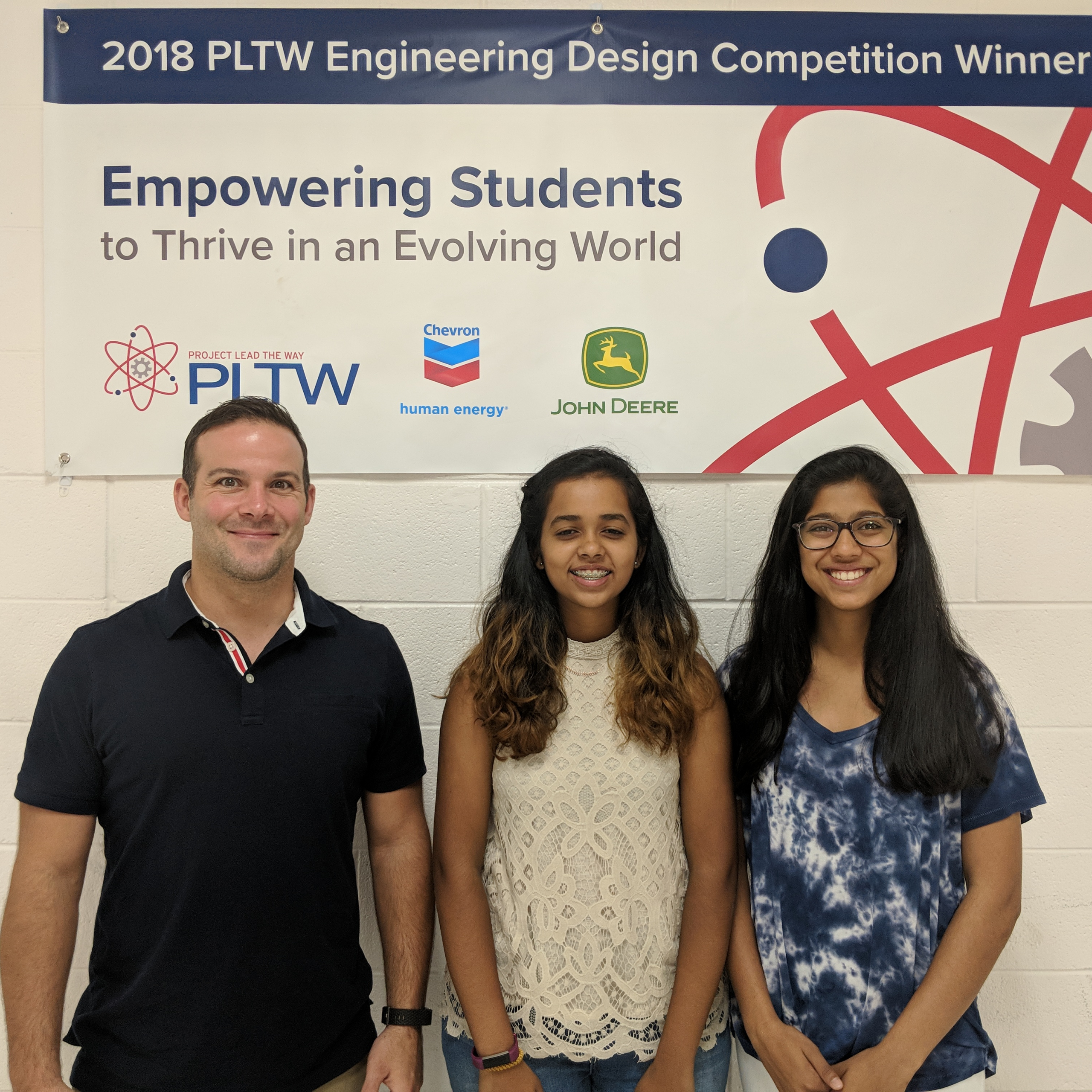
We are proud to announce that the winners of the 2018 ACTE Student Trophy Design Contest are Rashi Kejriwal and Shreya Santhanagopalan, of Ellicott City, Maryland, supported by their teacher, David Lucania.

The winners will receive a $1,000 scholarship prize, a one-year lease of a 3D printer (courtesy of Stratasys) and materials, and a trip to ACTE’s CareerTech VISION 2018 in San Antonio, Texas, where they will be recognized at the Awards Banquet. And here, an exclusive interview.

The Mount Hebron High School juniors, Kejriwal and Santhanagopalan, sat down with Techniques to discuss their interests in STEM now and in the future, and how they were inspired to enter — and ultimately win — the 2018 ACTE Student Trophy Design Contest.

Talk a little about yourself and your background, your school, your experience with CTE, and your plans for the future.

Rashi Kejriwal: I’m a junior in Howard County, Maryland, at Mount Hebron High School and I’m enrolled in the Project Lead the Way (PLTW) engineering classes at our school. Personally, apart from PLTW, I have always had a background in STEM. For example, I completed an assignment in elementary school in which students were tasked to design and build a city… Through these and other activities I have developed a strong interest toward multiple fields in engineering. In the future I want to pursue a career in which I can learn and contribute to society.

Shreya Santhanagopalan: I am also a junior at Howard County, Maryland’s Mount Hebron High School. From a young age, I was brought up to love engineering tasks and figuring out solutions to difficult problems. I began to learn to code when I was in fifth grade; in middle school I learned to create multiple apps with guidance. I am still exploring options for my future but I take great interest in computer science and engineering, and I plan to attend college until I receive a Master’s degree in my chosen field.

How and why did you decide to enter the ACTE Student Trophy Design Contest? What inspired your winning design?

Shreya Santhanagopalan: Rashi and I were intrigued when our teacher, Mr. Lucania, brought up the ACTE Student Trophy Design Contest in our shared Project Lead the Way class. After weeks of planning, in and outside of school, we had developed seven different design sketches…

Rashi Kejriwal: We combined the top portion of one remaining design with the bottom portion of the other to create our final design.

What guidance did your career and technical education teacher provide?

Rashi Kejriwal: When it came time to build the trophy, Mr. Lucania’s mentoring, along with the use of AutoDesk Inventor and its unique features, helped us turn our dreams into reality.

The trophy designed by Kejriwal and Santhanagopalan will be presented to ACTE’s national award winners at the Awards Banquet on Wednesday, Nov. 28. Check out the full list of finalists and make your plans to celebrate CTE on the first night of ACTE’s CareerTech VISION 2018, Nov. 28–Dec. 1, in San Antonio, Texas.

ACTE members can read the full interview, “ACTE Student Trophy Design Contest Winners Set Standard for Excellence,” in the October issue of Techniques today. Not a member? Join! ACTE is the largest national education association dedicated to the advancement of education that prepares youth and adults for successful careers.

Launching PAGES, a Techniques blog

Hello, world! Welcome to PAGES, a Techniques blog.

Since joining the staff of ACTE in 2017, I have worked for this day. We’re live! PAGES will feature excerpts from articles in print and wholly original content (interviews, case studies, news items and more) based on the theme of each new issue. We’ll talk about topics trending in career and technical education (CTE). And we’ll highlight stories of educators and programs doing the work to ensure our students graduate college- and career-ready.

From PAGES it is my hope you will find increased value in Techniques online, expanded opportunities for engagement and even more stories of CTE success. Written for career and technical educators by career and technical educators, Techniques addresses the issues ACTE members care about most, providing input you can trust when making decisions for your classrooms, programs and school systems — in print and on the web.

Are you interested in writing for PAGES?

Let’s collaborate! View the 2018–19 Editorial Calendar and reach out via email to discuss your ideas. At conferences, in conversation with students and on the Expo floor at VISION, think of Techniques (and PAGES) often. Bring me your stories, because they are the stories that matter to CTE educators like you.

Check back next week for a preview of our celebration in San Antonio: ACTE’s CareerTech VISION 2018.

# # # # # #