Techniques Year in Review: 2019–2020

The school year is wrapping up and you know what that means?! Summer reading season! Read Techniques. ACTE’s flagship publication addresses the issues ACTE members care about most, providing input you can trust when making decisions for your classrooms, programs and school systems — in print and on the web.

Articles published in Techniques are crafted to inspire and enrich the career and technical education (CTE) experience for all.

Find a comfortable spot in the shade and read Techniques.

In January 2019, business and community partnerships took center stage. Nicole Carter wrote “Colorado Partners Educate a Strong, Prepared Workforce.”

To meet the need for a more equipped labor force, communities, local businesses and national industry companies have come together to partner and support the growing requirement for skilled trades workers. …Widefield and Peyton School Districts purchased a 46,000-square-foot building known now as the Manufacturing Industry Learning Lab (MiLL) National Training Center.

Overall, the ultimate goal of the partnership is to promote a stronger and more consistent workforce in Colorado.

The February 2019 issue of Techniques focused on engaging students through CTE. In a centerpiece on career and technical student organizations (CTSOs), readers will “learn more about these nine organizations as they enhance student learning to address workforce development challenges and increase global competitiveness.”

A 21st century education for 21st century students

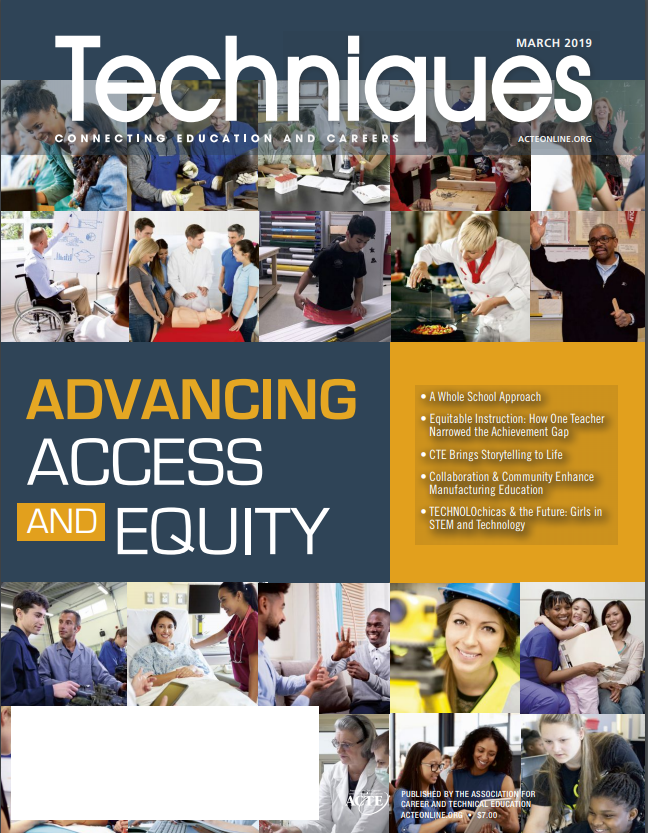
Dale Winkler and Scott Warren, of the Southern Regional Education Board, strongly recommend a whole school approach to increasing access and equity. Their article appeared in Techniques in March 2019.

We believe that career pathway programs that blend quality CTE and college-preparatory academics offer a way to increase readiness, postsecondary attainment, career advancement and economic stability for youth of all genders, races, socioeconomic backgrounds and ability levels.

States are using career pathways as an essential element of college and career readiness initiatives that satisfy the requirements of the Every Student Succeeds Act and Perkins V.

We made the case for family and consumer sciences in April 2019. With innovation at the forefront, Lori Wahl introduced fashion students to direct 3D printing on fabric. 3D printers are a versatile tool that can do more than print figures, parts and things. “While used predominantly for rapid protoyping and small-scale production of objects, 3D printing can also be used directly on fabrics to enhance the surface, dramatically change the appearance, or add a built-in feature.”

The future is bright! The future of career development, that is. Monica Amyett explored the important role of instructional coaching for CTE teachers in her article for Techniques in May 2019. “Quality teacher professional development is essential to the outcome of student achievement. In their careers, teachers must be challenged with new ideas in order to foster a classroom culture of student engagement that will lead to achievement.”

At the end of yet another school year, Techniques took a break.

Dear reader, will you share your experience from ACTE’s CareerTech VISION 2019? Leave a comment below. Techniques’ September issue gave association members a sneak peek at the innovative professional development to be undertaken in Anaheim, California. Consider Shannon Sheldon’s work on “Supporting the Gender Expansive Student.”

Students who blur the lines between masculine and feminine are considered to be gender expansive (Baum >amp; Westheimer, 2015; Murchison, 2016.) Pushing the boundaries of what is generally accepted as appropriate is not a new concept; at one time it was considered unacceptable for a female to wear pants to school.

But what about students who choose to express their gender outside of the norm? As educators, how can we make all students, regardless of gender identity or expression, feel welcome, included and supported in our classrooms?

October 2019 asked, “What is postsecondary success?” And our leaders in CTE answered.

Nzingha Williams, a fellow in the Postsecondary Leadership Success Program at ACTE – Sponsored by ECMC Foundation, wrote, “Postsecondary success is about the holistic success of the student and the institutions that serve them. Students come with a variety of different goals and aspirations. We must be able to help students achieve their goals. We also must be able to serve the economy and make sure that industries have enough skilled labor. True success comes when there is an intersection between our students, livable wage and economic mobility.”

California is stepping it up, shifting instructional focus from STEM to STEAM. So wrote Elizabeth McKinstry for the November/December 2019 issue of Techniques. Read more about how the Antelope Valley Unified School District has integrated art and engineering. “As the engineering students were tasked to train their classmates on equipment and use of tools, both groups improved their communication skills. Engineering students, typically focused on optimal and acceptable solutions, began to view their projects through a creative and emotional lens.”

Assessing the future of work

Ah, 2020. What a ride it’s been. The January issue of Techniques laid the foundation for developing effective work-based learning experiences. Consider the following from the Educational Development Center on “The Future of Work.”

A major transformation is taking place in America’s workplaces. The National Science Foundation calls it the Future of Work at the Human-Technology Frontier (Mervis, 2016) — a future that is driven by combinations of machine learning, artificial intelligence, the “internet of things” and robotics. Today’s students will need new sets of skills, knowledge and dispositions to succeed in workplaces. The CTE community is already giving students a head start in preparing for the future of work. But one key challenge involves predicting the multiple directions in which the workplace is heading and reconfiguring CTE to keep pace.

What has happened since the passage of the Strengthening Career and Technical Education for the 21st Century Act? What steps are being taken toward implementation? In February 2020, CTE professionals from around the country answered these questions and more. Heather M. Jones, a FACS teacher in Virginia, wrote, “Perkins V’s expansion to include middle grades CTE presents opportunities for those launching new initiatives and expanding existing programming. New funding streams create opportunities to reach more students earlier, educate them about future career options, and help dispel long-held myths about CTE in our schools and communities.”

A commitment to high-quality CTE

Data and Program Improvement is element No. 12 in ACTE’s Quality CTE Program of Study Framework. Gene Bottoms asserted our students’ voices are the key to program improvement. “Students can provide valuable insight into CTE courses. Consider the following data from surveys conducted on two groups of students. Their responses demonstrated that students can discern the type of rigorous CTE assignments that will prepare them for good jobs in the 21st century economy.” Read the March 2020 issue to learn more.

On land, out of this world… and in the watery depths as well. CTE offers opportunities for career success in and around the water. In April 2020, Techniques featured model programs in diverse pathways such as agriculture, STEM, health science, transportation and more. Emily Kuhn wrote “The Future of Hydroponics.” “To grow food (and economies) in and around cities, water-driven indoor farming methods like hydroponics are expanding rapidly, creating a favorable job outlook for students interested in what’s becoming an emerging industry of high-tech greenhouses, vertical farms, hydroponics and aquaponics.”

Learning is a lifelong process. In these unprecedented times, the traditional forms of instruction are being challenged. We’ve all been forced to rethink our strategy for teaching our students, and also for delivering quality professional development in CTE. While the majority of our May issue was developed prior to the COVID-19 pandemic, consider the following words from Nancy Trivette, ACTE’s board of directors president.

Our personal, social and professional interactions will be shaped as a result of the pandemic of 2020. Working, teaching and learning from home, just weeks ago, was uncommon for many of us. Today, as I write this, it is a reality for most, if not all of us. Everything we know, have done and will do in the future may be different. It is 2020, and our everyday lives have been reinvented and will continue to be reinvented at a speed that is hard to imagine. It is a time of change and a bit of uncertainty. However, it is also a time of great opportunity to change the way we teach, learn and do business! What will not change is the need for quality career and technical education.

ACTE members can read full issues of Techniques online.

E-learning Technical Vocabulary (Part 7): Word Tree

Word Tree is part seven in an eight-part series on e-learning technical vocabulary systems. Read part one, part two, part three, part four, part five and part six.

Advanced literacy skills help students learn more, in any subject. The problem is, you may not have time to teach reading and writing when you have your own set of content area standards to cover. I have good news. You can do both with a, What? How? approach.

Maybe you teach graphic design, not literacy. But literacy can be the how. Leverage graphic organizers and adaptable lessons to increase critical thinking and develop creative communication skills. Use reading and writing to help students learn on a deeper level. This is called content area literacy.

Build in collaboration.

Graphic organizers promote high-quality conversation during and after activities. Students involved will collaborate and explain their thinking during the lesson. As this occurs, all students benefit; they gain knowledge from the process. Keep in mind the central planning question, “How can I encourage speaking, writing, reading and listening to include regular use of vocabulary terms?

Use writing differently.

There are hundreds of ways to write that doesn’t involve composing an essay. These include providing descriptive and directive feedback; preparing visuals, videos and graphic organizers; and creating useful content within your career field. Make writing a tool for meaning.

Word Tree

Gist: Students group words together based on their relationships and figure out the meaning of the root word.

When to use: With vocabulary words that are related in some way. Great for medical terms in cosmetology and health careers.

How It Works

  1. Find a word root, prefix or suffix that relates to your vocabulary words. This is especially useful for medical terms. Place the root/prefix/suffix into the first box on the word tree.
  2. Challenge students to come up with words that coordinate to the root, prefix or suffix and place them in the “branches” of the tree. For example, if you wrote the root

    -alges/algia

    Students might write:

    • analgesic
    • abdominalgia
    • adenalgia
    • erythromelalgia
    • fibromyalgia

    Encourage them to include words from their prior knowledge as well.

  3. Ask students to explain the meanings of any of their “branch” words, if they can.
  4. Challenge students to define the meaning of the root/prefix/suffix, based on the meanings of the related words.

Tips

    • Visuwords, an interactive visual dictionary and thesaurus, may be useful for planning a word tree activity.
    • Encourage students to create their own word tree using paper or sticky notes on the wall. These changes will engage bodily-kinesthetic learners.

See the strategy in action.

Download the word tree for use in your CTE classes.

Sandra Adams is a teacher and instructional coach with the Career Academy, Fort Wayne Community Schools. She co-wrote the ACTE-supported book But I’m NOT a Reading Teacher!: Literacy Strategies for Career and Technical Educators with Gwendolyn Leininger, where further detailed explanations of the strategies in this series can be found. Email her.

Why Do You Think it is Important to Continue Professional Development Throughout your Career?

Those that have been given the charge and have the responsibility to educate others must be committed to continuous learning. Learning is fundamental throughout one’s career no matter what field. Professional development (PD) is a lifelong endeavor which allows educators to grow. Educators must improve their craft like a star athlete or musician. Educators should constantly work to increase their competence in order to take their skills to the next level.

Professional development must be intentional which requires setting goals both personal and professional. The overarching goal for a school system’s professional learning plan should be to get everyone to the point where they become a part of a high-performing, collaborative team that focuses on improving student learning as a part of a professional learning community.

Employees need to invest in themselves and employers need to invest in their people. People are the most important resource of any organization. Every person should have the opportunity for growth no matter their title or role. Professional development is critical in developing the leadership pipeline.

There are more ways than ever to participate in professional development. Options include videos, podcasts, audio books, blogs, textbooks, magazines, Twitter chats, conferences and workshops. No one has to wait for their workplace to offer PD because there are many ways to learn, some of which are free and simply require a commitment of time and the willingness to change.

The improvement of school performance, the quality of classroom instruction, and the implementation of new initiatives are all affected by the quality and quantity of professional learning offered within a district. The world is constantly changing. Professional development must be ongoing to meet the challenges of our ever-changing world. Continued education of all employees benefits the entire community, not just the individual. Professional development is the vehicle that will help teachers, paraprofessionals, administrators, and others to carry out the work that is necessary to grow and positively affect student achievement.

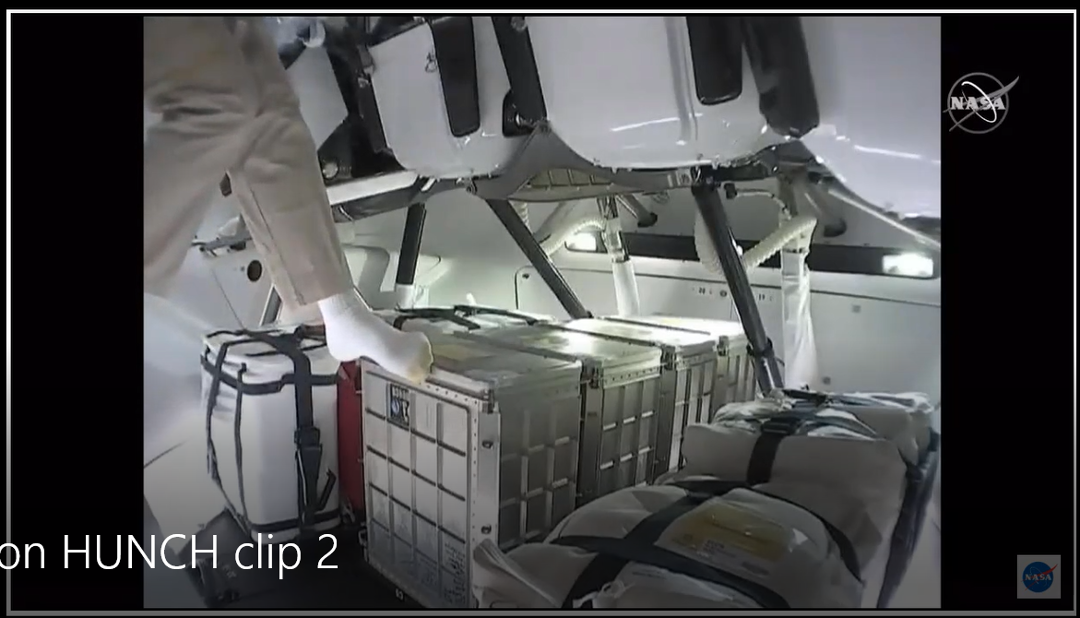
NASA HUNCH Students Send Hardware into Space

Four single stowage lockers made and signed by NASA HUNCH students, onboard Crew Dragon (May 31, 2020)

Ready for launch! High school students across the nation contributed flight hardware to the historic Launch America event. SpaceX Crew Dragon sent astronauts to the International Space Station (ISS) from the historic 39A launch pad at Kennedy Space Center on Sunday, May 31. And with them went four single stowage lockers (SSLs) designed by NASA HUNCH (High School Students United with NASA to Create Hardware) program participants.

Manufacturing students have made 70 flight-ready single stowage lockers (SSLs) over the past four years. Four of these SSLs carried supplies to the ISS; supplies included liquid cooling ventilation garments, crew shoes and an exercise harness for the astronauts.

In recognition of their dedication and skills, students and instructors were encouraged to sign their names on top of the single stowage lockers.

Do you have Member Connected News?

Member Connected News is a space designed for ACTE members to bang the proverbial drum. Has your CTE program reached an important milestone? Current or former student achieved something noteworthy? Fill out the form, and you might be featured next.

Start with the syllabus

Although remote learning is starting to wind down and educators across the country are once again joyously welcoming the start of summer, there remains a very real undercurrent of anxiety. No one knows what school will look like in the fall. Will schools return to normal with physical classes and traditional hours? Will they be fully remote? Or, will teachers, students and parents need to prepare for a hybrid model yet to be determined?

How can career and technical education (CTE) teachers prepare for these possibilities?

Re-examine your syllabus.

The syllabus serves as a roadmap, a first impression. It sets expectations, provides information about important dates and assignment deadlines, offers pathways for communication between the instructor, students and parents or guardians. The class syllabus guides students along a route to their final destination: course completion. And, like the GPS in your car, the syllabus becomes even more essential when students are at the highest risk for getting “lost.”

The syllabus does something else as well, something just as important. A well-designed syllabus informs class culture — even in remote or blended learning environments — by providing options and promoting accessibility.

The National Center on Accessible Educational Materials recommends a strategy — developed by the World Wide Web Consortium (2016) — for ensuring accessibility.

Course materials should be:

Perceivable, Operable, Understandable and Robust (POUR)

Applied to the syllabus the technique would look something like this:

Perceivable: Can everyone see and hear the content?

  • Use videos and images in the syllabus to increase understanding. Visuals are a powerful tool for educators to convey information and connect with students.
  • Create a video introducing yourself (and make sure to include closed captions).
  • Provide a space where students can introduce themselves, demonstrate a skill or practice, provide feedback and more.

Operable: Can everyone navigate with ease?

  • Consider creating a video tour of the course to outline expectations and goals.
  • Within the syllabus itself, apply styles to indicate section headings, which should be descriptive and unique.
  • Additionally, if you include links in the syllabus, they should be descriptive. For instance: “Click here” and the specific internet address, are not user friendly for students using text readers.

Understandable: Can everyone understand what is required?

  • To set the tone, include a syllabus statement that highlights your desire to support all learners.
  • Consider creating an online survey to ask students: What do you wish your teachers knew about you? Use these responses to design assessments and offer accommodations.
  • Include in the syllabus multiple ways for the students to reach out (e.g., email, phone, text, etc.).

Robust: Will the technology used transfer so the content remains accessible?

  • Students today are used to viewing materials on mobile devices. Open your syllabus on your phone; does everything function properly?
  • Perform an accessibility check on the syllabus. K-12 educational leadership, journalism and business. She has a proven record of achievement including being named the 2019 New Hampshire CTE Leader of the Year. Bastoni focuses on increasing equity and access for special populations in CTE. Her first book, From the Inside-Out will be released by Rowman >amp; Littlefield in June 2020. Email her.

    REFERENCE
    World Wide Web Consortium. (2016). Introduction to understanding WCAG 2.0. Retrieved from https://www.w3.org/TR/UNDERSTANDING-WCAG20/intro.html.

E-Learning Technical Vocabulary (Part 6): Linear Flow Chart

Linear Flow Chart is part six in an eight-part series on e-learning technical vocabulary systems. Read part one, part two, part three, part four and part five.

Ever played an anagram? Someone gives you a set of letters and you race to make as many words as possible. Scramble and unscramble. Focus. Concentrate. Identify new connections and patterns from the letters.

It’s a cognitive challenge!

Aren’t they fun? If you enjoy anagrams, you will love this vocabulary activity with your students.

Of course, it’s not quite the same. Students won’t simply be unscrambling letters. The flow chart activity is more about connecting terms with strategic thought. According to Daniel Pink (2009) author of Drive, the best methods to motivate students involve creating interesting challenges that offer multiple solutions. At the end of a round of anagrams, the buzzer sounds and lists are compared. Players “oooh” over other, often more complex, arrangements by their opponents.

The linear flow chart activity can work in much the same way. In the video attached for support, students are challenged to start with a word — “bradycardia” — and use its roots to form new words. They repeat until they have done this six times.

Allied health students must develop understanding of root words, prefixes and suffixes. Thus this approach for vocabulary practice works well. In the video below, one student began with bradycardia and flowed their thinking to end with the word psychosis.

Students share their lists and then natural dialogue ensues. They benefit from the opportunity to discuss meaning and connections between the technical terms. This will work in either a traditional classroom setting or in a digital setting, like Google classroom or Zoom.

Note: This vocabulary strategy should be adapted to reflect the type of thinking required for each field. The video addressed use in a health science classroom, while the steps below center automotive technology. In automotive, students conduct operations in a linear fashion. An instructor might challenge students to use the terms in progression and to follow up with dialogue about the why the flow matters.

Linear Flow Chart

Gist: Students put terms in sequential order to show a big-picture understanding of how they fit together.
When to use: When you have several vocabulary terms that all relate to the same process

How It Works

  1. Create a word bank of terms that relate to a relevant process. Want to make it more challenging and fun for students? Include several extra words so they must choose which ones are part of the process. (For example: An engine fundamentals instructor might use “intake valve,” “exhaust valve,” “power stroke,” “fuel-air mixture,” and so on.)
  2. Instruct students to fill in the flow chart, placing all the terms in sequential order. To engage students kinesthetically, have them create a large flow chart on the floor or wall.
  3. Say, “Now we want to be able to look at this chart and read it smoothly. Turn each step in the chart into a complete sentence. Explain the process, using the terms in the chart.” (For example: “Intake valve —>gt; fuel-air mixture” becomes “The intake valve opens to allow in fuel-air mixture.”)
  4. Repeat step three with each segment of the flow chart, so the student ends up with a few complete sentences that explain the process smoothly.

Download the Linear Flow Chart worksheet for use in your CTE classes.

Sandra Adams is a teacher and instructional coach with the Career Academy, Fort Wayne Community Schools. She co-wrote the ACTE-supported book But I’m NOT a Reading Teacher!: Literacy Strategies for Career and Technical Educators with Gwendolyn Leininger, where further detailed explanations of the strategies in this series can be found. Email her.

REFERENCE
Pink, D.H. (2009). Drive: The surprise truth about what motivates us. New York: Riverhead Books.

Dear Linda: Inclusion, Access, Equity & Diversity

Dear Linda,

I am a new teacher completing my first year and I want to be sure I am providing lessons that include all students’ individual needs. How can I promote equity while remote learning?

Dear New Teacher,

Congratulations on your first year of teaching. What a memorable year. Even under normal circumstances a teacher’s first year can be a challenge. What you are going through is beyond words. You are not alone. You will be stronger, and you will have developed skills that will enhance your teaching ability for years to come.

I love your question. We must consider inclusion, equity, access and diversity (IAED) with every lesson activity we plan. To ensure equity, recognize what that is. Equity is one of those words like engagement; everyone seems to have their own definition. The Ohio State University (2009) says, “Equity in the classroom can be defined as:

“…giving students what they need. When teachers truly listen to students and respect in the classroom is mutual between teacher and student, a productive classroom can be formed. Teachers feel good about the lessons they teach and students are engaged in learning.”

When planning a lesson, always:

Ask students about the barriers they face.

Many of our students use a school issued device. Some have their own, while others are using their phones. Ask, “Do you have a reliable device? Do you have a printer?” Ask. “Do you have a quiet location, and are you able to work during the day?” Some have to babysit and assist siblings with their work in addition to completing their assignments.

Be flexible.

If a student does not have a printer, for example, work with them toward a solution. Think of alternatives. Get creative. Much of what we are doing remotely can be compared to Apollo 13. Imagine the astronauts as they floated in space while basically everything shut down around them. They developed solutions using the items they had on board the ship.

We are doing the same thing as CTE teachers. Consider what materials students have available and create lessons using those items. Ask the students what they need, what they have, and what constraints they may be facing. Be flexible to work within those parameters.

Provide user-friendly materials.

Ease of use is key. We are drawn to new books and engaging online formats but unfamiliar materials may lead to confusion. Often, the same simple document you would have used in your classroom will suffice. Don’t inadvertently cause more stress for yourself or your students. Focus on keeping things as normal as possible while the education landscape shifts around us all.

Maslow first, then Bloom

Teachers are taught Bloom’s taxonomy to scaffold from one lesson to another. While that is important, during this ‘new normal” we have to consider Maslow’s hierarchy of needs first.

Physiological needs: Are they being met?

Safety: Is the student safe both emotionally and physically?

Love and belonging: What is happening socially? Are they completely isolated?

Esteem: Do they have support, reassurance?

Self-actualization: Is this their graduation year? How are they being recognized?

These are stressful times for all. I am proud of you, as a new teacher, for asking this question. All of us, new or seasoned teachers, need to carefully consider inclusion, access, equity and diversity. ACTE established an IAED advisory group to provide recommendations and support for CTE educators leading these efforts; learn more about the resources available and read the March edition of Techniques, which included several articles about IAED.

Consider a few additional resources; they have helped me with this topic:

Thank you as always for your questions.

With love and gratitude,

Linda Romano

Click here to submit your questions. Linda will have the answers.

Linda Romano is vice president of ACTE’s Health Science Education Division and a health science/nurse aide educator for Newburgh Enlarged City School District, where she has been a CTE teacher since 2006. In 2018, Romano was named ACTE’s Teacher of the Year. She also serves as president of the New York Health Science Educator Association.

Romano is an active registered nurse and serves in several volunteer capacities for her state of New York and within the local Newburgh Community/ Newburgh Armory Unity Center. In addition to mentoring new teachers, Linda Romano developed and leads a program called Scholars in Scrubs, which provides education, health and wellness, and opportunities for young people (pre-K to high school) and their parents/grandparents.

REFERENCE
The Ohio State University, College of Education and Human Ecology. (2009). Creating an equitable classroom through establishing respect. Retrieved from https://beyondpenguins.ehe.osu.edu/issue/polar-plants/creating-an-equitable-classroom-through-establishing-respect.

Preparing CTE Teachers for Re-Engaging with Students in the Fall

The 2019/20 school year is coming to an unusual end. After spring break, our students never returned to their classrooms. While core academic teachers were required to provide review materials online for their students, CTE instructors were asked to do the same being cognizant of the overall time students already had to spend online, the access to technology students may or may not have, and the fact that parents are going to be stretched thin trying to ‘homeschool’ and do their own work from home at the same time.

The results spanned the whole spectrum. Some teachers were trying to get their students through the final modules in preparation for an industry certification and we celebrated their students’ successes on social media. Other instructors, whose courses were not an EPSO (Early post-secondary opportunity like dual credit/enrollment, CLEP exam, or aligned industry certification) were not allowed to teach new content in order to provide equity to all students and stuck with the review material that was also not supposed to be graded. Other teachers stopped teaching entirely – reasons ranged from students not having access to technology, to not being able to get in touch with their students, to feeling limited as to how they could teach their hands-on skills remotely. To some extent they are right. However, this cannot mean we throw our hands up in the air and say I’m done. It does take a lot of creativity to take many of our CTE courses to a blended or remote setting.

Faced with these challenges, our school district has crafted a plan for all content areas to achieve two goals over the summer: 1) train our teachers on ‘distance learning’ strategies and the required technology know-how in case school will be out again in the future, and 2) give them guidance on how to teach missed content from the Spring semester in the next-level courses next school year. Each content area, including CTE, will have its own components to add to this training.

As the CTE Specialist in our district responsible for our CTE instructors’ professional learning, I will work closely with the other content areas in the next couple of days and weeks to develop these materials. First, in May and still on-contract, all teachers will participate in two one-hour trainings – one on Canvas 101 (our learning management system) and one on trauma-informed teaching. In June, all teachers will complete one Canvas course of the equivalent of one full day of professional development, which includes several modules on how to adapt traditional classroom instruction to a blended or even fully remote setting with examples around an “If this, then that” template to get educators thinking about what that would look like in their area. This would allow us to keep teaching new content even while school might be out part of next year. To ensure equity, our district is working on expanding 1:1 technology and internet access at the same time. Last, in July, all teachers will complete another day of remote training specifically for their content area. For us, this might be a CTE Canvas Course with modules for each career cluster or even specific programs of study.

Times have changed. Instruction must go with the times and adapt to challenges. It is not like our department has not offered training around learning management systems, Google classroom, and the like before. But it was all rather optional and some of our instructors shied away from using these teaching tools in their classrooms. We don’t have this option anymore. It has become a ‘must be up-to-date’ on this now. If we don’t adapt and offer our CTE students some level of content even if it has to be remotely, then we run the risk of our programs being closed.

E-learning Technical Vocabulary (Part 5): Connected Cards

Connected Cards is part five in an eight-part series on e-learning technical vocabulary systems. Read part one, part two, part three and part four.

Metacognition is an amazing force in classroom instruction. When we compel students to think about their own thinking, they learn to reflect more deeply. Momentum grows as they begin to work cooperatively with peers. Conversations are driven by purposeful dialogue. Coupled with the experiential nature of career and technical education (CTE) — learn by doing — we find innovative ways to encourage literacy learning.

But… how, while remote learning, do CTE teachers engage students in the productive talk needed to process technical vocabulary terms?

A possible solution

Plan strategically to encourage productive talk during online instructional sessions. With the use of the connected cards strategy, students learn to speak up, to take on an active role in the lesson. Rather than making occasional participation requests, create the expectation of continual talk and discussion. Pause to highlight a term or concept in any given lesson; then challenge students to make a connection with a previously learned term. As each student takes a turn, dialogue increases naturally. It becomes the essence of productive talk. The power in this approach lies here: Students have opportunities to examine the relationship between multiple terms, over multiple units.

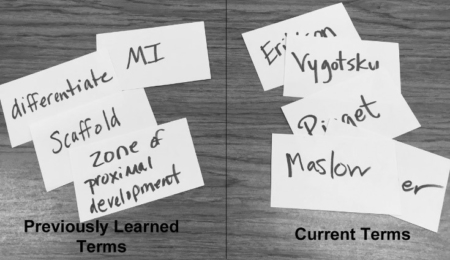
In an early childhood education class, students learn about child development theorists. The goal is to help them connect specific theorists’ ideas to previously learned topics.

Connected Cards

Gist: A game a bit like Apples to Apples, in which students must find a way to connect a previously learned term with a random term from the current lesson

When to use: To help students connect new learning to previously learned information. Also as test preparation, when terms have been covered but students need to practice

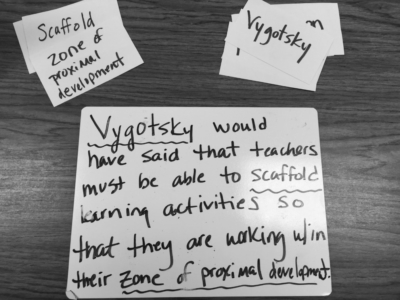
Small whiteboards come in handy for connecting terms in sentence form.

How It Works

  1. Write several previously learned vocabulary terms on a set of notecards. Create a second set of notecards with terms the students are learning currently. (Scaffolding Note: If you wish to emphasize definitions, include those on the backs of the cards.) Instruct students to create their own sets of cards.
  2. When the remote learning session begins, identify two students who will go first. Ask one student to pull a card from their stack of new terms. The other selects a card from previously learned terms.
  3. Say, “Students, converse about these terms.” The expectation is they will work together to reflect on their learned experience and make connections. Invariably, their classmates will think of the connections they themselves would make.
  4. The rest of the students give a thumbs up if the interaction created a memorable way to understand the new term. Majority rules. If most thumbs are up, the two students who made the connection each get a point.
  5. Remind students during play that this game is not about placing the word itself into its proper category. Instead, it is about finding a clever way to connect what they’ve learned in one category to what they’ve learned in another.
  6. Repeat until all students have participated in pairs.

A student’s perspective

“This game is a real challenge, but it’s fun! Using the new terms in a sentence about something I already know helps me remember.”

See the strategy in action.

Sandra Adams is a teacher and instructional coach with the Career Academy, Fort Wayne Community Schools. She co-wrote the ACTE-supported book But I’m NOT a Reading Teacher!: Literacy Strategies for Career and Technical Educators with Gwendolyn Leininger, where further detailed explanations of the strategies in this series can be found. Email her.

Supporting CTE Students During School Closures due to COVID-19

With the coronavirus spreading across the nation, this time is challenging for education in general but specifically for CTE with all its hands-on courses. My district’s schools started to be out one day before Spring Break, which was during the week of March 16. We are going to be out for a total of five weeks of missed instructional time – until April 24 if it is not going to be extended.

At first, our district told parents, students, and teachers that there will not be any instruction –online or in any other form – due to legal guidelines for public schools to provide equal access for all and our district is very diverse in many aspects. However, once school closures lasted longer than expected, the district decided to develop resources (online, paper packets, PBS videos) for students in the four core academic areas of Math, English Language Arts, Science, and Social Studies. No new content can be taught, everything is only for review to keep our students engaged. Nothing is graded, all assignments are optional due to the equity clause.

As a CTE Specialist, I support the Business >amp; Marketing teachers in our district – we are not part of the four core academic areas. However, our teachers have the option to also keep their students engaged with review materials. With one exception: any course that carries an early postsecondary opportunity (EPSO) like an industry certification, dual credit etc. may teach new content, so as to provide those students already enrolled with the option to finish their credits through the third-party providers. A lot of our vendors have graciously expanded their free online access for both teachers and students – certainly in hopes of generating business for themselves down the road but for right now we are thankful for their resources.

Videos and online activities certainly cannot replace practicing skills hands-on as they are required in CTE courses like Transportation or Construction. However, I have to believe, this is all temporary. We are all doing our best to stay connected with our students and to help them through this strange time of uncertainty. We can find ways to make up for lost instructional time later!

# # # # # #