Survey Says: Speak Up & Take Time for Yourself

On social media last week, ACTE asked,

How are you are taking care of yourself during the COVID-19 pandemic?

We heard from career and technical education (CTE) teachers and administrators representing a range of subject areas — including from family and consumer sciences, business education, engineering and design, agricultural education and more.

Here’s what CTE had to say about self-care:

  • Establish time off at home. Step away from the computer each hour for little brain breaks during the day.
  • Communicate when you are feeling overwhelmed; don’t bottle it up! Ask others — your peers and your leaders — for assistance when you need it.
  • Dress up each day.
  • Follow Centers for Disease Control and Prevention guidelines and precautions, such as wearing masks and gloves, washing your hands, practicing social distancing and limiting public outings to primarily work and grocery shopping.
  • Spend quality time with your family.
  • Play a board game.
  • Remove notifications from your cell phone.
  • Read, or journal.
  • Cook a favorite meal.
  • Eat more vegetables.
  • Drink lots of water.
  • Get enough sleep.
  • Exercise! Take walks and enjoy the fresh air. Play ping pong. Ride bikes. Bring a yoga mat and free weights to school to stretch and pump iron on breaks.

Thank you to all who completed the survey! #ACTECares

EIM Spotlight: Mike Parry (Grant Career Center)

[av_textblock size=” font_color=” color=” av-medium-font-size=” av-small-font-size=” av-mini-font-size=” av_uid=’av-keb1dqg1′ custom_class=” admin_preview_bg=”]
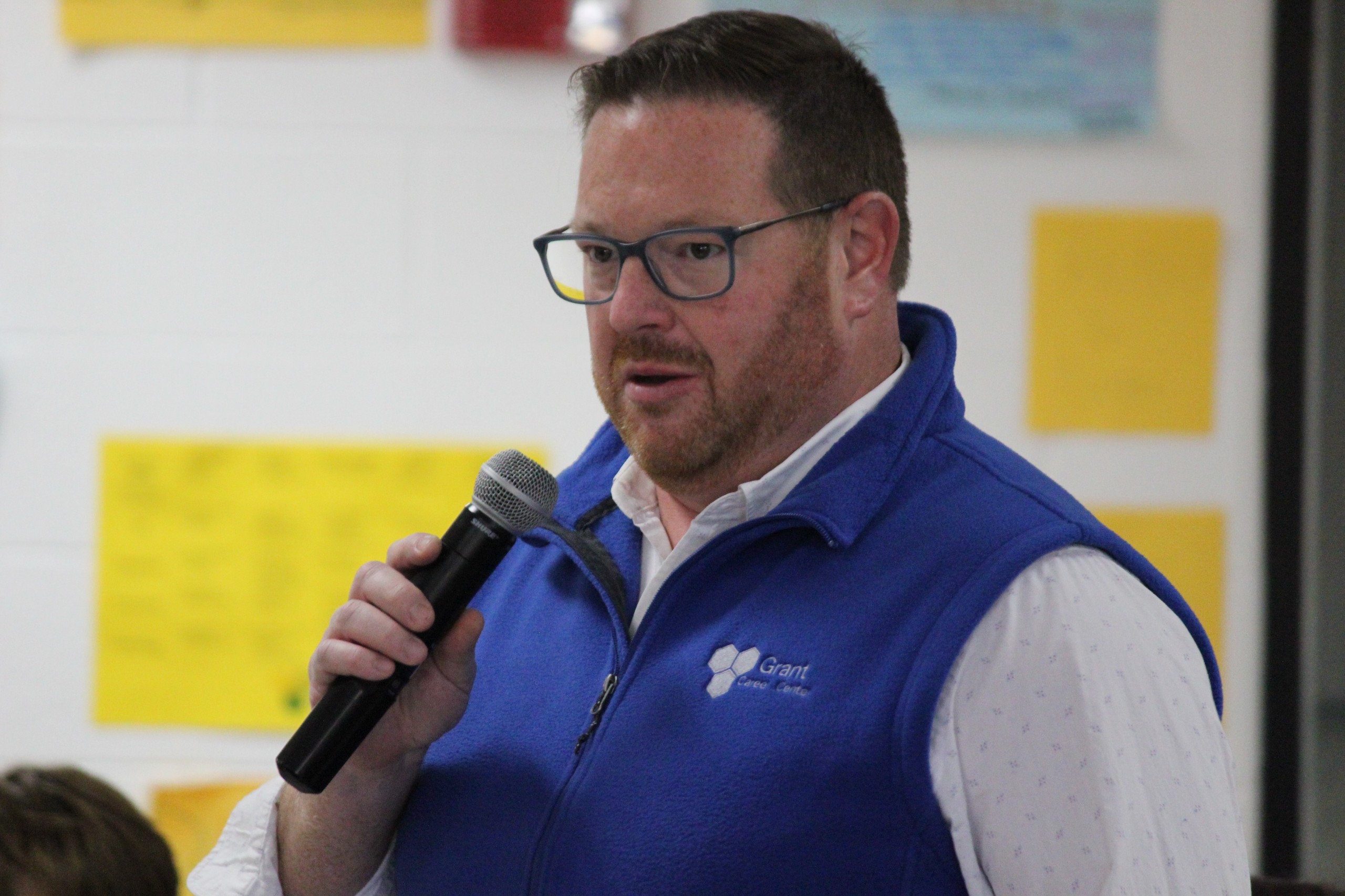
Meet Mike Parry, superintendent of U.S. Grant Career Center. Parry’s interview appears as part of a spotlight series on ACTE’s educational institution members (EIM).

Grant Career Center, located in southeast Clermont County, Ohio, provides career and technical education (CTE) programs to four member school districts. While the district offers programming in multiple locations — Bethel-Tate Local, Felicity-Franklin Local, New Richmond Exempted Village and Williamsburg Local — the administrative offices and main campus are located in the village of Bethel, Ohio.

Grant Career Center is deeply committed to serving students, both youth and adult, through strategic partnerships and by engaging business and industry. Innovative approaches; sound, front-line decision-making; and a culture of caring for students and the community are hallmarks of the successful organization.

Mike Parry, Grant Career Center, EIM

What do you do as superintendent of Grant Career Center?

I serve a role as the district’s chief executive — interfacing with the board of education, associate school districts, partners and the community. I work with internal and external stakeholders to develop and implement strategic direction for the organization.

Tell me a little about your upbringing. Where did you grow up?

I grew up in western Pennsylvania, the son of an educator and a social worker. I knew I wanted to become a teacher for as long as I could remember.

What was your postsecondary education experience like? What did you study?

I had a great educational experience. I attended the University of Dayton (UD) — go Flyers! — and earned a bachelor of science in secondary education with two teaching certificates: comprehensive social studies and English language arts. I also have a master of science in educational leadership from the University of Dayton.

What led you to your field?

After graduation, I taught theology on the island of Saipan. I returned to the states and taught for a time at Miami Valley Career Technology Center Youth Connections in Dayton, Ohio. It was during my participation in a statewide career, technical and adult education leadership program that I discovered all CTE has to offer.

After teaching at Youth Connections, I was offered an administrative job with Butler Technology and Career Development Schools, where I supervised programs working with at-risk youth. Subsequently promoted to become the vice president of educational options, I managed alternative programming, online learning, and transitions programs for special needs students.

Later I was selected as the executive director of secondary education, in charge of all secondary programs — both on-campus and satellite.

Is there anything else about your life that you’d like to share?

I have a beautiful wife named Nicolle and two beautiful daughters: Alizah and Ellie.

Do you have any advice about the higher learning experience that you would offer to students who intend to pursue postsecondary education in CTE?

Be bold! Be courageous and be confident. Each person is brilliant in their own uniqueness. Developing a skill, a craft or a trade will serve you well for the rest of your life.

Learn more about educational institution membership with ACTE.

[/av_textblock]

STEM Jobs of the Future: Engineering

Engineering is part two in a new series on STEM jobs of the future, by Ashley Pereira and Jacqui Schlesinger. Read part one, on technology jobs.

Engineers touch everything we interact with in daily life. They design bridges. Engineers innovate new beauty products, and they launch space exploration tools. Dozens of engineering sectors exist already. And growth into new frontiers expands rapidly.

Encourage your career and technical education (CTE) students to be innovators in engineering. Consider the following careers emerging now:

Space travel engineer >amp; flight planner

Many people dream, from childhood, of visiting space. Now, thanks to private companies like SpaceX, that dream is becoming reality. As the world saw for the first time in 2020, commercial rocket launches are possible, and many new space travel companies are likely to emerge. One ticket to the International Space Station can be yours for a cool $55 million.

As NASA aims for the moon by 2024 and Mars in the 2030s, the horizons of space are wide open!

The commercial spaceflight industry is in its infancy, but the need for planners and space travel engineers for space is pressing. Space travel engineers will have a wide variety of responsibilities — from designing a rocket to coordinating a commercial rover launch on the moon — to make space travel safe and enjoyable for everyone.

For high-profile clients, space travel agents will be in demand. They’ll plan seven-course liftoff meals and make sure the rover has heated seats.

A space travel engineer or planner could earn as much as $117,000!

Interstellar city planner

Imagine living on a different planet. Wake up and put on your space suit so you can breathe. Learn about nearby planets in geography class. In the evening, you might look up at the sky to see Earth and the moon far away.

Interstellar life could be the future for much of humanity as Earth’s swelling population continues to deplete its resources. But, before we inhabit these new worlds, someone will have to design them. That’s where an interstellar city planner comes in.

The job will require lots of research and development to help society adapt in different environments. Like urban planning today, this enormous task will require feedback from potential inhabitants and many professionals in supporting fields.

Interstellar city planners will have the exciting task of designing an entirely new and innovative society on a faraway planet. They can expect to earn at least $74,000 with a master’s degree in urban planning or related field.

Self-driving car engineer

Innovations in automobile design and technology are already changing the future of driving. But what happens when a teenager wants to get their license to drive a flying car? And who will fix the flying and self-driving machines of the future?

New jobs created by these emerging feats of engineering will be influential both in sheer number and financial opportunity. For every new type of car, engineers will be needed to design, build, teach and fix. Companies like Terrafugia and Waymo (backed by Google) are already developing autonomous vehicles. In addition to transporting people, autonomous vehicles also have commercial and logistics applications (e.g., delivering packages for Amazon, restocking Walmart after a natural disaster).

A bachelor’s degree in automotive engineering is a good place to start; new car technology engineers might earn a salary of $88,000.

Trash and recyclables construction specialist

The United States is the ‘king of trash’, producing an average of 4.4 pounds of garbage per person, per day. This isn’t sustainable. Trash and recyclables often end up in the ocean, on the side of the road and in overflowing landfills. Pollution harms the natural world and, to solving these issues, that’s where a trash and recyclables construction specialist comes in.

Forget wood and nails. Try reused plastic and reshaped metal cans! Construction engineers of the future will innovate to meet building codes that live up to increasingly stringent environmental standards. A perfect career for those who like to experiment with new materials and work with their hands! Can you imagine taking a pile of trash and creating a house? That’s the future of construction!

Construction specialists need to earn a bachelor’s degree in construction management; they may earn $95,000 per year.

Engineering jobs of the future are critical to the advancement of all branches of STEM. Science, technology and math professionals all will benefit from exposure to engineering fields, as they enter a job market predicated on critical thinking skills and innovation.

These careers represent only a few of the rapidly evolving fields within STEM. Come back soon, to PAGES, a Techniques blog, for our next feature on STEM jobs of the future: science!

Jacqui Schlesinger is passionate about STEM education and career development. As a rising high school junior in the Boston area, she is involved with several organizations including Career In STEM, The Math Club of Lexington, her school’s STEM Education Club, and the Masshire MNWB Youth Committee. She also enjoys playing tennis, writing and exploring nature.

Ashley Pereira is a former middle and high school science teacher, and owner of Career In STEM. She creates engaging STEM career exploration resources to prepare middle school students to succeed in future STEM careers.
EIM Spotlight: Laura Jaime (West-MEC)

Meet Laura Jaime, director of curriculum, instruction >amp; assessment at Western Maricopa Education Center (West-MEC). Jaime’s interview appears as part of a spotlight series on ACTE’s educational institution members (EIM).

West-MEC is a public school district dedicated to providing innovative career and technical education (CTE) programs that prepare students to enter the workforce and pursue continuing education. West-MEC CTE programs offer students opportunities to earn college credit and industry credentials.

Laura Jaime, West-MEC, EIM

What is your job title and what do you do?

As the director of curriculum, instruction >amp; assessment, I oversee the teaching and learning for the district. At West-MEC, we believe that all students can learn; teachers make the difference. Success leads to success, and high expectations lead to student success. We design all of our curriculum around the CTE delivery model:

  • Classroom instruction
  • Hands-on instruction
  • Work-based learning
  • Leadership development

We have also developed a three-tier system of support, our Teacher Induction Academy, to help all instructors succeed. We provide them with top-notch professional development, instructional coaching and support, along with networking and mentorship opportunities.

Can you tell me a little about your upbringing?

I am from a small rural farming community in Illinois. My mom was a schoolteacher for over 36 years. Like most children, I told myself that I would never have the same career as my parents. I wanted to be a marine biologist. I wanted to train orca whales at SeaWorld. Then I had a phenomenal science teacher, Mr. Johnson, who inspired me to pursue my passion for biology and also to inspire others. I followed in his footsteps and became a middle school science teacher.

What was your education experience like? What did you study?

I earned a bachelor of science, with a dual major in biology and secondary education from Eastern Illinois University.

After eight years, I left my teaching position and took a job working as a career counselor for a career and technical education district (CTED). I realized that I enjoyed community outreach, program management, and curriculum and instruction. I initially thought that I would like to be a middle school or high school principal, so I went back to school to get a master of education administration from the University of Phoenix.

Life has a funny way of making a full circle. While I was student teaching, my cooperating teacher told me that I should be a curriculum writer instead of a teacher, because I was extremely organized and had fantastic lesson plans. Now, as I look back, she was right. Curriculum and instruction was where I am supposed to be. I rounded out my education with a doctoral degree in organizational leadership — with an emphasis in K–12 leadership — from Grand Canyon University.

School was something that I always had to work at. My brother is four years older than I am, and I always felt that I had to meet his standards. He was valedictorian of his high school and went on to be an orthopedic surgeon. It was a great accomplishment for me to finish my doctoral degree, and to have him there to watch me graduate. Over the years, I learned how to accomplish my goals.

What barriers did you (or you family) face in pursuit of higher learning?

My stepchildren were first-generation students. Both of their biological parents have high school diplomas, but my older stepdaughter was the first one in the family to go to college. She has her bachelor’s degree in education and teaches seventh grade language arts. My son is a product of CTE; he’s a barber. My youngest will be a senior in high school and is looking into another CTE field: dentistry.

I believe that I have had an impact on their choices to pursue postsecondary opportunities that can improve their lives and make them economically independent.

What led to your current role at West-MEC?

I have been with West-MEC for three years now. When I initially came to West-MEC, I was the program quality manager; I oversaw all of the West-MEC programs to ensure quality and compliance with the department of education and CTED legislation. I enjoyed this position. It allowed me to network with other member district personnel, and to make several connections within the community.

In fall 2019, the position I hold now — director of curriculum, instruction and assessment — opened up. This presented an excellent opportunity for me to step up in the organization and continue the great work with program development.

How do you like working on campus?

My role allows me to visit all of our campuses and to work with all of our instructors. West-MEC currently has four central campuses, where students travel from 49 high schools in northern and western parts of the Phoenix, Arizona, metropolitan area. I love being part of a school district that puts students first and provides them with career opportunities that they might not have known were possible.

Do you have any advice that you would offer to students who intend to pursue postsecondary education in CTE?

CTE allows students the opportunity to learn transferable skills. The industry credentials earned within a chosen career field provide students with a springboard into industry. CTE is not a place to stop learning, but a pathway to future learning. We can all learn something new every day; CTE allows us to network within our communities and develop the employability skills needed to be successful in any field.

Learn more about educational institution membership with ACTE.

An Education In Grace

We have all had weeks that began seemingly normal, but ended anything but…however I think that we can all attest to the fact that the week of March 9, 2020 was one like no other.  In the blink of an eye, we were going from standard classroom instruction to this new environment of remote learning, for who knows how long.  Sure, things were going to be different but we are educators and used to pivoting on a dime depending on what is thrown at us, we will survive and come out on top…right?

Fast forward two weeks, as I prepare to log into my computer for the first meeting of the day (while also kicking off the 1st grade and pre-K lessons for the day), and I get a message from a colleague asking me to co-facilitate a meeting that he saw I was on.  Clearly, he is kidding, as I just apologized for the mess that will be going on in the background while my kids are ‘focusing’ on their school work and I am holding down the fort solo with my husband at work.  When I answered back with a ‘Sure!’ and the laughing/crying emoji, I was sure that he knew I was kidding as well.  The next thing I know, my 7-year-old exclaimed ‘Mommy, that man just said your name and that you were helping to lead the meeting.’  Clearly his question was not in jest, and clearly, I had missed my introduction (as I was in the other room dealing with some pre-K trauma).  While the meeting went off seemingly well, my facilitation included a 5-year-old sanding on the back of my chair jumping and playing with my hair, a 7 year old asking for help with his school work, and my phone ringing, verified by the video that I received later which had documented the entire debacle!  That is when it hit me…this is HARD!

As the week went on, I continued to work through my meetings and responsibilities to the best of my ability.  One of those responsibilities was a supportive collaboration call with one of our curriculum cohorts.  The idea behind these video meetings was to support teachers in their efforts to support kids, and reinforce the need to grant students grace during these unprecedented and trying times.  This particular call quickly pivoted to a session of support for our teachers, and all that they are balancing.  My new revelation was that this was REALLY HARD…on EVERYONE!!!

When the call ended, I felt deflated and unable to support my teachers in the way that they were needed.  Given what I had just experienced, I felt it was important to get on a call with my supervisor and talk through what we might be able to do to support our staff, who need just as much support as our students.  It was through that discussion that we developed our new NORMal.  While our district had established norms, we decided that the norm needed to be tweaked a bit in this situation.  It was determined that our staff needed these new norms to guide them through this unprecedented time…

  • Your current priorities are your health, your family, and maintaining relationships with students.
  • You have the autonomy to control your work and workload, as you are trusted as a professional to do what you find/feel is best for you, your family, and your students in these trying times.

This message was delivered to staff both in a video message from our Superintendent, and an email from our Executive Director of Teaching and Learning.   The feedback received was nothing short of phenomenal, and it was exactly the support that our staff needed!

In the end I think that maybe we as educators were taught the greatest lesson of all through this…an education in grace.  While some might fear that this type of grace could provide a ticket to do less, its effect was actually the complete opposite.  Bottom line, what you invest in trust and grace will come full circle and pay dividends.  We truly are all in this together!

Beyond Pedagogy in the CTE Classroom

Gliding seamlessly from traditional teaching models to semi-remote to completely remote teaching requires schools and teachers to understand more than the pedagogy for each of the scenarios. In CTE we use hands-on instruction and formative assessments the majority of the time. As instruction moves to a remote learning situation, we must consider liability and access and equity.

There is inherent risk with schools in general and in CTE classes it is higher than in an academic classroom. A couple of years ago I was investigating the risk associated with placing students in internship positions and I spoke with an attorney and he said the only way we eliminate risk in schools is not to open the door. We open the doors and try to mitigate risk as we go. In a remote teaching situation is it appropriate to ask students to complete projects at home for a grade, for example, baking a cake, building a dog house, changing the oil on a car, etc.? Would districts and teachers be liable if a student was burned or the house burned down, or injured while performing a construction or automotive task, or if personal property was damaged? Could this risk be mitigated by having parents sign indemnification paperwork to not hold the district or teacher liable? Is virtual reality technology going to become the norm in every CTE classroom?

The jury is still out on this issue and very few policies exist for this type of situation. Currently most districts are saying, don’t require hands-on projects at home until we can write policy and seek our precedents. This will require CTE teachers to think strategically when planning out their classes as they prepare to glide through different delivery scenarios.

The other area of consideration for teachers is the digital divide. Prior to March 2020, we knew it existed but didn’t pay very close attention to it. There are many schools that have 1:1 devices available to students but are they allowed to take them home; keep them throughout the summer? What about access to internet services? There are many families that can’t afford service and there are still many places in our country where there is no internet service. The district I teach in in Alaska is very large and some students have to drive 30 or more miles just to hit a hotspot. Not a good option in the winter in Fairbanks, Alaska, sitting in your car doing homework, watching videos, or completing projects online.

Districts around the country are going to be quickly trying to address this issue this summer but there may not be solutions in place by fall. Teachers are going to have to be creative to ensure that all students are having a similar, maybe different experience in all the delivery scenarios.

CTE teachers have many things to consider as they move forward to teaching in this new era. Having administrators that understand the needs and challenges of CTE teachers is imperative to moving programs forward.

STEM Jobs of the Future: Technology

The job market evolves constantly. Fueled by the rapid growth of technology, industry demands critical 21st century skills. Today’s students must be prepared for jobs which do not yet exist. It is estimated that 85% of jobs that will exist in 2030 haven’t even been invented yet (Institute for the Future, 2017). “New categories of jobs will emerge, partly or wholly displacing others” (World Economic Forum, 2018).

Tomorrow’s workforce must be adept critical thinkers. They must problem solve and innovate lest they be replaced by robots. There is a pressing need for educators to provide diverse experiences in science, technology, engineering and mathematics (STEM) — connecting passions to careers.

Technology offers a wide range host of new career fields that may seem of science fiction, but no… They are, in fact, on the brink of reality:

AR Developer

Have you ever used Snapchat? Then you’re already familiar with augmented reality (AR). In short, AR can transform the world around you, “adding imaginary elements into the real world for you to interact with” (Career In STEM, 2020).

Augmented reality is sweeping industries including education, manufacturing, retail, sports and medical fields. Try on the latest fashions from the comfort of home or bring textbooks to life; AR developers create experiences to reconceptualize activities that have been limited by proximity until now.

As staying home becomes the new normal, augmented reality will remain in high demand. AR developers need a bachelor’s degree in software development or a related field. They can expect to earn over $106,000 annually.

Workplace Productivity Manager

The world is digital and increasingly distracting. Where loss of productivity is directly correlated with loss of revenue, companies need employees focused on critical tasks.

The responsibilities of a workplace productivity manager could include:

  • Researching and implementing ways to reduce unnecessary screen time
  • Devising virtual experiences to keep employees motivated and connected

Workplace productivity managers should have postsecondary credentials in human resources or a related field. They can expect to earn over $117,000 annually.

Drone Traffic Controller

The Federal Aviation Administration (FAA) reports there are approximately 40,000 plane flights, on an average day, in the United States alone. To service that volume, there are more than 14,000 air traffic controllers recognized by the FAA.

Now imagine this:

How many air traffic controllers would be needed to manage drones that carry the almost 7 million Amazon packages a day across the U.S.?

That’s a lot of jobs!

To manage drone traffic will be a huge undertaking. With the rapid development of these technologies, thousands of drone-related jobs will soon be available. Develop technology and strategies to manage drone swarms. Check the registration of vehicles in flight. And work with maps and data to monitor drone traffic. Drone professionals will need technology, data analysis, logistics and multitasking skills.

Drone pilots are also in high demand, often earning over $87,000. With a high school diploma, a love of the outdoors, and hands-on training, anyone can explore careers in drone technology. Could you pass the test?

Nanobot Programmer

Robots can make drinks at a cafe. They can manufacture products in an industrial setting. But what if these robots were so small that you couldn’t see them? A nanobot is a relatively new type of robot the size of a nanometer; that is 10 million times smaller than a centimeter!

Nanobots could be deployed inside the human body — to deliver targeted medicines, attack cancerous cells or collect internal data on a specific problem. The application possibilities are endless. Related career pathways may include medicine and healthcare, as well as pollution monitoring and cleanup.

The need for people with expertise in nanobot technology is growing rapidly. The field lies at a unique intersection between robotics, computer science and helping others.

Nanobot programmers will likely need a bachelor’s degree in a computer science field, with a minor connected to fields of interest (e.g., biomedical engineering, environmental science). Nanobot programmers can expect to earn over $87,000 annually.

These careers represent only a few of the rapidly evolving fields within STEM. Come back soon, to PAGES, a Techniques blog, for our next feature on STEM jobs of the future: engineering!

Jacqui Schlesinger is passionate about STEM education and career development. As a rising high school junior in the Boston area, she is involved with several organizations including Career In STEM, The Math Club of Lexington, her school’s STEM Education Club, and the Masshire MNWB Youth Committee. She also enjoys playing tennis, writing and exploring nature.

Ashley Pereira is a former middle and high school science teacher, and owner of Career In STEM. She creates engaging STEM career exploration resources to prepare middle school students to succeed in future STEM careers.
EIM Spotlight: Rebecca Armitage (Salt Lake Community College)

Where industry >amp; education intersect

Rebecca Armitage takes center stage in our latest spotlight on ACTE’s educational institution members (EIM). Armitage is CTE manager and interim associate dean for business, IT and health-related technologies in the School of Applied Technology and Technical Specialties at Salt Lake Community College.

Salt Lake Community College is the only comprehensive community college in Utah. The institution serves more than 60,000 students annually, offering more than 200 career and technical education (CTE) programs of study. Salt Lake Community College is also a recognized leader in competency-based education (CBE); more than 20 CTE programs, as well as several general education courses, are offered in this modality.

Rebecca Armitage, Salt Lake Community College, EIM

Tell me a little about your job at SLCC. What do you do?

My permanent position is as the CTE manager. In this role, I assist in leading the institutional Perkins four-year planning team, managing institutional Perkins funds, and coordinating CTE efforts throughout our region. I collaborate to develop cohesive marketing messages, while maintaining all institutional program advisory committee membership listings and, most importantly, promoting career and technical education.

Currently, I am also the interim associate dean for business, IT and health-related technologies in the School of Applied Technology and Technical Specialties. In this role, I manage multiple CBE short-term, certificate-based programs designed to help move individuals directly into employment. Programs I oversee include are certified nursing assistant, graphic technician and commercial foods.

What barriers did you face in pursuit of postsecondary education? How did you overcome those obstacles?

I was raised by a stay-at-home mother; my father was a blue-collar worker. Neither of my parents encouraged higher education but they also did not deter me. My younger sister played a big role in getting me into college at the age of 27. I was a first-generation, low-income, single parent, nontraditional student. I had a great many hurdles and I would not have been able to complete school without identifying a community of support for myself and my daughter. One of the biggest helps for me, as a parent, was a now-defunct program at Arizona Statue University (ASU) that allowed me to bring my daughter to campus for child care.

I enrolled first at Glendale Community College; I wanted to be a kindergarten teacher. After completing two years, I was ready to transfer to the university, until I learned I would have to quit work in order to complete that program. I was devastated. My math teacher told me to get my bachelor’s degree in something that I liked, and I could then get my postbaccalaureate teaching credentials.

That advice put me on the path to meeting my mentor; William Simmons, currently an associate professor of gender studies at the University of Arizona, was instrumental in strengthening my desire to make a difference.

In what subject is your bachelor’s degree? Did you pursue postgraduate degrees?

I obtained a bachelor of science in political science from Arizona State University. I then went on to get a master of arts in interdisciplinary students from ASU, and then a second master’s in social justice and human rights, also from Arizona State University.

What led you to your work at Salt Lake Community College?

After moving to Utah in 2011, I took a part-time job as a recruiter for the applied technology programs at SLCC. Within one year I was working full-time. With some institutional restructuring, our former dean — Eric Heiser, now provost at Central Ohio Technical College — identified a need for a manager to support CTE programs, Perkins, the work of the CTE director, and other institutional endeavors. I was fortunate enough to be selected for the position. CTE is something that I am truly passionate about.

I worked in the diesel/shipping industry for 20 years, where I learned a great deal about industry and how education intersects. This has been a great benefit to me as an educator. I can bring industry knowledge and experience, coupled with my formal education.

How do you like working on campus?

I love working on campus. SLCC has 11 campus locations and I enjoy the opportunity to visit most of these sites. I get to see students in action; I have conversations with diverse faculty members and watch programs grow.

Do you have any advice about the higher learning experience that you would offer to students who intend to pursue postsecondary education in CTE?

Apply for scholarships! There’s funding out there, but you need to apply. Don’t wait until the day before the deadline — reach out and ask for help. Use the resources around you to help in forming articulate statements. Speak with your teachers early to request letters of recommendation. We’re here to support you in your endeavors and only want the best for you.

Learn more about educational institution membership with ACTE.

Dear Linda: Unwinding after a stressful school year

Dear Linda,

My school obligations have ended; I am finished with report cards and such. But now I have this strange feeling that I am forgetting something. I can’t seem to relax. What do I do now?

I appreciate your advice,
An ACTE member from Kentucky

Dear Kentucky,

Congratulations on making it through the year! We need to celebrate that milestone!

Many career and technical education (CTE) teachers feel the same way. The school year ended without fanfare or long goodbyes. Students and teachers, alike, miss a sense of closure. Take that away and we are left feeling upset and, often, devalued. These feelings filter into the stress of not knowing what fall will look like. It is important to find some relief. To take some time for self-care this summer and prepare for the new year.

Feel your feelings.

Don’t try to minimize your emotions. You might say, “Well it was a stressful experience this year and I wanted it to end anyway.” But the reality is, that won’t make anything feel better.

  • Reach out to a colleague or two to talk it out. Recall the good parts and the frustrating parts. Discuss what things you look forward to next year (even though it may be uncertain).
  • Journal some of your experiences and feelings.
  • Email yourself: things to remember, things that helped you get through, what worked and what didn’t work. Keep these emails in a folder and send more as thoughts pop into your head.

Practice self-care.

It has been a difficult year. We spent months glued to our computer screens, taking little time to relax. Start now. Break the habit of rushing to check emails; unless you are currently teaching, your computer can wait. Self-care can mean different things to different people.

  • Enjoy a cup of coffee or tea outside. I placed hummingbird feeders and I highly recommend them. Hummingbirds are active early in the morning and evening; these moments quiet my mind as I enjoy the sweetness of nature.
  • Begin a summer project. Clean out closets, or organize your home. Plant a garden or learn a new skill.
  • Exercise to get your blood circulating. Taking a walk in the cooler times of day can increase your endorphins and give you energy. I feel joy when walking outside in the evening here at my house; I see bunnies, birds, deer and an occasional black bear.
  • Hydrate! Drinking water cleanses the body and refreshes. Have some fun and use this water calculator to learn how much you need.
  • Challenge yourself to plan and prepare healthy meals. You might even invite a friend to create healthy meals at their home too. Share photos and recipes!

Plan for the future.

If you are like me… I still think of work. The large number of emails looming in my inbox only makes it worse. So, my last piece of advice is to clear out and organize your inbox. This is a great rainy day activity and one your future self will thank you for.

Remember to give yourself a break.

You are important! You are valued, and you are loved!

Take brain breaks and develop a mindfulness practice for yourself. And then you can use those strategies with your students. Always bring gratitude and kindness to everything you do for yourself and others. I wish you all the best!

With love and gratitude,

Linda Romano

>nbsp;

Click here to submit your questions. Linda will have the answers.

Linda Romano is vice president of ACTE’s Health Science Education Division and a health science/nurse aide educator for Newburgh Enlarged City School District, where she has been a CTE teacher since 2006. In 2018, Romano was named ACTE’s Teacher of the Year. She also serves as president of the New York Health Science Educator Association.

Romano is an active registered nurse and serves in several volunteer capacities for her state of New York and within the local Newburgh Community/ Newburgh Armory Unity Center. In addition to mentoring new teachers, Linda Romano developed and leads a program called Scholars in Scrubs, which provides education, health and wellness, and opportunities for young people (pre-K to high school) and their parents/grandparents.

E-learning Technical Vocabulary (Part 8): Vocabulary Grid

Vocabulary Grid is part eight in an eight-part series on e-learning technical vocabulary systems. Read part one, part two, part three, part four, part five, part six and part seven.

Explore relationships.

This eight-part vocabulary series has focused on meaningful ways to deepen student understanding of technical vocabulary. With careful planning and creative lesson designs, you can create multiple opportunities for students to talk productively with one another. Encourage students to drive their own learning by recalling terms from earlier lessons, preventing a natural forgetting curve. Note: Each activity can be adapted to suit instruction in traditional and blended learning environments.

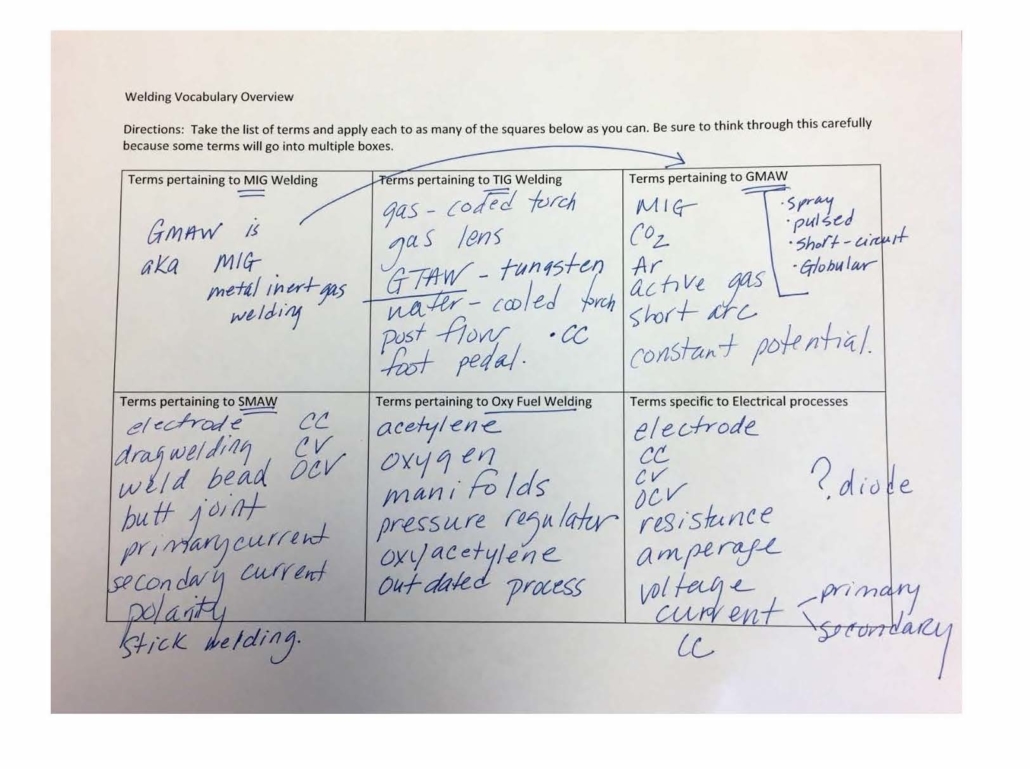
Our final vocabulary lesson provides opportunities for critical thinking and deep follow-up discussion among students. The vocabulary grid challenges students to think through terms and processes where several terms fall into more than one category. Further, after completing the grid, students rationalize and justify their choices — getting to the essence of critical thinking.

Students develop a more complex understanding of vocabulary words by thinking about how they relate to one another. Do this informally by calling attention to connections during class discussion. You can also add specific activities for this purpose. Graphic organizers like the attached vocabulary grid are especially helpful for defining word relationships.

Vocabulary Grid

Gist: Students record vocabulary terms in categories as they read technical text or work in the lab.
When to use: During reading of manuals, software, or other text. Or bring into the lab with clipboards.

How it works

  1. Chunk the text into (X) number of groups and group your students into (X) number of groups. Assign each group a portion of text.
  2. Before reading begins, call students’ attention to the categories on the grid so they know what to look for as they read:
    • Describes software or machinery
    • Indicates an action
    • Describes steps of operation
    • Indicates ways to use software or machinery
    • Predicts a successful ending of use of software or machinery
    • Describes troubleshooting actions
  3. Each student group reads their portion of text, filling in their grid together.
  4. There may be overlap or ambiguity about which category a term fits into. Encourage students to discuss this ambiguity. If they can articulate a reason why the term fits into more than one category, they should write it in both. The key is that they must verbalize their reasoning.

In this example, a welding teacher purposely separated “terms pertaining to MIG welding” and “terms pertaining to GMAW” so that students would notice which terms overlap.

Twist

Assign each group a separate category and instruct them to fill in as many terms as possible for that one box. Then have each group share their results with the class.

Tip

Scaffold for students who need additional support by giving them a copy of the chart that is partially filled in. For students needing the highest level of support, fill in the entire grid and ask them to point out terms as they read them.

See the strategy in action.

Download the vocabulary grid for use in your CTE classes. (Note: This sample was created for use in a welding class but can be customized to suit other fields.)

Sandra Adams is a teacher and instructional coach with the Career Academy, Fort Wayne Community Schools. She co-wrote the ACTE-supported book But I’m NOT a Reading Teacher!: Literacy Strategies for Career and Technical Educators with Gwendolyn Leininger, where further detailed explanations of the strategies in this series can be found. Email her.

REFERENCE
López-Barroso, D., Catani, M., Ripollés, P., Dell’Acqua, F., Rodríguez-Fornells, A., >amp; de Diego-Balaguer, R. (2013). Word learning is mediated by the left arcuate fasciculus. Proceedings of the National Academy of Sciences of the United States of America, 110(32), 13168–13173. https://doi.org/10.1073/pnas.1301696110
# # # # # #