
Napa Educator Externships Expose Teachers & Students to Local Industry

In summer 2019, the California-based nonprofit NapaLearns partnered with the Napa County Office of Education to launch a yearlong, three-phased, work-based learning program called NEXT — Napa Educator Externships. These externships took place over three days and provided participants with comprehensive, on-the-job experiences. Participating teachers received a true picture of the work being performed, the challenges encountered, and the structure of a typical workday in various roles and departments within our local health care, hospitality and wine industries.

In the second phase of the program, they took the information learned and created a proposed unit of study or a project that integrated these industry skills into their existing academic curricula, which they presented to each other and their business hosts. Last, in spring 2020, the teachers will present the finished projects and the results to their business hosts in a showcase event.

What does NEXT mean to our teachers?

Almost 60 K–12 teachers spent their summers immersed in what it takes to run a business: sales, marketing, finance, human resources, manufacturing and much more. They developed employability skills, communicating and collaborating in daily meetings, and technical skills, using Excel spreadsheets and working in a lab.

Hear from Betsy Whitt, an integrated science teacher at Redwood Middle School in Napa:

We received many, many positive comments across the spectrum of K–12 teachers:

“We learned so much and felt we were given access to a world that we would never have been able to navigate otherwise,” said Keenan Hale, a visual arts teacher at New Tech High in Napa, California. “I’m so excited to share my own experience with my students who are interested in professions in this industry — students can be involved with healthcare on so many levels, and there are so many different entry points to find out if it is right for them.”

“It was really cool to see the skills I teach my students in action in the hospitality industry,” noted Kayla Bryant, an elementary school teacher at Napa’s Northwood Elementary. “It helped broaden my perspective on why collaboration and communication are so important by seeing these skills applied in real-world situations during every moment of our visits. It gave me a deeper understanding of the kinds of jobs some of my students may have when they enter the workforce and consequently made me feel more prepared to teach them and get them ready for their future.”

What does NEXT mean to our business partners?

During the externship, teachers got to see a variety of professions in-person and ask their business hosts questions that they had about the roles. By sharing their time and talents with participating teachers, businesses had the opportunity to support students, build relationships with local schools, and invest in their potential future workforce.

However, NEXT meant a lot more than that to the businesses: It was about building community and sharing their passions for what they do with the next generation growing up in Napa Valley.

One of the wine industry participants was Trinchero Family Estates (TFE). TFE is the second largest family-owned winery in the world and the fourth largest winery in the United States. It has a global presence in 50 countries and, according to Wine Business Monthly, it produced 20 million cases of wine in 2018 (Caporoso, 2019). They enthusiastically introduced teachers to their business.

“Trinchero Family Estates was happy to provide the teachers with a nearly end-to-end look at how we develop, make, market and distribute our products. Many of our staff are Napa residents and there is a strong sense of community within our industry,” said Kent Mann, director of operations for Trinchero Family Estates. “What was particularly satisfying was seeing some of our floor level operators, who were former students, come up to the teachers to say hello. The teachers, as well as the TFE folks who were involved, were fully committed to this program, and I believe that it was a very rich experience for all.”

What comes after NEXT?
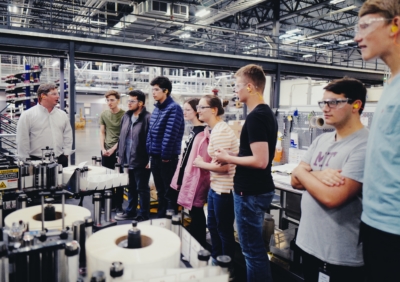
The relationships between the teachers and businesses have been further strengthened by business employees becoming guest speakers in the classrooms and by hosting students for on-site or virtual field trips. For example, Trinchero Family Estates recently hosted 15 CTE computer science students from New Tech High School at their manufacturing facilities to learn about the role of robotics in the production and distribution of their wines.

The net effect of NEXT is to enrich the classroom experience for students through the teachers’ hands-on participation in the working world. According to the U.S. Department of Education, the average student-to-school counselor ratio is 482–1 (Fuschillo, 2018). Because this is such an important role, participating NEXT teachers are becoming “career ambassadors,” exposing students to job options that are available and the skills they need to obtain them.

NEXT provides the opportunity for more teachers to participate in CTE and to teach specific career skills to their students. Many students — and their teachers — are unaware of the rich employment opportunities available in Napa County and nearby regions. NEXT is a way to inspire and prepare our students for a wide variety of high-wage, high-skill and in-demand careers that are going unfilled. By integrating traditional academic teaching with career education, NEXT teachers are building high-quality classroom instruction and enriching their curricula.

Peg Maddocks, Ph.D., is executive director of NapaLearns, where she is responsible for advancing innovative programs to improve the educational outcomes of students in public schools throughout Napa County. While Maddocks has spent most of her career in private sector leadership positions, she began her professional life as a teacher, principal and program director in a K-12 public school district. Maddocks holds a bachelor of science in early childhood education/special education, a master’s degree in school administration from Rhode Island College and a Ph.D. in instructional psychology from Michigan State University.

REFERENCES
Caparoso, R. (2019). A listing of Lodi grown wines produced by non-Lodi wineries. Retrieved from https://www.lodiwine.com/blog/A-listing-of-Lodi-grown-wines-produced-by-non-Lodi-wineries.
Fuschillo, A. (2018). The troubling student-to-counselor ratio that doesn’t add up. Education Week. Retrieved from https://www.edweek.org/ew/articles/2018/08/14/the-troubling-student-to-counselor-ratio-that-doesnt-add.html.

Teaching Strategy: SWOT Analysis

Establishing routines wherein students continually face formative tasks can boost achievement tremendously. The frequent use of formative assessments such as the SWOT analysis technique is recommended when you, the CTE teacher, want to push your students further. SWOT stands for strengths, weaknesses, opportunities and threats. This strategy involves microteaching (.88 effect size), and strategies are designed to integrate new learning with prior knowledge (.93 effect size) (Hattie, 2009).

SWOT analysis strategies are best used to review for performance testing and can also be helpful when attempting to solve a problem. Students examine strengths, weaknesses, opportunities and threats to gain a well-rounded understanding of any idea. Examination complete, they evaluate the given variables before taking the next step in their process.

The Strategy in Action

How it Works

  1. Divide students into groups. Or choose to keep the whole class together.
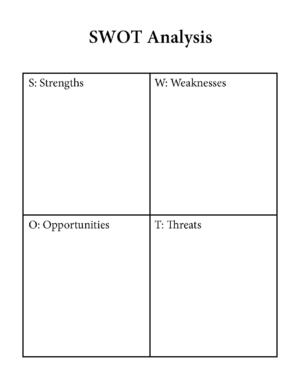
  2. Distribute a blank SWOT diagram each group. Or have students create a large version on the board or on chart paper. (Note: If you use a large diagram on the board, have students write their ideas on sticky notes. These allow you to move ideas between boxes. And as a bonus, they get students out of their seats.)
  3. Present students with a topic, video clip or written scenario. For example, you might show a video of an interaction with a customer.
  4. Say, “As a group, analyze the video through four different lenses: strengths, weaknesses, opportunities and threats. Jot down ideas in each box as you go.” In the customer interaction example given, students would analyze the actions and words of the employee and gauge customer satisfaction. (Note: Don’t feel constrained to the exact terminology on the diagram. For example, if your situation does not include any threats, use the word “tweaks” instead. Leverage the tools available to help students brainstorm possible challenges.)
  5. Lead a group discussion of the positive and negative aspects of the topic. For a customer interaction, challenge students to suggest changes the worker could make.

For an added twist

Have student groups practice performance testing and record themselves on video. Then have groups trade videos and analyze each other’s actions using a SWOT analysis.

Final Thoughts

The SWOT Analysis is one formative tool that provides a lot of flexibility for use. You can use this as a pre-assessment, while reading or delivering content, or as a post-instruction tool. It works to emphasize collaboration, connections and synthesizing information. It also serves as an efficient tool for connecting new information to prior learning. The gist: The SWOT analysis will encourage your students to think critically; implement this strategy in your classroom today.

Sandra Adams is a teacher and instructional coach with the Career Academy, Fort Wayne Community Schools. She co-wrote the ACTE-supported book But I’m NOT a Reading Teacher!: Literacy Strategies for Career and Technical Educators with Gwendolyn Leininger. Email her.

REFERENCE
Hattie, J. (2009). Visible learning: A synthesis of over 800 meta-analyses relating to achievement. London: Routledge.

Techniques Returns with A VISION of High-quality CTE

It’s here! It’s here! It’s the happiest time of the year! A new school year brings a fresh start, new pens and crisp paper — and Techniques! For 2019–2020 Techniques returns with A VISION of High-quality CTE. As the premier event for career and technical education (CTE) professionals nationwide, ACTE’s CareerTech VISION 2019 is the place to ask, “What is high-quality CTE?” In Techniques in September, discover new best practices as they relate to the 12 elements of ACTE’s Quality CTE Program of Study Framework.

What is high-quality CTE?

A few years ago, ACTE embarked on an initiative to bring clarity to the conversation and to help CTE educators and administrators develop and improve the quality of their programs. Resulting from this initiative was our evidence-based framework defining high-quality CTE across 12 elements:

  • Standards-aligned and Integrated Curriculum
  • Sequencing and Articulation
  • Student Assessment
  • Prepared and Effective Program Staff
  • Engaging Instruction
  • Access and Equity
  • Facilities, Equipment, Technology and Materials
  • Business and Community Partnerships
  • Student Career Development
  • Career and Technical Student Organizations
  • Work-based Learning
  • Data and Program Improvement

For the second year in a row, educational program sessions at ACTE’s CareerTech VISION 2019 will be tagged to match these elements. Attendees can identify sessions that address issues about which they want to learn more, in order to improve their programs. And now you can get a head start. This issue of Techniques offers a sneak preview of what to expect at VISION and what the elements look like in action!

One featured article highlights cybersecurity programs and touches on a number of high-quality CTE elements. “Teaching Cybersecurity Through Virtual Labs and Hands-on Experience” (on pp. 28–33) meets criteria under Facilities, Equipment, Technology and Materials; Engaging Instruction, Student Assessment; and Business and Community Partnerships.

Another, Shannon Sheldon’s article on “Supporting the Gender Expansive Student” (on pp. 35–39), addresses the Access and Equity element of the Framework and demonstrates the ways in which traditional language, classroom procedures and social norms work against inclusion — while offering suggestions to help readers develop improvements to lessons and language.

And further, Peggy and Steven Bridges are “Class Disruptors” (on pp. 40–43), offering insight and inspiration as they encourage teachers to shake up their classroom management with the art of disruption — related to the Engaging Instruction Framework element.

These articles provide a brief glimpse into the wide range of high-quality CTE programs around the country, and we hope they provide you some insights that will help you improve the quality of your programs too!

ACTE members can read Techniques‘ September 2019 “A VISION of High-quality CTE” issue online now.

Teaching Strategy: Got 30 Seconds? Talk About It.

Career and technical education (CTE) students are asked to learn hundreds of new concepts and technical terms every year. How can CTE teachers know when their students have processed the learning correctly? How can we catch thinking errors when they occur? The answer is simple: Frequently check for understanding; challenge students with a formative assessment. Traditionally this comes in the form of Q>amp;A sessions.

However, with a strong push for higher levels of student engagement, teachers are being asked to develop bigger tool boxes of formative strategies — tools that allow teachers to engage all students accurately and creatively. When John Hattie (2008) released his meta-analysis on the factors that impact student achievement, he used a standard effect size scale. In his work, Visible Learning, Hattie demonstrated that frequent formative assessments may be among the best instructional practices that teachers can use to impact student achievement.

For this reason, it is beneficial for teachers to have an arsenal of effective formative assessments at their disposal. Many go-to practices include traditional Q>amp;A, exit/entrance cards, quizzes and free-writes. I would like to suggest adding the 30-second-talk-about to these more traditional approaches — as it creates equitable productive talk for all students.

The objectives are simple.

We want to gauge how much understanding students have gained and if something has been learned incorrectly. The sooner a thinking error can be identified, the better student achievement will be. Formative checks for understanding also give students an opportunity to focus on the essential information, separating the key concepts from the details surrounding it.

As an instructional coach, I like to provide teachers, whose classes I observe, with an objective snapshot of student participation. I do not make any subjective statements. I simply diagram the room, placing an X on each student place. A tally mark is given each time a student answers a teacher’s question. I use a Q to note if the students ask questions in return. At the end of an average 45-minute lecture with Q>amp;A, only about 1/3 of students will have tally marks. It is painful to see how many students don’t have tally marks, especially if we factor in the likelihood that these patterns persist throughout the school year.

Where is the equity in this? We owe to students to give 100 percent of students a voice, 100 percent of the time, when we wish to check for understanding.

How can we do this? One very effective place to start is the 30-second talk-about. Students cannot opt out and, when they discover how fun the exercise can be, they don’t want to opt out. This teaching strategy works well because it simultaneously activates all three domains: cognitive, physical, and affective. Full of smiles and laughter, students greatly appreciate the movement and fast pace. Teachers weave in and out of students as they talk — taking mental notes of who is struggling.

The Strategy in Action

How long will it take?

The session can be as quick as five minutes or as lengthy as 20 minutes — depending on how much you elaborate on student paraphrasing.

What’s the gist?

Students take turns talking productively with a peer about a term for 30 seconds.

How It Works

  1. Pair students into groups of two.
  2. Randomly assign one student in each group the role of “talker” and the other the role of “listener.”
  3. Say, “Talkers, your task is to keep talking about the topic I assign for 30 seconds without stopping. Listeners — don’t get too excited — you are not just listening. You’re active listening, which means that you nod and smile for affirmation. Then, once the time is up, you also are the paraphraser, telling the rest of us what they said.”
  4. Start the time. Walk throughout the class, listening and assessing your students’ understanding of the concept or process. Encourage talkers to back up their words with evidence they remember from reading. Remember, you can’t have a successful talk-about unless you walk about!
  5. After the timer goes off, call on various listeners, asking them to share something their partner talked about.
  6. Switch! Listeners become talkers, and talkers listen, on a new challenging prompt.

This is a formative approach that is difficult to top. The 30-second talk about is an activity that builds a risk-taking, growth mindset type classroom culture. Some students don’t raise their hands during Q>amp;A for fear that they may have the wrong answer, and be embarrassed. However, with the 30-second-talk-about strategy, there is safety in only having to speak to one fellow student. For the listener, safety comes from paraphrasing what they have heard. If the paraphrased comments need correcting, teachers can address both students together with probing questions, which should help to build student efficacy.

I often say to teachers, “You can’t do a talk-about unless you also do a walk-about.” This brief rhyme reminds teachers to weave through the student teams as they talk. Teachers are often surprised at just how much data they can collect in a couple 30-second time periods. Teachers collect several comments and elaborate to connect student’s different ideas. Give it a try; even the most reserved students will not feel intimidated to participate.

Sandra Adams is a teacher and instructional coach with the Career Academy, Fort Wayne Community Schools. She co-wrote the ACTE-supported book But I’m NOT a Reading Teacher!: Literacy Strategies for Career and Technical Educators with Gwendolyn Leininger. Contact her to learn how you can implement theses certification test prep and other innovative teaching strategies in your CTE classroom.

REFERENCE
Hattie, J. (2008). Visible learning for teachers. Abingdon, UK: Routledge.

Teaching Strategy: Start Strong! Captivate Students on Day One

Imagine you are a high school junior the morning of your first day at your new career tech center. Maybe you’ve enrolled in a half-day automotive, culinary, computer programming or health careers program. What do you envision? How do you hope the day will go? Do you hope to learn differently than you did in your traditional high school?

If you’re like many students, the answer is a resounding “YES!” You anticipate getting your hands on tools, moving among peers in a lab, and listening to an instructor’s experiences from the field. You are ready to have a new instructor who will fuel your excitement to begin a career and technical education (CTE) experience.

However, a basic principle of psychology could disrupt your plans. All human beings assess and understand new people and new situations by fitting them into mental schemas — existing frameworks created by past experiences with similar people and situations. And the schemas in our brains play a role in releasing dopamine. Novelty brings a dopamine reward to the brain.

Imagine you’re that student, walking into your new classroom, excited for a change, only to discover it fits your existing schema for traditional classroom learning. Your brain misses out on dopamine, and your anticipation quickly dissipates. It’s your first day in what you expected to be a brand new kind of school, yet already there is more of the same.

A First Day Re-imagined

Our staff decided last year that we would all design a day one that would not disappoint these energized students.

No classroom had columns and rows. No students were immediately given rules and procedures. What they were given was a challenge! Not all teachers gave the same challenge — but they all led some cooperative and competitive challenge that demonstrated a new type of expectations. The intended message to students was, they would be asked to process together, to make decisions, practice leadership, and frequently provide feedback to one another.

A student walked into a computer repair classroom to begin her IT pathway. The classroom featured tables in a U shape in the center of the room. Across each of the tables was an organized computer repair station with broken computers and numerous parts spread about. The student and her classmates were greeted by the teacher and were told to have a seat at any station with a partner. They were presented with a simple assignment: “Using any resources at your disposal and one student partner, reassemble the computer in under 40 minutes. Go!”

On the other side of campus, construction students walked in to find piles of newspapers and duct tape. Their task was to build the tallest freestanding tower in 30 minutes, using nothing but those two supplies.

In the cosmetology and culinary classes, however, the excitement rose to a whole new level. Students in these classrooms found stations of stacked solo cups with a strange looking tool attached. The tool was made of a standard rubber band with four, two-feet long pieces of yarn attached. The challenge here was to build a tower where six cups made the base, followed by a row of five, four, three, two and one on top. The catch was that they could ONLY touch the yarn.

The Strategy in Action: Build a cup tower!

How it Works

  1. Set out a stack of 21 plastic cups on each table designed to fit four students. A rubber band should be secured to the bottom of the top cup. Attach four, two-feet lengths of yarn to the rubber band spaced equally apart.
  2. Clear the table of anything except the cups.
  3. Explain to the teams that the objective is to build a tower where the base is six cups long, and continue to build until they place one cup at the top of the tower. Students are not to touch anything but the yarn. Even if the cups fall to the floor — which can easily happen! The objective is of course to be the first team to complete their tower successfully.
  4. Let the games begin! Facilitate the room, making your observations and enjoy learning about your new students and how they interact with one another.

Final Thoughts

This “start strong” approach stretches students’ imaginations and expectations. It brings the lab’s free movement, shared processing, student agency and relevance right into the classroom and helps students practice the kinds of collaborative skills they’ll be honing all year. The challenge involves critical thinking, adaptability, innovation, even literacy, all without seeming like “school work.”

The real beauty to this is also what it affords teachers. Within the very first hour of the new school year, teachers can observe students in a charged environment. They can quickly assess who are the natural leaders, who are the loquacious kids, who are quiet, who frustrates easily, and who loves a good challenge. Teachers can move right into conversations about learning in a CTE environment versus traditional schools. Teachers can also segue right into their expectations for collaborating, critical thinking, oral communication, and learning to adapt to new situations.

Sandra Adams is a teacher and instructional coach with the Career Academy, Fort Wayne Community Schools. She co-wrote the ACTE-supported book But I’m NOT a Reading Teacher!: Literacy Strategies for Career and Technical Educators with Gwendolyn Leininger. Contact her to learn how you can implement theses certification test prep and other innovative teaching strategies in your CTE classroom.

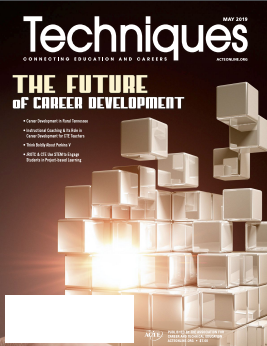
EXCERPT: Instructional Coaching & Its Role in Career Development for CTE Teachers

What is an instructional coach?

Quality teacher professional development is essential to the outcome of student achievement. In their careers, teachers must be challenged with new ideas in order to foster a classroom culture of student engagement. The instructional coach is an embedded professional development practitioner who helps teachers attain these lofty educational outcomes (Blackman, 2010).

Instructional coaches share the responsibility of teacher leadership with administrators in the district. Typically, however, coaches are not teacher supervisors and serve a non-evaluative function (Hanover Research, 2015). Coaches employ their pedagogical expertise and the relationships built with teachers to influence change.

CTE and Instructional Coaching

Career and technical education teachers face unique challenges in the secondary educational setting, where many arrive from industry following a change in careeer. Though they may be experts in their subject matter, they often have minimal training in pedagogy (Foster, Hornberger, >amp; Watkins, 2017). New CTE teachers benefit from mentorship and coaching.

New CTE teachers must learn how to instruct in both classroom and lab environments. Training in classroom safety protocols is a priority. They must learn how to implement classroom management and best practices for engaging students. New CTE teachers also will benefit from understanding, more generally, the field of education. They need to be informed about work expectations, academic achievement, special populations and school policy.

In a large school district, as CTE administrators are busy with the day-to-day business of running the department, important communications with teachers can be lost. Instructional coaches provide mentorship to teachers and they also listen to the teachers’ aspirations and concerns. As a result, through listening, the CTE instructional coach can counsel the teacher on their goals.

Monica Amyett is a CTE instructional coach with Fort Worth Independent School District. Email her.

ACTE members can read the full article, “Instructional Coaching >amp; Its Role in Career Development for CTE Teachers,” in the May issue of Techniques. Not a member? Join! ACTE is the largest national education association dedicated to the advancement of education that prepares youth and adults for successful careers.

REFERENCES
Blackman, A. (2010). Coaching as a leadership development tool for teachers. Professional Development in Education (36)3, 421–441.
Foster, J., Hornberger, C., >amp; Watkins, D. (2017). CTE administrative leadership: 10 things to know in your first year. Alexandria, VA: Association for Career and Technical Education.
Hanover Research. (2015). Best practices in instructional coaching. Arlington, VA: Hanover Research.

Teaching Strategy: Build Vocabulary with Jenga

In a given school year, CTE students are challenged to learn more than 200 technical terms. Learning these terms, however, is only the beginning.

The art of teaching vocabulary lies in engaging students in conversations around technical vocabulary terms without them even realizing it. If you announce, “We are going to work on vocabulary terms for the next 30 minutes,” you will hear students sigh. It’s not their favorite activity. Knowing this, teachers can design engaging activities and games.

Gen Z learners prefer lessons that are experiential, participatory, image-rich and connected (EPIC). We know that most students want to learn; most want to perform well on tests. However, that does not mean you can create enthusiasm toward practicing and learning simply by stating it. CTE teachers must foster environments in which students want to say the terms, and willingly work with peers to build connections.

Why Tapping the Affective Domain is Important

Think back to some of your own high school learning. What are the first images to come to mind? I would guess these memories involved sensory learning or positive emotions, which trigger the release of dopamine. It is this dopamine surge that creates, in us, a desire to continue. It serves as our motivation.

As students engage in a round of Jenga, you will hear laughter. People are smiling and enjoying the challenge to recall the terms.

Explained below are two different versions of our game. I would highly encourage you to be creative and let students modify as they play new rounds.

The Strategy in Action

How long will it take?

20–30 minutes, depending upon how long you want students to play

What’s the gist?

This is best used as a review tool. It is an excellent tool for refreshing older terms students may not have used in a few months — tapping their neural pathways of memory.

How It Works

Object of the game: Winner is the player with the most points when the tower tumbles.

Version 1

Our focus is on making connections with the term in context.

  1. Someone volunteers to be the scorekeeper.
  2. Youngest player starts the game by removing a peg. Player reads the terms (two per) and then gives a scenario with one or both of the terms used.
  3. The other players at the table acknowledge if it is correct or not.
  4. If the player is correct, a point is given. If the player is not correct, the player to their left can score by explaining the term.
  5. The game repeats until the tower falls.

Version 2

Our focus is on asking questions.

  1. Someone volunteers to be the scorekeeper.
  2. Youngest player starts the game by removing a peg. Player reads the term (two per) and then creates a question to ask the player to their left.
  3. If the player answers the question correctly, a point is given. If the player is not correct, the player to their left can score by explaining the term.
  4. The game repeats until the tower falls.

Final Thoughts

Frequent use of formative assessments is the best way to gauge where students have gaps in their knowledge and understanding. However, with 20 or more students in a class, this can become challenging. By using games like Jenga with students, teachers become facilitators. Listen closely to a couple rounds of Jenga play and you will develop a good grip on where knowledge gaps lie. It is a win-win in the classroom, when learning and practice meet laughter and engagement.

Sandra Adams is a teacher and instructional coach with the Career Academy, Fort Wayne Community Schools. She co-wrote the ACTE-supported book But I’m NOT a Reading Teacher!: Literacy Strategies for Career and Technical Educators with Gwendolyn Leininger. Contact her to learn how you can implement theses certification test prep and other innovative teaching strategies in your CTE classroom.

Teaching Strategies: Certification Test Prep

For career and technical education (CTE) teachers, spring brings with it a focus on certification test preparation. This can be a daunting task. Consider how a teacher might approach supporting student review sessions. You might hear a teacher announce, “You have 45 minutes to study today. Use this time now to review your notes quietly.”

Is it effective? On the surface, it seems to be a good use of time. Students need to perform well. Time is needed for review. However… Students’ attention spans begin to slip around the 15 minute mark (Medina, 2014). Rather than becoming frustrated when students struggle with quiet review, get creative.

Here is an approach you can take: Structure meaningful test prep lessons in which students talk through questions and concepts and, as a result, engage in deeper thinking. Use the following strategies together to help students identify their knowledge gaps.

Socratic Circle

In a traditional Socratic circle, students are seated in a circle without the teacher. They are challenged with open-ended questions or hypothetical scenarios, and instructed to discuss. This exercise helps students to talk through scenarios and situations — to explore possibilities and think deeply — without constant acknowledgement from a teacher.

Early childhood education students were given the following instructions, “We have studied eight leading theorists this year. Discuss each person’s contribution to understanding and rank them by importance to preschool development.”

Students then learn to collaborate and struggle through awkward moments. According to Tony Wagner (2015), agility and adaptability are as important as collaboration and critical thinking for success in 21st century workplace. Engaging in conversation that is challenging, open for exploration but also outcome-based, will push students to construct deeper meaning for themselves.

Forced Agreement

When you want students to arrive at one correct answer, use the forced agreement strategy alongside your Socratic circle. Design this session to follow a think-pair-share lesson. Students are accountable to think on their own, and then they must “pair” together, with forced agreement, to “share” a single correct answer. With the full class group, expand on and discuss those areas where students disagreed.

Because our session was deliberately designed as test prep, students were given three difficult questions to answer. Students were instructed to answer individually and then deliberate together. When the table agreed to one response, and had a strong defense for that response, they signaled the instructor with a thumb in the air.

While each table of students collaborated, the instructor facilitated. More importantly, the instructor listened and checked for understanding, identifying which students grappled with difficult concepts.

The Strategy in Action

https://youtu.be/skJbGwU55aA

How long will it take?

20–30 minutes, depending on the number of students present

What’s the gist?

When your goal is to prime students for deeper retention of key concepts and theories, arrange students in a circle. Students engage in discussion about the question or scenario given. Students use constructive criticism to make judgments and come to sensible conclusions together. The teacher serves as only a facilitator. The goal is for the teacher to never intervene in the dialogue.

Add the forced agreement piece when you are moving toward a specific desired answer. This is a great tool to engage students in modeling and reflection.

Structuring Success for Your Students

Educators must be cognizant of how many students struggle with study and test prep skills. Given that certification testing covers a vast array of standards, terms, concepts and processes, structuring powerful study sessions is crucial.

By doing so, teachers avoid the habituation of routine studying and help students deepen their own understanding by engaging in continual productive talk themselves. Further, by focusing on strategies that are metacognitive in nature, students can identify the areas in which they are still weak.

Sandra Adams is a teacher and instructional coach with the Career Academy, Fort Wayne Community Schools. She co-wrote the ACTE-supported book But I’m NOT a Reading Teacher!: Literacy Strategies for Career and Technical Educators with Gwendolyn Leininger. Contact her to learn how you can implement theses certification test prep and other innovative teaching strategies in your CTE classroom.

REFERENCES
Medina, J. (2014). Brain rules: 12 principles for surviving and thriving at work, home and school (2nd ed.). Seattle, WA: Pear Press
Wagner, T. (2008). The global achievement gap: Why even our best schools don’t teach the new survival skills our children need — and what we can do about it. New York, NY: Basic Books.

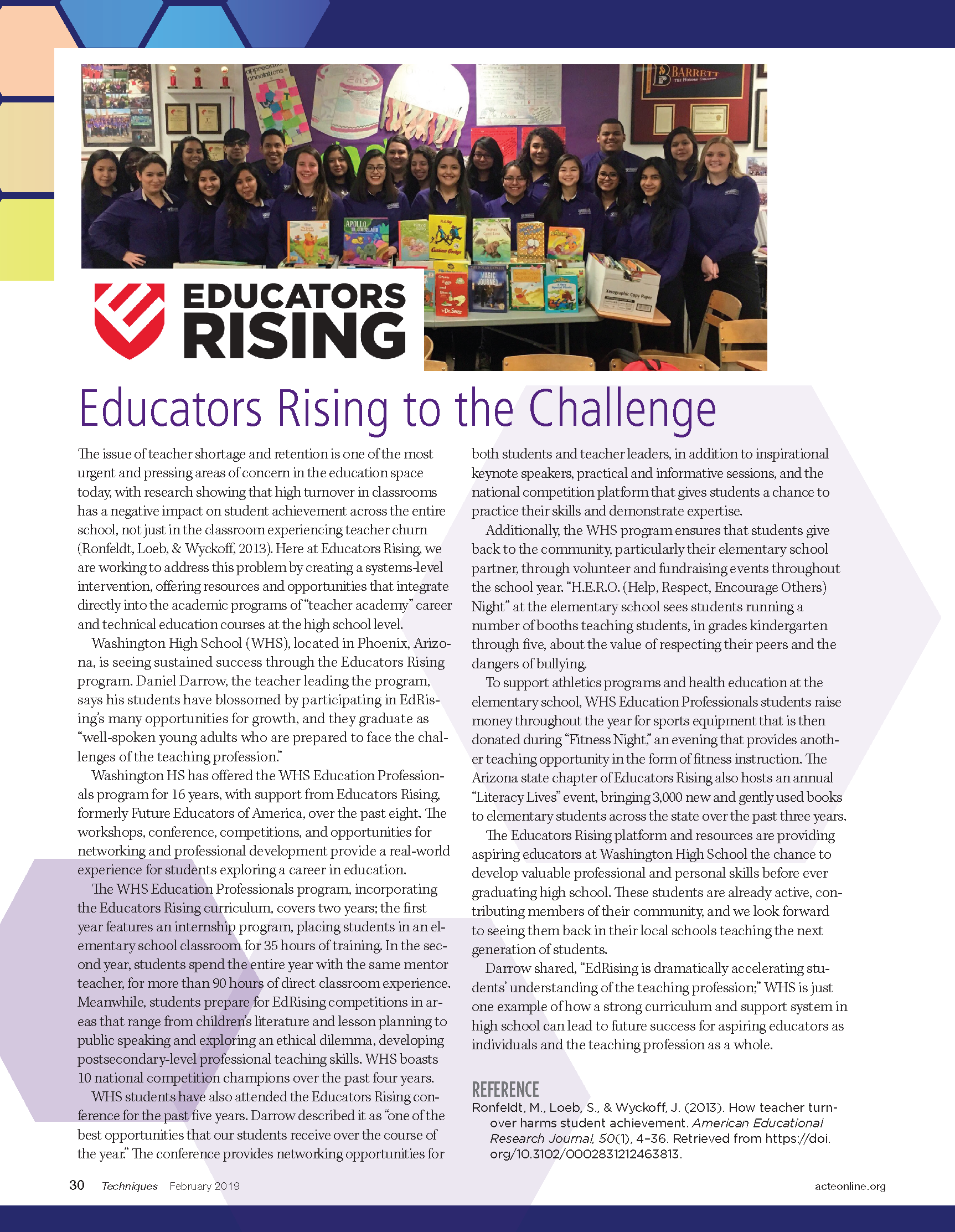
CTSOs Engage Students: Educators Rising to the Challenge

The issue of teacher shortage and retention is an urgent concern today. Research shows that high classroom turnover has a negative impact on student achievement. Educators Rising works to address this problem by offering resources that integrate with CTE at the high school level.

Washington High School, in Phoenix, Arizona, is seeing sustained success through Educators Rising. Daniel Darrow, the teacher leading the program, says his students have blossomed. They graduate as “well-spoken young adults prepared to face the challenges of the teaching profession.” WHS has offered the WHS Education Professionals for 16 years with support from Educators Rising, formerly Future Educators of America, over the past eight. Workshops, competitions and other professional development events provide real-world experience for students exploring careers in education. READ MORE

Educators Rising

Educators Rising to the Challenge: Read Techniques February 2019 issue, page 30, to learn more.

To learn more about how CTSOs engage students in CTE, ACTE members can read the February 2019 issue of Techniques online today.

Teaching Strategy: Peer Video Critique

“I wish students would give each other valuable feedback about what they are learning.”

If that sounds familiar, you might want to try this strategy.

The gap in reading skill levels is an issue nearly every CTE teacher faces. Walk into any given classroom, in any given program area, and it is likely you will find students whose ability levels vary between the seventh and 12th grade. CTE teachers must structure learning so that all students can learn equally, despite these differences. Fortunately, technical vocabulary presents a viable solution. When low-level readers and struggling learners focus on building expertise with technical vocabulary, they are able to close achievement gaps and pass certification exams.

The Catch

There’s a catch, and one in complete sync with the popular learning retention theory. Technical vocabulary terms are likely to be forgotten when the information is received via auditory and passive means (A. Raymond, personal communication, Oct. 4, 2012). In contrast, when students are actively saying the terms in context repeatedly, they are deepening the neural connections and vastly increasing the chances that the terms will be retained.

A solution: Leverage peer feedback >amp; embrace technology.

The Peer Video Critique strategy is leveraged to foster peer feedback between students while embracing their love of technology. When students create short video segments and critique them with a “critical friend,” they learn the art of descriptive and directive feedback. In most learning situations, students are given evaluative and corrective feedback. Both methods are end result-oriented. In contrast, however, descriptive and directive feedback teach students to be actionable. They learn to ask questions and discover the worker’s thought process rather than focusing on the work produced (William, 2011).

The Strategy in Action

https://www.youtube.com/watch?v=179A98fgSd0>amp;t=5s

How long will it take?

20–40 minutes, depending on the number of students and how many practice video sessions students need before mastering.

When should I use the Peer Video Critique teaching strategy?

  • During a unit of study, to reinforce technical vocabulary usage
  • When you need students to demonstrate a deeper understanding of processes and how concepts relate to one another

As demonstrated in the video above, the Peer Video Critique strategy provides an excellent platform for students to think critically. Encourage them to use if-then statements as they describe a process.

What’s the gist?

It’s an active learning strategy that allows Gen Z students to collaborate via video on iPads and/or iPhones.

How It Works

  1. Partner students and provide a device for each group.
  2. Provide students with simple written directions.
  3. Allow teams space in the lab to practice the process and revisit their notes as needed until they feel comfortable to begin recording. Some students will go through several practice rounds, and that’s okay! This allows the teacher to pause and work directly with struggling students to clarify misunderstandings.
  4. With two videos created per team, one per person, encourage them to watch, compare against the directions and critique each other. As students finish at different times, you can have completed teams work to provide feedback to other teams. In some cases, students will want to view one another’s videos — which can be a great way to facilitate class discussions.
  5. Once students each have developed a strong critique, videos are submitted to the teacher via email or uploading to a private classroom YouTube channel.

Example: Peer — Video Observations

Task: You will be working with a partner to explain the four furnace operations that we have learned. Each person will create one BEST video explanation with performance. Here is your list of objectives:

  1. You need to sound like a professional plumber/HVAC installer — not a DIYer.
  2. Name the four key parts of the furnace as you run through the process.
  3. Explain how each of the parts operates.
  4. When you talk about the process, use at least two if-then statements.
  5. Discuss why the order of operations is important.
  6. Follow and discuss PPE and safety practices.

Choose who goes first. Practice, and then create your video. Watch the video together to check-off the six points above. Redo the video until it is perfect. Switch roles… Repeat.

Final Thoughts

A few days following the activity shown, students were assessed on the content with an exit slip. Raymond (2012) would not be surprised to find that students had retained the information quite well. All students scored above 75 percent on this particular assessment. By incorporating video and descriptive feedback, the teacher was able to create a sense of urgency often missing in the classroom. The teacher created a learning environment where students engaged in both active learning and metacognition. As they perfected their videos, they reflected on what they did and did not know. The power of this lesson lies in the reflective, focused and shared thinking.

Sandra Adams is a teacher and instructional coach with the Career Academy, Fort Wayne Community Schools. She co-wrote the ACTE-supported book But I’m NOT a Reading Teacher!: Literacy Strategies for Career and Technical Educators with Gwendolyn Leininger. Contact her to learn how you can implement the Peer Video Critique and other innovative teaching strategies in your CTE classroom.

REFERENCES
William, D. (2011). Embedded formative assessment. Bloomington, IN: Solution Tree Press.
# # # # # #