Member Connected News: Washington High School Students Compete at DECA International Career Development Conference

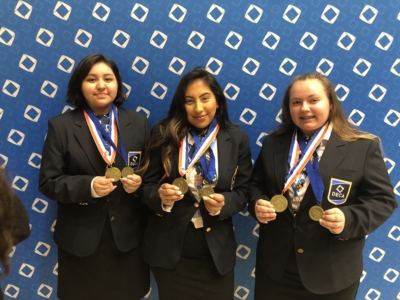
In April 2019, DECA students from Lakewood, Washington’s Clover Park High School competed at the DECA International Career Development Conference in Orlando, Florida. In recognition of their hard work and determination, Kitti Wheeler, ACTE member and Clover Park marketing teacher, wrote:

“We are a new DECA Chapter and we had just opened our student store the year before. This was the first opportunity for us to compete in the school-based enterprise event. As a new adviser, I didn’t know how to prepare my students to compete at this level. Not to mention, my students had numerous extenuating circumstances — including personal illness and a parent’s terminal cancer diagnosis. These events caused two of my three team members to miss a lot of school and presented significant barriers, making it more challenging to work together and compete.

“I requested an extension and, to my surprise, we were granted one extra day. When I received word that we qualified to compete, I was in disbelief. Actually, I’m still amazed because we placed in the top 10! Proud doesn’t describe how it felt to watch my students receive award medallions on stage in front of 20,000 people. As a result our student store earned Gold Certification.

“This is truly a Cinderella story. Every time I think about our accomplishment, I get goose bumps.”

When asked about what motivated their success, the Clover Park High School students responded, “Teamwork and [Ms. Wheeler’s] belief in us.”

Wheeler, who was recently named the WA ACTE Teacher of the Year, concluded, “I learned a huge lesson to never underestimate what my students can achieve.”

Do you have news?

Member Connected News (MCN) is a new regular column on PAGES, a Techniques blog. Here is where we highlight the buzz about career and technical education. If you have something (program news, event news, award news or a note of appreciation) to share, we want to hear about it. Fill out the form and you might be featured next.

The Eighth Habit by Stephen R. Covey

I recall back in 1990’s reading The 7 Habits of Highly Effective People (1989) and consecutively completing a Franklin Covey Planning workshop. I had felt that I was “Covey Ready” to begin my journey into educational leadership. Stephen Covey taught us to be more effective in accomplishing our goals by aligning ourselves to the principles of “true north”. Covey described “Ture North” as a moral and ethical compass that is timeless and foundational to a leader’s character. With book and planner in hand and my brain busting with new information, I felt that I was well-prepared.

I am a regular podcast-“er” which is sometimes good and sometimes not-so-good. By that I mean that sometimes I get tired of pouring “knowledge” in and take the occasional daily break with “junk food” for the brain. This typically equivalates to the occasional stand-up comedy or pop-culture podcast.

I did take the time to listen to Stephen Covey podcast and other recommended leadership audio tutorials. When The 7 Habits for Highly Effective Teens (Sean Covey, 1998) came out on the local bookshelves I purchased a class set for the entrepreneurship program I taught.

As you can tell I was a true advocate for the teachings of Stephen Covey.

When our Fellowship Group was given the charge of choosing a book about leadership I had originally chosen “The Life Code” by Dr. Phil McGraw. I appreciated this reading but felt I needed to find something that better aligned to my own journey into leadership. That is when I decided to do some googling which lead me back to over a dozen selections from Stephen R. Covey. After browsing through the various titles and summaries I landed on The 8th Habit From Effectiveness and Greatness (2001).

Covey describes the 8th Habit as:

“…the most important vision of all is to develop a sense of self, a sense of your own destiny, a sense of your unique mission and role in life, a sense of purpose and meaning”.

In alignment with this is one of my favorite Dr. Phil McGraw’s quotes:

“If you don’t know who you are and someone comes to tell you who you are, there’s nothing for them to compete with.”

It’s about knowing “self”. Knowing your mission, role, and a sense of destiny. The 8th Habit is defining what that sense of self is. It’s also about defining your purpose and your meaning. Covey suggests that it takes profound personal reflection and asking deep questions to yourself.

In Chapter 5 Covey provides a visual interpretation on this 8th element with a segmented circle with passion, vision and discipline circling the inside of portion of the word “Conscience”.

In regard to the conscience Covey quotes Gandhi’s teachings about what will destroy us:

  • Wealth without work
  • Pleasure without conscience
  • Knowledge without character
  • Commerce without morality
  • Science without humanity
  • Worship without sacrifice
  • Politics without principle

These points are reflective of gifts that are falsely gained.

However, “…When people strive to live by their conscience, it produces integrity and peace of mind”, author J.H. Boetcker.

Covey explains what he calls “The 4 Roles’ model. In a five-year study called the “Evergreen Project” more than 200 well-established management practices as they were employed by over 160 companies over a 10 year period. They concluded that companies that outperformed their industry peers excelled at four primary management practices:

  1. Strategy -Devise and maintain a clearly stated, focused strategy.
  2. Execution – Develop and maintain flawless operation execution.
  3. Culture – Develop and maintain a performance-oriented culture.
  4. Structure – Build and maintain a fast, flexible, flat organization.

In summary the 8th Habit is finding your voice and inspiring others to find theirs.

If I had to define my own voice, I would use the 4 components with each being titled the same as Covey’s.

  1. Passion – my passion is to enrich the lives of others by providing information and guidance that can help direct their futures. To assist companies in workforce development strategies that can build communities, increase local pools of talent and therefore provide workers with an increased sense of being valued.
  2. Vision – my vision is to develop industry tools that can assist educators and businesses to begin moving at a more aligned “speed” as well as being able to utilize a common language. I also believe that understanding one another’s barriers and opportunities will bring these two entities together and authentically understanding all needs of all stakeholders. My vision is also to develop a communication tool that can reach families and students to channel authentic and unbiased information to them that they can base their decision making on.
  3. Discipline – the way that I demonstrate discipline in my life is both professional and personal. Personally, I see to it everyday that I have these daily habits:
    1. I drink a bottle of water every morning when I first get up.
    2. I do some form of a workout everyday for a minimum of 30 minutes.
    3. I eat a salad every day.
    4. I drink 4 bottles of water (min.) every day.
    5. I avoid sugar, red meat and pork.
    6. I speak with my son every day.
    7. I list 3 things I am grateful for every day.
    8. Point out the positive in others.
    9. Reach out to one friend a day to let them know I am here for them.
    10. Have a personal conversation with our creator.

Professionally I see to it everyday that I have these daily habits:

  1. Respond to all emails and phone calls within a 24-hour period.
  2. Acknowledge a co-worker/colleague for a job well done.

Professionally I am working to become more disciplined:

  1. Read one professional development book a month.
  2. Focus on one professional and one personal topic each month.
  3. Decrease social media time.
  4. Conscious – the heart of it all. I feel that the most important act that I can submerge myself in is to role model for others that are around me. Integrity and self-value come through the peace of mind that is attained through a “clean” conscious.

As my own personal role model Dr. Phil McGraw says:

“…Those who have nothing to hide, hide nothing.”

I am not certain that I am an authentic model of this theory, but I do feel that my morals, values and ethics do drive my decision making and hope that it will have an even bigger impact in my future as a professional leader.

Mid-Life Career Change- Career Tech Is The Answer

I cannot imagine what it would be like to have one profession my adult life and in the blink of an eye have to change my life course at the age of 43.  All of the uncertainty and worry about being able to provide for my family would be almost enough to consume a person.

This is exactly what happened with one of our post-secondary students, Brian Thomas.  Brian was a Market Manager/Butcher for 27 years before being hurt on the job. When listening to him, you can tell he enjoyed his craft and the amount of pride in how good he was at it.  It was his life.  It was the only skill he had to provide a livable wage to support his family.  Unfortunately, Brian’s workplace accident fractured several vertebrae.  The doctors were not able perform surgery on 2 of the vertebrae for fear of leaving him paralyzed.  This left him with a 20lb weight restriction meaning he could not work in any manual labor job.

Brain had to start from scratch in his professional life.  Having 3 children and a mortgage, Brian knew he had to work but was lost in what direction he should take.  He did some research and found the CADD program at Francis Tuttle Technology Center. I spoke with Brian several times throughout the enrollment process.  It was apparent that he was nervous and anxious to start the CADD program.

The first week after he started classes we touched base and he was enjoying the program, but was still apprehensive. The next week he came to me and said he thought that he had made a mistake.  He said that he was having trouble but was not a quitter so he was going to see it through.  The third week of Brian being enrolled I attended a CADD Advisory Board meeting.  The instructor shared information with the group about a project his students were working on.  He even showed one outstanding student’s project.  I immediately knew who the creator was because of conversations that Brain and I had about his hobbies.  I was proud that he had fought through his doubts and had given the program his all!  That afternoon I went to the CADD program to tell Brian “I told you so.”  Walking through the door of the classroom Brain looked at me and immediately came to me saying he needed to talk to me.  He ushered me to a table in the corner and said, “I cannot do this program.”  I was completely baffled!  He was having an anxiety attack and almost in tears.  He was talking about how he was never going to be able to keep up and he had definitely made a mistake enrolling into CADD.  I told him I was in a little bit of shock because I had just been at a meeting where his instructor used his project over students that had been enrolled in the program for a much longer time.  I shared some of the complements that the group was saying.  I then asked, “Your teacher thinks you’re doing fabulous, why do you not think you are?”  It turns out Brian had never used a computer except for the ten key to order products at his old profession.  Not only was he training for a new profession with the weight of the world on his shoulders but he was training on a device that he was unfamiliar with.   Brian was not comfortable telling his instructor that he needed him to slow down, that the simple instructions that were being given were not simple at all because he had never used that terminology before, or to ask him to show steps again.  He was bottling up the worry and frustration, working hard to try to keep up and it had got to him.  The weight of the mortgage, groceries, and family on his mind set him into panic mode.

Brian and I talked to the instructor who had no idea that he never used a computer before and the instructor was more than happy to slow down and repeat instructions.  Now, Brian is ahead in his course work.  He also has an air of confidence that was not apparent to me earlier in the school year.  As a matter of fact, Brian has become someone that other students turn to for advice.  He came to me just the other day and said, “you need to go talk to a student, they are feeling frustrated.”

Teaching Strategy: SWOT Analysis

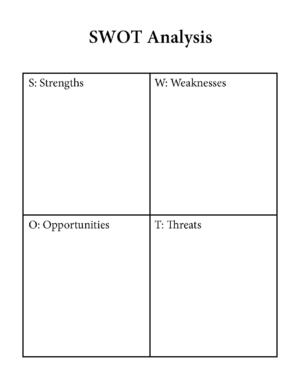
Establishing routines wherein students continually face formative tasks can boost achievement tremendously. The frequent use of formative assessments such as the SWOT analysis technique is recommended when you, the CTE teacher, want to push your students further. SWOT stands for strengths, weaknesses, opportunities and threats. This strategy involves microteaching (.88 effect size), and strategies are designed to integrate new learning with prior knowledge (.93 effect size) (Hattie, 2009).

SWOT analysis strategies are best used to review for performance testing and can also be helpful when attempting to solve a problem. Students examine strengths, weaknesses, opportunities and threats to gain a well-rounded understanding of any idea. Examination complete, they evaluate the given variables before taking the next step in their process.

The Strategy in Action

How it Works

  1. Divide students into groups. Or choose to keep the whole class together.
  2. Distribute a blank SWOT diagram each group. Or have students create a large version on the board or on chart paper. (Note: If you use a large diagram on the board, have students write their ideas on sticky notes. These allow you to move ideas between boxes. And as a bonus, they get students out of their seats.)
  3. Present students with a topic, video clip or written scenario. For example, you might show a video of an interaction with a customer.
  4. Say, “As a group, analyze the video through four different lenses: strengths, weaknesses, opportunities and threats. Jot down ideas in each box as you go.” In the customer interaction example given, students would analyze the actions and words of the employee and gauge customer satisfaction. (Note: Don’t feel constrained to the exact terminology on the diagram. For example, if your situation does not include any threats, use the word “tweaks” instead. Leverage the tools available to help students brainstorm possible challenges.)
  5. Lead a group discussion of the positive and negative aspects of the topic. For a customer interaction, challenge students to suggest changes the worker could make.

For an added twist

Have student groups practice performance testing and record themselves on video. Then have groups trade videos and analyze each other’s actions using a SWOT analysis.

Final Thoughts

The SWOT Analysis is one formative tool that provides a lot of flexibility for use. You can use this as a pre-assessment, while reading or delivering content, or as a post-instruction tool. It works to emphasize collaboration, connections and synthesizing information. It also serves as an efficient tool for connecting new information to prior learning. The gist: The SWOT analysis will encourage your students to think critically; implement this strategy in your classroom today.

Sandra Adams is a teacher and instructional coach with the Career Academy, Fort Wayne Community Schools. She co-wrote the ACTE-supported book But I’m NOT a Reading Teacher!: Literacy Strategies for Career and Technical Educators with Gwendolyn Leininger. Email her.

REFERENCE
Hattie, J. (2009). Visible learning: A synthesis of over 800 meta-analyses relating to achievement. London: Routledge.

Benefits of Professional Memberships

I have been a member of different professional organizations throughout my 15 years in education and often questioned the value of those dollars. What exactly does that $125 get me? Is it worth it? You may ask yourself the same questions.

As President of the Alaska Association for Career >amp; Technical Education (AK ACTE), I want to highlight the value of your professional membership. Alaska is a big state but a small state. In CTE, it’s even smaller.  Many of you work in isolation in your school or in your community, without a peer to bounce ideas around with or ask questions. This is one of the values of being a member of the AK ACTE. We are an organization that is focused on quality Career >amp; Technical Education and providing you a network to learn and grow. As a member of the AK ACTE, you are also a member of the national ACTE. This means you have access to even more resources, professional development and networking!

In October, we will hold our annual Professional Development Conference at the Hotel Captain Cook in Anchorage, AK. This annual conference provides teachers, administrators and industry the opportunity to network and learn. Workshops, breakout sessions, keynotes, panels and educational tours focus on best practices in CTE. Every year attendees walk away with a bigger network and more tools in their instructional toolbelt. Incorporating feedback from our membership, we have developed one of the best conference lineups yet, and we hope you will attend!  Highlights include:

  • Full-Day, hands-on workshops (Sunday, Oct 13)
  • Keynote, Dr. Kevin Fleming, will talk about (Re)defining Success
  • Breakout sessions from CTE leaders will share best practices
  • Tours of AVTEC, UAA, Mat-Su School District and ASD provide an opportunity to see how other campuses are embedding CTE
  • CTE Learn portal will be revealed to membership

Lastly, but certainly what I would consider MOST important, is the opportunity to help shape the education conversation in Alaska. If you are involved in organizations like AK ACTE, you have an opportunity to engage in conversations with leaders from across the state about what our students need from a well-rounded education. CTE is critical to our state and we need you engaged and contributing to the conversation.

Being a member of AK ACTE, it didn’t take me long to experience the benefits of being involved in a professional organization and believe you will too. I look forward to serving you over the next year and hopefully I will see you in October!

Missy Fraze

Acting Director, CTE

Anchorage School District

President, Alaska ACTE

Postsecondary Pathways Begin with Dual & Concurrent Enrollment Programs

Maricopa County in Arizona is setting a record-breaking pace as the fastest growing county in the U.S. for the past three years. Home to strong technical, health, aerospace, business and agricultural sectors, as well as low unemployment, competitive universities, affordable housing, and superb leisure and recreation options, it is no wonder 4.3 million people start careers, raise families and retire in the Phoenix area (U.S. News >amp; World Report, 2019). Prominent companies, like Nike and Microsoft, are investing in Maricopa County and rely on a pipeline of qualified workers.

A challenge in Arizona is the current 45 percent postsecondary attainment. Simply, there aren’t enough adults with the education needed to support the growing economy. By 2020, seven out of 10 jobs in Arizona will require more education after high school (Achieve60AZ, 2019).

West-MEC, a large career and technical education district in the greater Phoenix area, is striving to meet and exceed the needs of the economy. They are advancing dual and concurrent enrollment programs with Maricopa community colleges and partnering with Northern Arizona University (NAU) to strengthen pathways.

Further, nine programs are articulated to bachelor’s degrees through 90-30 pathways.

What is a 90-30 pathway?

In a 90-30 degree pathway, students complete 90 college credits at the community college. Through dual and concurrent enrollment offerings, West-MEC students are able to complete approximately 30 of these credits while still in high school.

Next, students complete the remaining 30 credits at Northern Arizona University through an online or on-location degree program.

“NAU is committed to providing quality instruction at a great value,” asserted Rita Cheng, university president. “Our 90-30 transfer programs let students maximize their community college experience. They can stay in their local community and earn a bachelor’s degree in highly marketable fields.”

How does a 90-30 pathway benefit students?

Students get a head start on postsecondary education while in high school. They are able to enter the workforce at a younger age, and they can support themselves while pursuing a degree or credentials.

“There are multiple benefits for students who chose to follow a 90-30 pathway. First, there is no waiting; they can begin working toward their degree right away. Additionally, the plan is clearly outlined, so they have a clear vision and can plan accordingly through their high school and CTE journey.

“Finally, the financial savings may be the most significant benefit of the 90-30 opportunity. For those students who may not have envisioned college as a viable option, earning their degree becomes a reality,” said April Tyrrell, West-MEC counselor.

A great benefit to students is the affordability of this degree. The average total cost of a four-year bachelor’s degree though the 90-30 path is more than $8,000 less than the typical cost of university attendance for an Arizona resident (NAU, 2019). The students pursuing 90-30 pathways see additional savings, able to live at home and skip the cost of room and board.

90-30 pathways offer on and off ramps with sustainable employment at every level. Students may enter the workforce directly after completing the associate degree and may return to complete the bachelor’s degree.
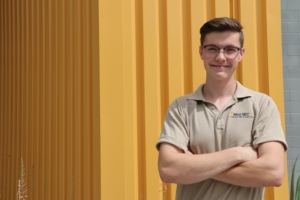
“I took dual enrollment at my home high school and at West-MEC. I am proud to be halfway through my associate degree and the recipient of an academic scholarship,” said Garrett Rose, a law, public safety and security student. “Dual enrollment strengthened my commitment to my future education and career in criminal justice.”

Dual enrollment is for all students.

The West-MEC counselors and instructors believe it is a moral and economic imperative to increase awareness, access and equity for students. We focus not only on access, but also on academic and personal support. Forty-seven percent of West-MEC (2019) students participate in early college opportunities.

West-MEC’s early college programs serve special populations with equity. Male and female students participate equitably.

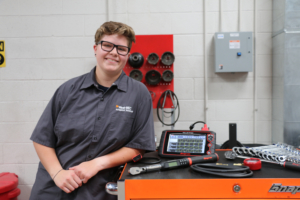
“Dual enrollment puts me ahead in college and life. This opportunity has shown me how affordable college is,” said Cali Orr, an automotive technology student. “Dual enrollment helps me with my college career by giving me a great direction for my future studies. This program has given me the ability to achieve more than my peers and put me ahead in my college career. I have the chance to get hired faster at a job I love.”
What is the process to establish this pathway?

Postsecondary pathways begin with robust dual and concurrent enrollment programs. West-MEC works closely with the Maricopa Community College and Northern Arizona University to strengthen and expand early college programs, certify instructors and support students.

Learn more at ACTE’s CareerTech VISION 2019, where West-MEC and its postsecondary partners will present Three’s Company: Building a High School, Community College to University Pathway. We hope to see you there on Thursday, December 5, 4:30–5:30 p.m.

Speranta Klees is the postsecondary partnerships manager at West-MEC. Her mission is to collaborate with colleagues for CTE programs that afford students full participation in a spectrum of postsecondary opportunities, meaningful work, financial independence and career advancement. She is a fellow with the Association for Career and Technical Education of Arizona and a recipient of the 2015 CTE Counselor of the Year Award. Email her.

REFERENCES
Achieve60AZ. (2019). Achieve60AZ state of attainment report 2019. Retrieved from https://achieve60az.com/news/.
Northern Arizona University. (2019). Tuition and expenses. Retrieved from https://nau.edu/admissions/tuition-and-cost/tuition-expenses/.
West-MEC. (2019). Dual and concurrent report for West-MEC students 2018–19. Glendale, AZ: Author.
U.S. News >amp; World Report. (2019). Maricopa County is fastest-growing US county for 3rd year. Retrieved from https://www.usnews.com/news/best-states/arizona/articles/2019-04-19/maricopa-county-is-fastest-growing-us-county-for-3rd-year.
Techniques Returns with A VISION of High-quality CTE

It’s here! It’s here! It’s the happiest time of the year! A new school year brings a fresh start, new pens and crisp paper — and Techniques! For 2019–2020 Techniques returns with A VISION of High-quality CTE. As the premier event for career and technical education (CTE) professionals nationwide, ACTE’s CareerTech VISION 2019 is the place to ask, “What is high-quality CTE?” In Techniques in September, discover new best practices as they relate to the 12 elements of ACTE’s Quality CTE Program of Study Framework.

What is high-quality CTE?

A few years ago, ACTE embarked on an initiative to bring clarity to the conversation and to help CTE educators and administrators develop and improve the quality of their programs. Resulting from this initiative was our evidence-based framework defining high-quality CTE across 12 elements:

  • Standards-aligned and Integrated Curriculum
  • Sequencing and Articulation
  • Student Assessment
  • Prepared and Effective Program Staff
  • Engaging Instruction
  • Access and Equity
  • Facilities, Equipment, Technology and Materials
  • Business and Community Partnerships
  • Student Career Development
  • Career and Technical Student Organizations
  • Work-based Learning
  • Data and Program Improvement

For the second year in a row, educational program sessions at ACTE’s CareerTech VISION 2019 will be tagged to match these elements. Attendees can identify sessions that address issues about which they want to learn more, in order to improve their programs. And now you can get a head start. This issue of Techniques offers a sneak preview of what to expect at VISION and what the elements look like in action!

One featured article highlights cybersecurity programs and touches on a number of high-quality CTE elements. “Teaching Cybersecurity Through Virtual Labs and Hands-on Experience” (on pp. 28–33) meets criteria under Facilities, Equipment, Technology and Materials; Engaging Instruction, Student Assessment; and Business and Community Partnerships.

Another, Shannon Sheldon’s article on “Supporting the Gender Expansive Student” (on pp. 35–39), addresses the Access and Equity element of the Framework and demonstrates the ways in which traditional language, classroom procedures and social norms work against inclusion — while offering suggestions to help readers develop improvements to lessons and language.

And further, Peggy and Steven Bridges are “Class Disruptors” (on pp. 40–43), offering insight and inspiration as they encourage teachers to shake up their classroom management with the art of disruption — related to the Engaging Instruction Framework element.

These articles provide a brief glimpse into the wide range of high-quality CTE programs around the country, and we hope they provide you some insights that will help you improve the quality of your programs too!

ACTE members can read Techniques‘ September 2019 “A VISION of High-quality CTE” issue online now.

Teaching Strategy: Got 30 Seconds? Talk About It.

Career and technical education (CTE) students are asked to learn hundreds of new concepts and technical terms every year. How can CTE teachers know when their students have processed the learning correctly? How can we catch thinking errors when they occur? The answer is simple: Frequently check for understanding; challenge students with a formative assessment. Traditionally this comes in the form of Q>amp;A sessions.

However, with a strong push for higher levels of student engagement, teachers are being asked to develop bigger tool boxes of formative strategies — tools that allow teachers to engage all students accurately and creatively. When John Hattie (2008) released his meta-analysis on the factors that impact student achievement, he used a standard effect size scale. In his work, Visible Learning, Hattie demonstrated that frequent formative assessments may be among the best instructional practices that teachers can use to impact student achievement.

For this reason, it is beneficial for teachers to have an arsenal of effective formative assessments at their disposal. Many go-to practices include traditional Q>amp;A, exit/entrance cards, quizzes and free-writes. I would like to suggest adding the 30-second-talk-about to these more traditional approaches — as it creates equitable productive talk for all students.

The objectives are simple.

We want to gauge how much understanding students have gained and if something has been learned incorrectly. The sooner a thinking error can be identified, the better student achievement will be. Formative checks for understanding also give students an opportunity to focus on the essential information, separating the key concepts from the details surrounding it.

As an instructional coach, I like to provide teachers, whose classes I observe, with an objective snapshot of student participation. I do not make any subjective statements. I simply diagram the room, placing an X on each student place. A tally mark is given each time a student answers a teacher’s question. I use a Q to note if the students ask questions in return. At the end of an average 45-minute lecture with Q>amp;A, only about 1/3 of students will have tally marks. It is painful to see how many students don’t have tally marks, especially if we factor in the likelihood that these patterns persist throughout the school year.

Where is the equity in this? We owe to students to give 100 percent of students a voice, 100 percent of the time, when we wish to check for understanding.

How can we do this? One very effective place to start is the 30-second talk-about. Students cannot opt out and, when they discover how fun the exercise can be, they don’t want to opt out. This teaching strategy works well because it simultaneously activates all three domains: cognitive, physical, and affective. Full of smiles and laughter, students greatly appreciate the movement and fast pace. Teachers weave in and out of students as they talk — taking mental notes of who is struggling.

The Strategy in Action

How long will it take?

The session can be as quick as five minutes or as lengthy as 20 minutes — depending on how much you elaborate on student paraphrasing.

What’s the gist?

Students take turns talking productively with a peer about a term for 30 seconds.

How It Works

  1. Pair students into groups of two.
  2. Randomly assign one student in each group the role of “talker” and the other the role of “listener.”
  3. Say, “Talkers, your task is to keep talking about the topic I assign for 30 seconds without stopping. Listeners — don’t get too excited — you are not just listening. You’re active listening, which means that you nod and smile for affirmation. Then, once the time is up, you also are the paraphraser, telling the rest of us what they said.”
  4. Start the time. Walk throughout the class, listening and assessing your students’ understanding of the concept or process. Encourage talkers to back up their words with evidence they remember from reading. Remember, you can’t have a successful talk-about unless you walk about!
  5. After the timer goes off, call on various listeners, asking them to share something their partner talked about.
  6. Switch! Listeners become talkers, and talkers listen, on a new challenging prompt.

This is a formative approach that is difficult to top. The 30-second talk about is an activity that builds a risk-taking, growth mindset type classroom culture. Some students don’t raise their hands during Q>amp;A for fear that they may have the wrong answer, and be embarrassed. However, with the 30-second-talk-about strategy, there is safety in only having to speak to one fellow student. For the listener, safety comes from paraphrasing what they have heard. If the paraphrased comments need correcting, teachers can address both students together with probing questions, which should help to build student efficacy.

I often say to teachers, “You can’t do a talk-about unless you also do a walk-about.” This brief rhyme reminds teachers to weave through the student teams as they talk. Teachers are often surprised at just how much data they can collect in a couple 30-second time periods. Teachers collect several comments and elaborate to connect student’s different ideas. Give it a try; even the most reserved students will not feel intimidated to participate.

Sandra Adams is a teacher and instructional coach with the Career Academy, Fort Wayne Community Schools. She co-wrote the ACTE-supported book But I’m NOT a Reading Teacher!: Literacy Strategies for Career and Technical Educators with Gwendolyn Leininger. Contact her to learn how you can implement theses certification test prep and other innovative teaching strategies in your CTE classroom.

REFERENCE
Hattie, J. (2008). Visible learning for teachers. Abingdon, UK: Routledge.

Teaching Strategy: Start Strong! Captivate Students on Day One

Imagine you are a high school junior the morning of your first day at your new career tech center. Maybe you’ve enrolled in a half-day automotive, culinary, computer programming or health careers program. What do you envision? How do you hope the day will go? Do you hope to learn differently than you did in your traditional high school?

If you’re like many students, the answer is a resounding “YES!” You anticipate getting your hands on tools, moving among peers in a lab, and listening to an instructor’s experiences from the field. You are ready to have a new instructor who will fuel your excitement to begin a career and technical education (CTE) experience.

However, a basic principle of psychology could disrupt your plans. All human beings assess and understand new people and new situations by fitting them into mental schemas — existing frameworks created by past experiences with similar people and situations. And the schemas in our brains play a role in releasing dopamine. Novelty brings a dopamine reward to the brain.

Imagine you’re that student, walking into your new classroom, excited for a change, only to discover it fits your existing schema for traditional classroom learning. Your brain misses out on dopamine, and your anticipation quickly dissipates. It’s your first day in what you expected to be a brand new kind of school, yet already there is more of the same.

A First Day Re-imagined

Our staff decided last year that we would all design a day one that would not disappoint these energized students.

No classroom had columns and rows. No students were immediately given rules and procedures. What they were given was a challenge! Not all teachers gave the same challenge — but they all led some cooperative and competitive challenge that demonstrated a new type of expectations. The intended message to students was, they would be asked to process together, to make decisions, practice leadership, and frequently provide feedback to one another.

A student walked into a computer repair classroom to begin her IT pathway. The classroom featured tables in a U shape in the center of the room. Across each of the tables was an organized computer repair station with broken computers and numerous parts spread about. The student and her classmates were greeted by the teacher and were told to have a seat at any station with a partner. They were presented with a simple assignment: “Using any resources at your disposal and one student partner, reassemble the computer in under 40 minutes. Go!”

On the other side of campus, construction students walked in to find piles of newspapers and duct tape. Their task was to build the tallest freestanding tower in 30 minutes, using nothing but those two supplies.

In the cosmetology and culinary classes, however, the excitement rose to a whole new level. Students in these classrooms found stations of stacked solo cups with a strange looking tool attached. The tool was made of a standard rubber band with four, two-feet long pieces of yarn attached. The challenge here was to build a tower where six cups made the base, followed by a row of five, four, three, two and one on top. The catch was that they could ONLY touch the yarn.

The Strategy in Action: Build a cup tower!

How it Works

  1. Set out a stack of 21 plastic cups on each table designed to fit four students. A rubber band should be secured to the bottom of the top cup. Attach four, two-feet lengths of yarn to the rubber band spaced equally apart.
  2. Clear the table of anything except the cups.
  3. Explain to the teams that the objective is to build a tower where the base is six cups long, and continue to build until they place one cup at the top of the tower. Students are not to touch anything but the yarn. Even if the cups fall to the floor — which can easily happen! The objective is of course to be the first team to complete their tower successfully.
  4. Let the games begin! Facilitate the room, making your observations and enjoy learning about your new students and how they interact with one another.

Final Thoughts

This “start strong” approach stretches students’ imaginations and expectations. It brings the lab’s free movement, shared processing, student agency and relevance right into the classroom and helps students practice the kinds of collaborative skills they’ll be honing all year. The challenge involves critical thinking, adaptability, innovation, even literacy, all without seeming like “school work.”

The real beauty to this is also what it affords teachers. Within the very first hour of the new school year, teachers can observe students in a charged environment. They can quickly assess who are the natural leaders, who are the loquacious kids, who are quiet, who frustrates easily, and who loves a good challenge. Teachers can move right into conversations about learning in a CTE environment versus traditional schools. Teachers can also segue right into their expectations for collaborating, critical thinking, oral communication, and learning to adapt to new situations.

Sandra Adams is a teacher and instructional coach with the Career Academy, Fort Wayne Community Schools. She co-wrote the ACTE-supported book But I’m NOT a Reading Teacher!: Literacy Strategies for Career and Technical Educators with Gwendolyn Leininger. Contact her to learn how you can implement theses certification test prep and other innovative teaching strategies in your CTE classroom.

Changing Careers, Chasing a Dream

For as long as I can remember, I have been interested in the technical aspects of things. I loved understanding how things worked and I seemed to gravitate toward engines. Although this was a primary interest of mine, everyone always told me that I couldn’t be successful in that field; I was led to believe I needed to go to a four-year university in order to become successful in life.

Challenges >amp; Misconceptions

In high school I joined the National Guard and, as a result, I purchased my first car. The car was a 1973 Volkswagen Super Beetle that had rotted away, having been forgotten in a barn for 15 years. My father thought it was a great opportunity to learn the value of work. He and I rebuilt the car over the following two years. I remember spending every waking minute and every spare cent I had on the car. It was my pride and joy in life at that time. I finally finished the car during my senior year of high school. Three months later, I learned one of the hardest lessons of my life when I was involved in an automobile accident.

I thought I was invincible but I wasn’t; my 1973 Volkswagen Super Beetle crashed on the expressway and I was thrown from the car at 85 miles per hour. Miraculously I survived but spent the next month in a coma, the following five months in a hospital, and I had to relearn to walk and speak.

My injuries were only able to hold me back for a few years. The accident inspired me to become an advocate, to speak out, to raise awareness of the dangers of driving distracted. I enrolled in the University of Iowa, first to major in pre-law, then history… Five years and several major changes later, I finished a bachelor’s degree in recreational therapy.

After graduation, like many new graduates, I wanted to move to the big city where the opportunities were said to be endless. Chicago was just far enough to not be close. My first job was for the Illinois Department of Corrections, working with violent offenders. I became quickly burned out.

Many of the people I spoke with agreed that I should follow a natural progression to graduate school. I worked hard to obtain my graduate degree, finishing near the top of my class with a master’s in public administration from Northern Illinois University. From this experience, I took an opportunity to travel to war-torn Iraq to help rebuild the government there. I spent additional time living in Jordan as a Peace Corps volunteer.

Upon my return to America, I worked several white-collar jobs. None of these brought me any fulfillment in life. I often laid in bed and stared at the ceiling, telling myself, “I need to make a change.”

A Choice to Follow a Dream

My father was instrumental in teaching me the importance to technical skills, of the value in understanding how things worked, and how it can bring happiness to a person when they know they can fix something. His lessons really sunk in as we worked, over two years, to restore the 1973 VW Beetle; I value that quality time I shared with my father. Now, at 40, I am a strong advocate for the community college system and the technical skill development opportunities they afford students.

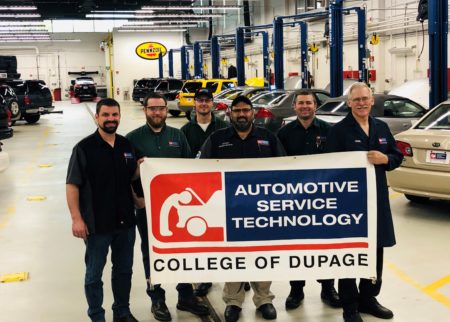
After my realization and some research, the diverse course offerings and small class sizes at The College of DuPage led me to enroll in their automotive technology certificate program. After attending my first class, I knew I had made the right choice. I was confident in my decision to make a change, to pursue a career as an automotive technician.

I am now enrolled and taking courses to receive a bachelor’s degree in automotive technology from Southern Illinois University. Until graduation, I work at the College of DuPage as an automotive tutor where I can give back and help make a difference in the lives of the students there.

After graduating from Southern Illinois University, my plan is to obtain employment at a private auto shop and, down the road, I hope to use my previous education in business to open and manage my own shop. I owe a lot of my future success to the career and technical education programs at The College of DuPage and SIU; the automotive instructors have given me the confidence and skills to make a choice to follow my dream.

Ben Pohl is a “moti-spirational” speaker and an automotive technician. Email him.

# # # # # #