
08/18/2025


Congress remained
mainly focused on summer recess activities this week. Both the House and Senate will return to Washington on September 2 to resume appropriations work as the end of the fiscal year approaches next month. Floor activity was limited to pro forma sessions, but members still introduced legislation in areas including workforce development, small business incentives and education access. In the Administration, the Departments of Labor (DOL), Commerce and Education (ED) published a new workforce strategy earlier this week with plans to advance skills development. See below for more updates from the past week: 
 

  • DOL, Commerce, and ED Issue Report on Workforce Development: On August 12, the three agencies jointly released “America’s Talent Strategy: Building the Workforce for the Golden Age,” a federal strategy aimed at enhancing the country’s approach to career readiness training. It includes five different focus areas to meet modern day workforce demands. You can read more about it in this blog post 
  • Federal Judge Rules Against ED’s Anti-DEI Requirements: On August 14, a federal judge ruled against ED’s February 14 guidance memo, requiring educational institutions to certify compliance with ED’s interpretation of the anti-discrimination law to receive federal funding, ruling that the ED cannot enforce the restrictions without proper legislation or rulemaking.  
  • ACTE and Partners Request Clarity on Serving Undocumented Learners: ACTE, along with Advance CTE, AACC and ACCT, sent a letter to ED seeking answers to critical questions regarding their recent notice of interpretation of the Personal Responsibility and Work Opportunity Reconciliation Act (PRWORA) provisions related to benefits for undocumented learners. 
  • ED Announces Career Z Challenge Recipients: ED wrapped up the final phase of the Career Z Challenge, recognizing student-centered work-based learning (WBL) in high school programs. Each recipient received a portion of $1.5 million to expand WBL initiatives. Each of the winners showcased strong partnerships, student impact, and sustainability within WBL. The Department of Education recognized the following institutions: Atlanta College and Career Academy (GA), Kirkwood Community College (IA), YouthForce NOLA (LA), Grand Forks Public Schools (ND), Future Focused Education (NM), South Bronx Community Charter High School (NY), Educational Service Center of Central Ohio (OH), Lorain County Joint Vocational School (OH) and Roanoke City Public Schools (VA).  
  • Secretary of Education Conducts School Tour: In conjunction with the beginning of the school year, Secretary of Education Linda McMahon is kicking off a 50-state tour titled “Returning Education to the States.” The tour has already included stops at several community colleges.  
  • Rep. Josh Harder (D-CA) and Rep. Jen Kiggans (R-VA) Introduce Apprenticeships for Small Businesses Act of 2025: Rep. Harder and Rep. Kiggans introduced a bill to create a refundable tax credit for small businesses that hire CTE students and trainees. Each participating business would be eligible for up to $10,000 in tax credits. 


08/18/2025

ACTE, along with a coalition of other organizations, sent a letter to the Department of Education (ED) seeking answers to critical questions regarding the their recent notice of interpretation impacting postsecondary CTE and adult education programs.

Earlier this summer, the Trump Administration issued new interpretive guidance on the Personal Responsibility and Work Opportunity Reconciliation Act (PRWORA). The Notice of Interpretation removes prior exemptions from PRWORA’s definition of a “public benefit,” further limiting access for undocumented immigrants. Under this change, postsecondary CTE programs funded through Perkins V and adult basic education programs supported by the Workforce Innovation and Opportunity Act (WIOA) are now included, despite previously being exempt. The interpretation also appears to extend to K-12 dual and concurrent enrollment programs.

While court action has put the implementation of this new interpretation on hold in some states, we hope to get additional clarity soon. ACTE is joined by Advance CTE, the American Association of Community Colleges (AACC), and the Association of Community College Trustees (ACCT) in seeking clarification regarding how and in what ways states and local grantees are expected to operationalize these new requirements.

ACTE is looking forward to a response from ED on these important questions. If you have any questions, please reach out to ACTE’s Government Relations Manager, Jimmy Koch (jkoch@acteonline.org).

Posted by cimperatore on 08/18/2025 AT 15:35 pm in Executive Branch Perkins Postsecondary Issues WIOA | Permalink

08/15/2025

This week, I joined ACTE as the new media and advocacy coordinator. In this role, I will work closely with other members of the public policy team to support ACTE’s mission by ensuring members have the most up-to-date information on policy developments and the resources they need to take action, including by managing our social media, website, and the CTE Policy Watch blog. I will also be working to amplify ACTE’s policy priorities through media outreach and special events, as well as providing advocacy training. I am very excited to be a part of the team and advance the conversation around the important role of CTE in education policy! I wanted to take the opportunity to introduce myself in my first blog post. 

I recently graduated from the University of Maryland with a dual bachelor’s degree in Journalism and Public Policy. While earning my degree, I began my professional journey and interned at the White House in the Office of National Drug Control Policy (ONDCP), where I supported communications on drug policies and initiatives. In this role, I drafted press releases, prepared media plans, and social media content to expand ONDCP’s priorities. This experience afforded me a profound insight into federal policymaking, particularly in areas affecting public health and safety.

Most recently, I served as a temporary Communications Assistant for the Office of Congressman Jim Costa of California’s 21st District. In this role, I worked among Congressman Costa’s communications team to compile daily press clips, create digital content, photograph constituent meetings, and draft written materials. This role fine-tuned my ability to analyze and distill complex legislative policy, ensuring it resonates with and informs California’s 21st district.  

I am originally from the Midwest, where I had the honor of growing up in a community deeply invested in its public education system. My father served on the school board of our hometown district for 14 years. His dedication to shaping educational policies and advocating for the students in our community sparked my interest in education policy. I developed an early understanding of how crucial equal access to a quality education is for students everywhere, not just in my hometown.  

I look forward to contributing to ACTE’s goals, priorities, and membership support as I take on this role! Please do not hesitate to reach out to me at ajablonski@acteonline.org if I can be of any assistance.  

Posted by jgalvan on 08/15/2025 AT 13:40 pm | Permalink

08/15/2025

The U.S. Departments of Labor, Commerce and Education on Tuesday released their blueprint to overhaul the federal government’s approach to workforce development.

The 27-page paper, America’s Talent Strategy: Equipping American Workers for the Golden Age, outlines a five-pillar plan designed to expand access to good-paying jobs, strengthen talent pipelines for critical industries, prepare the workforce for an AI-driven economy, and solidify the United States’ position as the world’s leading economic power. The report was initiated due to an Executive Order earlier in the year on preparing Americans for high-paying skilled trade jobs that called for a review of all federal workforce programs.

The pillars are:

  • Industry-Driven Strategies: Expand proven work-based learning models, such as registered apprenticeships, and align education programs with career pathways in priority industries to directly meet employer needs. This includes streamlining program administration, simplifying governance requirements and enabling states to integrate funding streams for more efficient service delivery.
  • Worker Mobility: Expand workforce participation by identifying the skills and credentials needed for in-demand jobs and connecting individuals to personalized support to help them advance in their careers.
  • Integrated Systems: Streamline federal workforce development programs to give states greater flexibility, unify access points for workers and employers, and advance the president’s Make America Skilled Again proposal, which includes block grants to states.
  • Accountability: Increase transparency and oversight of federally funded workforce programs by strengthening measures of success and redirecting resources to initiatives proven to connect Americans with good-paying jobs.
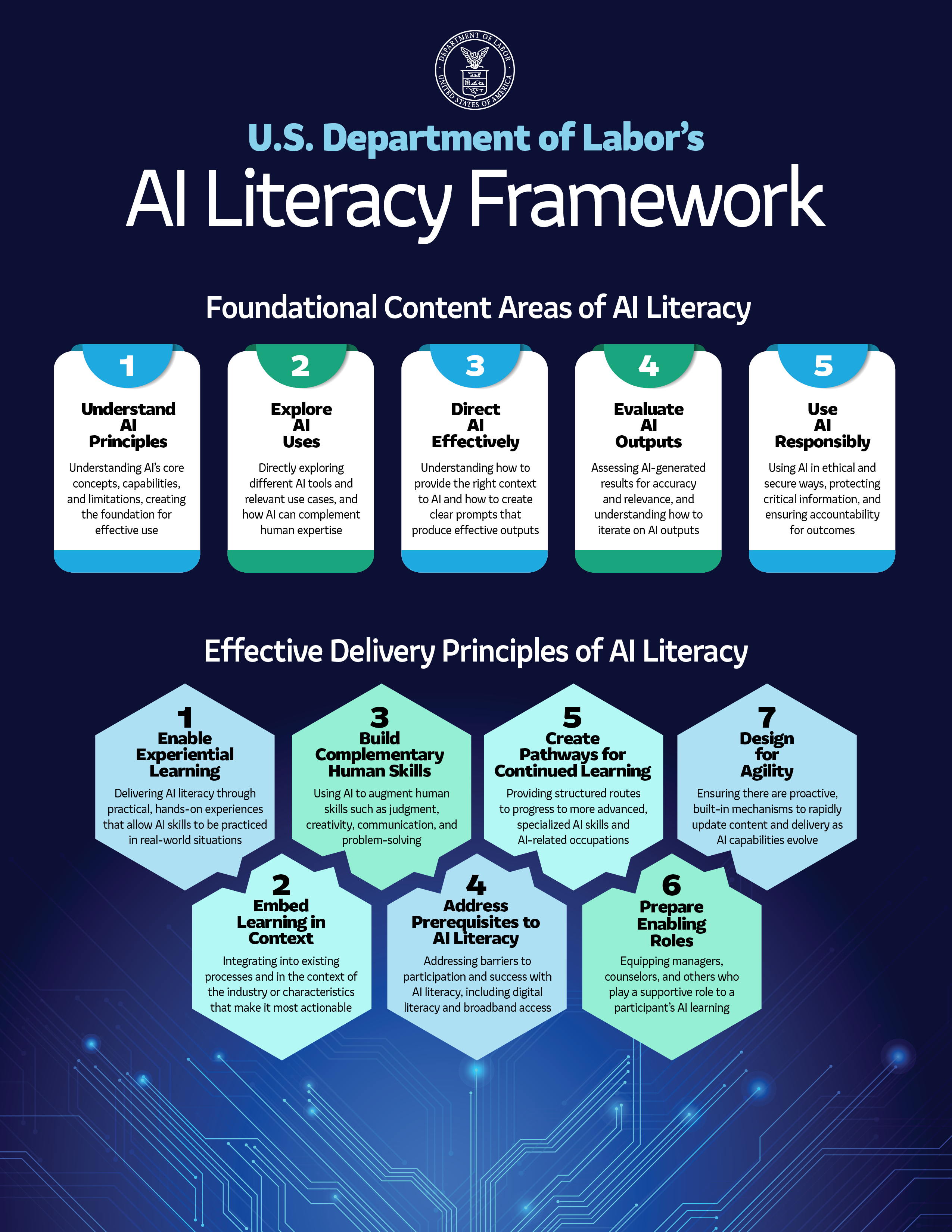
  • Flexibility and Innovation: Prepare the workforce to thrive in an AI-driven economy by prioritizing AI literacy, developing new pathways into AI careers, and supporting rapid reskilling initiatives and other innovation pilots.

The report also touches on the Inter-Agency Agreement (IAA) between the Departments of Education (ED) and Labor (DOL), which entails joint administration of CTE initiatives like Perkins V and the Perkins Innovation and Modernization (PIM) Grant program. Future PIM competitions will emphasize education-workforce alignment, apprenticeships, innovative work-based learning models, and competency-based hiring, with grant applications requiring support from governors and state workforce boards. ACTE has previously expressed concern about the IAA.

Registered apprenticeships are central to the approach, with proposed regulatory streamlining, expanded funding, and on-ramps such as pre-apprenticeships, internships, and dual-enrollment programs.

On AI, the report emphasizes both opportunity and urgency, calling for regional AI learning networks, partnerships with the National Science Foundation’s AI Institute, and rapid retraining pilots to keep pace with shifting skills. Special attention will be given to ensuring equitable access so all communities can share the benefits of an AI-powered economy.

Please reach out to ACTE’s Government Relations Manager Jimmy Koch (jkoch@acteonline.org) if you have any questions or concerns. 

Posted by jimmykoch on 08/15/2025 AT 11:51 am in Apprenticeships Executive Branch Perkins WIOA | Permalink

08/15/2025

Gaps in Understanding the PD Needs of Postsecondary CTE Educators: A white paper from CAST examines how Universal Design for Learning (UDL) can improve postsecondary CTE instruction and boost student outcomes.

In a separate study, the authors found that there is a lack of research and guidance on postsecondary CTE professional development (PD) practices. Moreover, interviews they conducted revealed that postsecondary CTE instructors struggle with supporting students and managing their classroom. Because teacher self-efficacy—the belief in one’s ability to help students learn—relies on positive PD experiences and is tied to higher student outcomes, the authors argue that there is an urgent need to fill the postsecondary CTE PD gap and propose UDL as a potential solution. 

UDL’s emphasis on student access and success makes it applicable to postsecondary CTE and can increase self-efficacy, according to the authors. They point to the experiences of postsecondary CTE instructors who received UDL-based PD from CAST; the instructors described shifting their perspectives to focus on how they present information to students, such as utilizing videos to introduce a piece of equipment, and being more aware of the different ways students process information and express their knowledge.  

Moving forward, the authors provide a series of recommendations that call on stakeholders to implement UDL-based PD for postsecondary CTE instructors, including promoting awareness of UDL, conducting research and investing in teacher support initiatives. 

A Regional Look at the ROI of California’s Community and Career Colleges: A study from College Futures analyzes the return-on-investment (ROI) of California’s community and career colleges. The researchers compared the median salary of graduates from individual colleges to the median salary of a California high school graduate with no postsecondary education ($32,476). They then calculated how long it took for college graduates to recoup the costs of their credential based on their additional earnings. 

The researchers found that the ROI varied greatly between California’s regions. Thirty-eight percent of community and career colleges in the Bay Area enable students to recoup the costs of their credential in under a year compared to only six percent in the Inland Empire; notably, 34% of colleges in the Inland Empire provide no economic returns at all. Differences also emerged between public and private colleges, with 40% of public community and career colleges allowing students to recoup costs in under a year compared to five percent for private colleges. The top 25 institutions with the quickest ROI span the entire state and allow students to recoup costs in under six months; these colleges also primarily serve low-income students, charge less than $5,000 annually, and demonstrate earnings that are at least $10,000 more than a high school graduate. 

A 50-state Analysis of College, Career, Military and Civic Readiness Indicators: A report from the Urban Institute and All4Ed examines how states are utilizing and measuring college and career readiness (CCR) indicators. The author scanned indicators across all 50 states and Washington, DC, and found the following: 

  • Forty-two states use at least one CCR indicator in their federal or state accountability systems, with 17 states using multiple.  
    • 20 states also measure military or civic readiness. 
  • AP or IB coursework is the most common college readiness measure used by states (35), followed by dual or concurrent enrollment (34) and college admissions tests (25). For career readiness measures, industry-recognized credential attainment is most common (23), followed by CTE pathway completion (16) and work-based learning (14). 
  • Only 12 states report data on how students demonstrate readiness through their CCR measures. 
  • Twenty-six states exclusively rely on input measures—such as test scores—to measure a student’s readiness rather than outcomes measures such as wages and college enrollment. 

American Sentiment Toward The Skilled Trades: A recent survey from The Harris Poll investigates how individuals view careers in the skilled trades. The researchers surveyed over 2,000 adults aged 18 and older across the nation and found the following: 

  • Americans overwhelmingly support the skilled trades: 90% of respondents believe that the skilled trades offer a fast and affordable path to a good career while 91% believe they are as important as white-collar jobs. Ninety percent agree that most people do not realize how high paying the skilled trades can be. 
    • Attitudes differ by age group: 59% of boomers said that the skilled trades offer the best job opportunities compared to only 38% for Gen Z. 
  • Across all age and racial/ethnic groups, respondents said that the biggest barrier for individuals pursuing skilled trades is that trade careers are seen as less prestigious than other occupations. Other barriers ranked highly by respondents include lack of awareness of trade careers, pressure to attend a four-year college and trade careers not being seen as financially rewarding. 

08/11/2025

After a flurry of summer activity, things are quieting down in Washington as lawmakers wrapped up work and recessed for the August break. Congress will return on September 2 to what is likely to be a contentious work period as the end of the fiscal year approaches. The Senate did make some progress on appropriations bills before leaving town, but there is still much more work to be done! August is a great time to connect with policymakers who are back in their home states and districts and emphasize the importance of federal funding for CTE. See below for a wrap up of other news these past two weeks:

  • Senate Moves Forward on Appropriations Bills: The Senate passed three full appropriations bills before leaving town, covering Military Construction and Veterans Affairs, Agriculture, and the Legislative Branch. The Senate Labor, Health and Human Services, and Education Appropriations Subcommittee also approved its bill, which provided level funding for Perkins and most other education and workforce programs.
  • Senate Approves Under Secretary of Education: On August 4, Nicholas Kent was sworn in as the Under Secretary of Education after being confirmed by the Senate. He will have a leadership role in overseeing postsecondary, CTE and adult education programs, along with federal student aid. In other nomination news, Penny Schwinn removed herself from consideration as the Deputy Secretary of Education, and will instead assume an advisory position that is not subject to Senate confirmation.
  • ACTE Support College Transparency Act: On July 29, Sens. Bill Cassidy (R-LA) and Elizabeth Warren (D-MA) reintroduced the College Transparency Act in the Senate, with Reps. Mike Kelly (R-PA) and Raja Krishnamoorthi (D-IL) introducing a companion in the House. The bill would lead to a stronger postsecondary education data system and make it easier to collect and report on CTE student outcome measures, and ACTE was proud to continue our support!
  • Department of Justice Issues Memo on DEI Programs: On July 30, the Department of Justice issued non-binding guidance to all federal grantees related to “the application of federal antidiscrimination laws to programs or initiatives that may involve discriminatory practices, including those labeled as Diversity, Equity, and Inclusion (“DEI”) programs.”
  • Administrations Issues Requirements for New Postsecondary Data Reporting: On August 7, the White House Issued a memo requiring new reporting from institutions of higher education on applicants and those admitted, including data disaggregated by race and sex, as well as information on test scores and GPAs. An accompanying fact sheet and follow-up communication from the Secretary of Education provide more details.
  • Department of Education Issues Guidance on Waivers: In a letter sent to chief state school officers on July 29, the Department provided guidance to states on how they can use existing flexibilities in education laws or “to seek creative and effective waivers for improving student academic achievement and maximizing the impact of Federal funds.”
  • President Issues Executive Order on Federal Grantmaking: On August 7, the President issued an executive order titled “Improving Oversight of Federal Grantmaking” that institutes new approval processes for the posting of funding announcements and awarding of funds to ensure they advance the President’s policy priorities. This could slow the funding process down considerably.

08/04/2025

Addressing CTE Faculty Shortages in Community Colleges: An article by Brandon Hensley, Michelle E. Bartlett, James E. Bartlett II and Sophia Alston in The CTE Journal investigates the challenges that shape CTE faculty shortages in community colleges and the institutional practices aimed at recruiting and retaining instructors.

The researchers surveyed postsecondary CTE instructors nationally and analyzed data from community college faculty in North Carolina to provide state-specific insights. They found that respondents from North Carolina struggle to find instructors, with 66% of respondents stating it is always or often hard to find full-time faculty and 60% reporting the same for part-time faculty. Within CTE program areas, 41% of respondents say that their institutions face a shortage in one area, 17% in two areas, 13% in three areas and 14% in 10 areas. Health (50%), Construction/Trades (27.5%) and IT (23%) are the most common program areas in which respondents report faculty shortages.  

When asked about how their institutions recruit and retain CTE faculty, the most common strategies reported by North Carolina respondents are posting positions on the school’s website or online job boards, word of mouth and faculty referrals. For retention, respondents report that their institutions actively address factors that lead to faculty burnout and consider feedback from faculty in decision-making. However, respondents rate their institution’s benefits and sense of community among faculty members as weak.  

The State of CTE in Ohio: A report from the Fordham Institute examines the current state of CTE programs and work-based learning opportunities in Ohio using state longitudinal data. 

  • Participation in CTE coursework and work-based learning opportunities has risen in recent years. About one in four high school students completed at least one CTE course in the 2022-23 school year, up from one in six for 2014-15. In addition, about one-third of students, over 44,000, graduated as CTE concentrators in 2023 compared to 36,000 students in 2020. 
  • The class of 2023 saw over 4,500 additional students (26% of CTE concentrators) accumulate more than 250 hours of work-based learning experiences compared to the class of 2022. 
  • Attainment of industry-recognized credentials soared from 14,500 earned in 2014-15 to nearly 70,000 earned in 2021-22. 
    • Attainment of high-demand credentials, as defined by the state’s Innovative Workforce Incentive Program (IWIP), also rose significantly—from about 3,000 earned in 2019-20 to over 19,000 in 2022-23. However, IWIP credentials only made up 16% of the credentials students earned in 2022-23, indicating that students are largely pursuing lower demand credentials. 
  • The top CTE programs for concentrators are agribusiness and production systems (15.4%), engineering and design (9%) and allied health and nursing (8.5%). 
  • Low-income and Black students are underrepresented in enrollment at specialized career centers, which are more likely to offer high-demand programs and credentials. 

Which College and Career Readiness Standards Best Align with Positive Outcomes after High School?: A study from the Urban Institute examines 12 college and career readiness standards in state accountability models, investigating which ones best predict post-high school outcomes.  

The author analyzed 100+ studies that examined the causal impact of each standard and found that seven are positively linked to post-high school outcomes:  

  • AP or IB Enrollment 
  • Mandatory SAT or ACT Testing 
  • Mandatory FAFSA Completion 
  • Early College or Academic Dual Enrollment  
  • CTE or CTE Dual Enrollment 
  • Industry-recognized or CTE Dual Enrollment Credentials 
 
  • Military Enlistment 
 

Participation in early college programs or academic dual enrollment as well as participation in CTE or CTE dual enrollment are the standards mostly positively aligned to positive outcomes, each supported by a significant number of studies that indicate strong links to postsecondary enrollment, persistence and degree attainment as well as employment and earnings. The author noted that enrollment in CTE coursework appears to be particularly beneficial for male, Black, Hispanic and disabled students, echoing other studies that have made similar findings.  

Strengthening Career Value Across Diverse Models of Work-based Learning: A report from the Strada Foundation explores students’ experiences and attitudes toward various work-based learning (WBL) experiences. The researchers surveyed over 2,000 undergraduate students at public four-year colleges nationwide and found the following: 

  • 65% of students who participated in WBL said it was to gain experience and skills in a specific career they plan on pursuing. Students highly value WBL experiences, with 40% ranking the career value of their experiences a ten on a 1-10 scale, 13% ranking their experiences a nine, and 18% rating their experiences an eight.  
  • Experiences that students rated the highest in making them stronger candidates for careers are paid internships, undergraduate research experiences and practicums. On- and off-campus jobs were ranked the lowest. 
  • Students indicated that, broadly, WBL experiences helped them expand their professional network, develop technical and soft skills, and receive extensive feedback and mentorship from their supervisors.  

Search

# # # # # #