
Special Populations
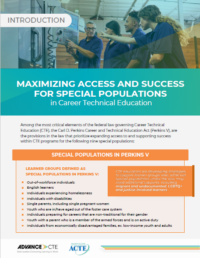
The federal Carl D. Perkins Career and Technical Education Act, known in its most recent iteration as Perkins V, defines nine learner groups as special populations:
- Individuals with disabilities
- Individuals from economically disadvantaged families, including low-income youth and adults
- Individuals preparing for careers that are non-traditional for their gender
- Single parents, including single pregnant women
- Out-of-workforce individuals
- English learners
- Homeless individuals
- Youth who are in, or have aged out of, the foster care system
- Youth with a parent who is a member of the armed forces and is on active duty
The law requires states and local recipients to report disaggregated data for these learner groups. It also requires states to spend funds on recruiting special populations into CTE and preparing students for careers non-traditional for their gender. In addition, Perkins V permits state and local funding to provide supports for these populations.
- Students with disabilities in CTE programs are more likely to graduate on-time (Georgia Policy Labs); earn industry-recognized credentials (Dougherty, Grindal & Hehir 2018); and be employed full-time after high school than other students with disabilities (Lee, Rojewski & Gregg 2016).
- While students from all income backgrounds benefit from CTE, low-income students experience stronger positive outcomes (Dougherty 2018) and are more engaged in CTE coursework (Plasman, Gottfried & Klasik 2021).
- In 2022-23, English learners who concentrated in CTE had a 94.2% high school graduation rate (Office of Career. Technical and Adult Education) compared to the national EL graduation rate of 73.1% (ED Data Express).
- Homeless students in Washington and Montana who took 3+ CTE courses are more likely to graduate high school than those who take fewer courses (Advance CTE).
- Foster youth who take three or more CTE courses are much less likely to drop out of high school (U.S. Department of Education).
Maximizing Access & Success for Special Populations in CTE series (December 2023): This series of briefs and webinars, developed with Advance CTE, addresses how to support each of the nine Perkins V special populations and other underserved learner groups.
Engaging Families and Communities to Support Special Populations in CTE (September 2021): This report describes strategies for communicating with, collaborating with and supporting CTE learners’ families and communities, particularly for learners and communities who have been historically underserved.
With Learners, Not for Learners: A Toolkit for Elevating Learner Voice in CTE (August 2021): This toolkit, created with Advance CTE, provides CTE leaders with actionable resources, guidance and tools to ensure CTE learner voices are elevated and heard in order to improve CTE policies and practices.
Special Populations Repository (March 2025): This repository provides practitioners with various resources, guides, and toolkits on how to best serve students in special population groups as defined by Perkins V.