Report on Reforming ED Research Highlights CTE

Last week, the U.S. Department of Education (ED) released a report outlining recommendations on reforming the Institute of Education Sciences (IES), including focusing on CTE and college and career pathways as among the most urgent education challenges. These recommendations align with Secretary McMahon’s supplemental priorities, which identified CTE and work-based learning as focus areas for future discretionary grant programs.  

The report, compiled by Senior Advisor Dr. Amber Northern, argues that while IES has contributed significantly to education research and the nation, much of its current work does not capture the on-the-ground realities and challenges facing local and state leaders and educators. The report identifies six broad recommendations for reforming IES: 

  • IES should focus on the most urgent education challenges rather than spreading resources across disconnected projects. 
  • The National Center for Education Statistics (NCES) should develop a streamlined and coordinated data strategy instead of funding multiple data collections and surveys that may be redundant. 
  • IES should prioritize multi-state grants that seek to scale interventions and policies instead of awards to individual states and institutions. 
  • Research conducted by IES should focus on practicality, innovation and relevance.  
  • IES should ensure that the research and technical assistance activities of its Regional Educational Labs (RELs) is responsive, timely, coordinated and disseminated across the nation. 
  • IES should narrow the scope of the What Works Clearinghouse to focus on practical guides and tools backed by a strong evidence base. 

The report also makes recommendations around state longitudinal data systems, including supporting technological upgrades, enhancing technical assistance, expanding the types of entities who can receive grants and improving interoperability among states. Other recommendations include improving cross-agency data collaboration and utilizing AI tools to support researchers and improve dissemination. 

The report comes after significant staffing reductions and grant cancellations occurred at IES last year.  

2025 State CTE Policies: Report and Webinar

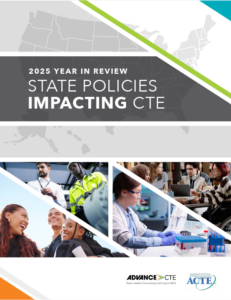
ACTE and Advance CTE just released their 13th annual joint report on state CTE policy, State Policies Impacting CTE: 2025 Year in Review, which examines state-level CTE and career readiness policy trends from across the nation.

In 2025, 49 states enacted 172 CTE-related policies: the largest volume of state CTE policy activity in a single year since before the coronavirus pandemic. These actions span legislation, executive orders and budget decisions that continue to strengthen education-to-career pathways and align learning with workforce needs.

This year’s analysis highlights sustained and growing state investment across the top policy categories, including:

  • Funding and industry partnerships/work-based learning, which tied as the most common policy areas
  • Data, reporting and accountability, reflecting states’ emphasis on transparency and return on investment
  • Access and supports and industry-recognized credentials, expanding opportunities for learners of all backgrounds

Read the 2025 report and register to join Advance CTE and ACTE March 5, 2–3 p.m. ET, for a companion webinar that will provide a high-level overview of national policy trends and a deeper dive into how Texas advanced policies in 2025 related to credentials, apprenticeships and workforce alignment.

Research Roundup: Noncredit Programs, Working Adult Outcomes, High School Policies, Youth Apprenticeship

Enrollment in Community College Noncredit Workforce Programs: study from the Education and Employment Research Center at Rutgers University investigates why students pursue nondegree workforce programs in community colleges.  Drawing on more than 80 student interviews across three community colleges, the researchers organized their findings into three broad categories. 

  • Diverse student populations with complex backgrounds: The noncredit students interviewed represent a wide range of backgrounds. Students ranged in age from 18 to 60 and had different financial and employment circumstances.  
  • Nonlinear and interrupted postsecondary pathways: Most of the students had prior college experience, primarily in credit-based degree pathways. Students cited various reasons for leaving those programs, including disengagement with the coursework, dislike of online learning during the COVID-19 pandemic, lack of motivation and financial need/personal hardships.  
  • Enrollment considerations: why now?: Students identified several reasons for enrolling in a noncredit program, including affordability, to seek employment/a career change, and alignment with future education goals such as four-year degrees and medical school. 

Employers as Partners in the Success of Working Adult Learners: A study from RAND evaluates the effectiveness of the Achieve Your Dream (AYD) initiative, an employer-community college partnership that allows adult workers to earn a free certificate or associate degree.  

Analysis of program data reveals that AYD participation is associated with increased attainment of short- and long-term certificates as well as associate degrees. This association is stronger for adult workers earning a short-term certificate. The researchers also surveyed AYD staff and employer partners and found that both spend a significant portion of their time focusing on AYD-related administrative tasks rather than direct program support.  

From these findings, the researchers developed a set of recommendations for future partnerships to consider, including leveraging federal tax allowances to build partnerships and investing more in student supports such as mentoring and career coaching, which AYD staff indicated they provide little of.  

The Future is High School: A new resource from the XQ Institute identifies a high school redesign framework focused on teacher professional development, postsecondary credits, work-based learning and K-16 alignment, with examples of relevant state policies. Alongside reports for each state, the national report found that, among the 10 policy actions identified in the framework: 

  • 46 states and D.C. award credit for work-based learning experiences such as internships and apprenticeships. 
  • 38 states and D.C. support high school students’ access to rigorous postsecondary coursework such as dual enrollment and early college programs.  
  • 32 states and D.C. have established high school graduate profiles that align academic and real-world competencies. 
  • 32 states have established policies that award credits based on mastery and not seat time. 
  • 23 states invest in teacher professional development opportunities that integrate academic and durable skills through instructional approaches such as project-based and competency-based learning. 
  • 12 states publish disaggregated postsecondary enrollment and persistence data for each high school, while 27 states and D.C. partially meet this requirement by publishing disaggregated postsecondary enrollment data. 

Embedding Youth Apprenticeship in High School Pathways: A report from the Partnership to Advance Youth Apprenticeship examines youth apprenticeship programs from across the nation and finds that each program utilizes the following four strategies to ensure success: 

  • Establishing strong, cross-sector partnerships and governance structures: Partnerships between K-12 schools, postsecondary institutions and industry leaders ensure that youth apprenticeship programs are aligned with academic and industry needs. The Charleston Regional Youth Apprenticeship program cultivates strong, sustained partnerships between schools and employers that connect students with high-demand careers.  
  • Designing programs to enable acceleration and multiple entry and exit points: These programs allow students to accelerate, pause or pivot along their education and career pathways. The LAUNCH Apprenticeship Network integrates related technical instruction through CTE and dual enrollment coursework, allowing students to earn postsecondary credit while participating in their apprenticeship. 
  • Establishing statewide policies, incentives and accountability measures: Effective state policies incentivize districts and schools to embed youth apprenticeship programs in high school pathways. The Tech Ready Apprentices for Careers in Kentucky program is intentionally embedded in the state’s CTE programs of study. 
  • Investing in high-use resources: Resources such as implementation toolkits or technical assistance can help sustain and scale successful program models. Youth Apprenticeship Wisconsin develops a suite of resources tailored to employers, school districts, students and parents. 

Integrating Academics and CTE

new resource from Advance CTE provides state leaders with a framework to use when integrating core subjects with CTE programs. After conducting a national landscape scan, the researchers identified three pillars essential to academic-CTE integration. 

  • Supportive Policies: These policies lay the foundation for integration through course sequencing, standards alignment and similar initiatives. In Delaware, CTE programs of study that apply to receive approval and funding must directly link the program’s technical standards to related academic standards. Similarly, for an Ohio CTE program to be considered exemplary by the state’s education department, it must integrate academic content into its curriculum. 
  • Enabling Policies: Building upon supportive policies, enabling policies work to remove barriers that may prevent the implementation or expansion of integrated academic and CTE programs. Modifying high school graduation requirements is one area states have been actively engaging with. For instance, Oregon recognizes applied academic credit earned through some CTE courses while Arkansas allows students to substitute core academic requirements with specific CTE coursework. Offering flexible guidance for teacher credentialing is another way states can bridge academic and CTE coursework. The Idaho Division of CTE, for example, has developed a resource detailing how core subject teachers can transition to CTE teaching. 
  • Implementation Supports: Once supportive and enabling policies are in place, the focus shifts to implementation and translating policy to practice. This primarily looks like offering professional development opportunities that prepare teachers and administrators to integrate CTE and academics. In Hawai’i and New Mexico, CTE teachers in each state are being trained to include math and numeracy-related skills into their courses. New York’s CTE Technical Assistance Center offers a specialized professional learning community focused on integrated academics.  

In addition to the framework and state program examples, Advance CTE also compiled a repository of state resources focused on academic-CTE integration, including crosswalks, graduation requirements and relevant state legislation.  

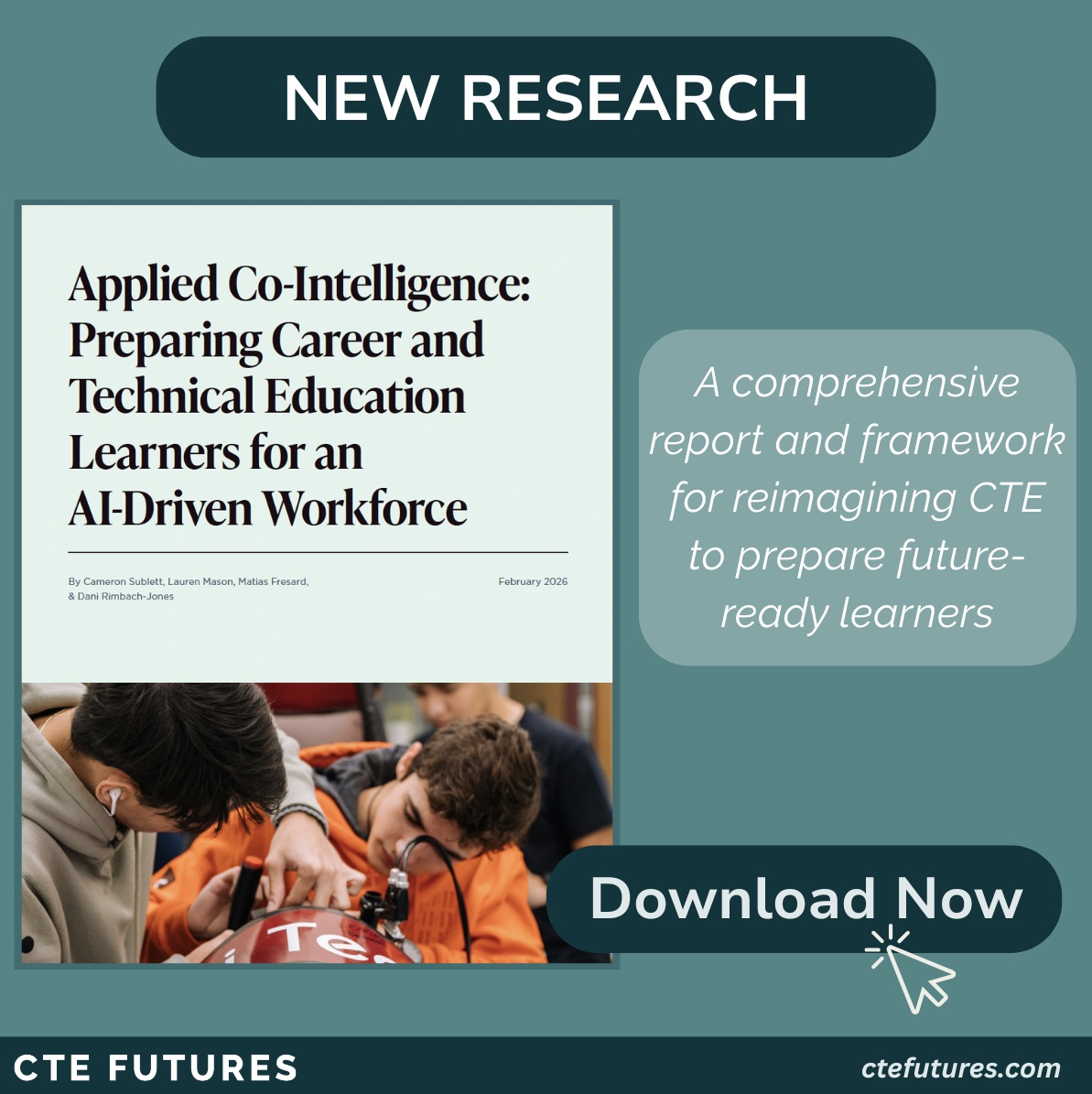
New Report – Applied Co-Intelligence: Preparing Career and Technical Education Learners for an AI-Driven Workforce

On Feb. 3, ACTE worked with CTE Futures, along with partners at Advance CTE, to release a comprehensive new report on the impact of AI on CTE programs: Applied Co-Intelligence: Preparing Career and Technical Education Learners for an AI-Driven Workforce.

This report, funded by the ECMC Foundation, examines how CTE can evolve to prepare students for an AI-driven workforce. It traces AI’s trajectory, explores its impact on the future of work, includes analysis of its impact across Career Clusters, and provides actionable guidance for CTE educators, policymakers, employers, and researchers.

The report introduces the Applied Co-Intelligence (ACI) model—a framework designed for the realities of technical education in the AI era. The ACI model goes beyond teaching learners to use AI tools to ensure they are equipped with the uniquely human skills to critique, direct, and collaborate with AI.

Drawing on research, interviews, policy developments, and emerging practice, the report serves as both a roadmap and a call to action for all stakeholders committed to equitable, future-ready workforce preparation in CTE.

A webinar will be held to discuss the report on Feb. 19 at 2:00 Eastern. You can register at https://acte.zoom.us/webinar/register/WN_U2w5w3bHRheeQ9CuEmib2g#/registration.

House Holds Hearing on AI in the Workplace

On February 3, the House Education and Workforce Committee held a hearing titled “Building an AI-ready America: Adopting AI at Work.” The witnesses included: 

  • Mr. Bradford Kelley, Shareholder, Littler Mendelson, P.C. 
  • Ms. Revana Sharfuddin, Research Fellow, Mercatus Center at George Mason University  
  • Ms. Tanya Goldman, Fellow, Workshop  
  • Mr. David Walton, Partner, Founder and Co-chair of AI, Data and Analytics Group, Fisher Phillips 

Throughout the hearing, lawmakers and witnesses discussed several issues related to how workers and employers use AI in their day-to-day work. Democratic lawmakers emphasized protecting workers from job displacement and potential misuses of AI by employers while Republicans focused on utilizing AI to strengthen the economy, create new jobs and make work easier for workers and employers. 

There was also discussion on the importance of data in understanding the impact of AI. Revana Sharfuddin of the Mercatus Center at George Mason University stated that “by investing in better data now, Congress can ensure that debates over training, labor standards and social insurance are grounded in evidence—and that AI adoption at work proceeds in a way that is both innovative and worker centered.” Sharfuddin also recommended that the Bureau of Labor Statistics and the Census Bureau launch AI-related data collections that are linked to worker outcomes.  

Several lawmakers touched on the impact of AI on education as well. Rep. John Mannion (D-NY) briefly discussed the Immersive Technology for the American Workforce Act, a bipartisan bill—endorsed by ACTE and partners—that would expand the use of virtual reality, augmented reality and simulation-based training tools in CTE and workforce development programs across the nation. Rep. Suzanne Bonamici (D-OR) mentioned her current work developing a framework that addresses AI education and workforce readiness. Responding to a question on AI in job training from Rep. Bobby Scott (D-VA), David Walton with Fisher Phillips indicated that AI could assist with upskilling and reskilling workers across career pathways. 

A recap and recording of the hearing can be found here. 

Research Roundup: Parent Views on Postsecondary CTE, WBL in Prison, Degree Apprenticeships, Postsecondary Enrollment

Parent Views on Postsecondary Education and Career Paths: A report from Britebound examines parents’ views on various postsecondary and career pathways. The researchers surveyed over 2,200 middle and high school parents nationwide in 2025 and found the following: 

  • Parents increasingly view CTE as an option for high-achieving students—35% in 2025 compared to 13% in 2019. 
  • Although most parents prefer traditional college degrees for their children, 17% prefer that their child pursue a nondegree pathway, up from 11% in 2019. 
  • 98% of parents see at least one benefit in nondegree pathways, particularly hands-on learning (60%) and high demand for skilled workers (55%). 
  • Most parents are familiar with different types of nondegree pathways, including trade/technical schools, apprenticeship programs and industry certifications. 
  • Parents who prefer nondegree pathways for their child identified as their top reasons why “they’ll learn skills for a specific career” (34%), “this will provide the best experience suited to my child’s interests and/or academic needs” (32%) and “it will increase their chances of being hired” (28%). 

Work-based Learning in Prison: study conducted by the Alliance for Higher Education in Prison and the American Institutes for Research examines the landscape of work-based learning (WBL) prison programs in 11 states. After conducting a policy scan and interviewing officials from state correctional agencies, the researchers compiled their findings into four broad categories: 

  • Buy-in and Championship: Support from state education and correctional agencies is key in creating and expanding WBL opportunities. Most states in the study indicate they receive support from state leaders as well as employers; however, several also noted pushback they face when providing incarcerated individuals with access to technology or free programming. 
  • Policy Pathway: Most states have policies that govern how WBL programs function, with greater or lesser flexibility for creating new opportunities, that can be leveraged to create new WBL programs in prisons. However, coordination among education, labor, correctional and other state agencies remains a challenge, and some states have laws that prohibit incarcerated individuals from accessing the internet or earning wages for work. 
  • Education, Training and Work Experience: State leaders leverage existing education and workforce programs to provide incarcerated individuals with experiences such as CTE and Registered Apprenticeship. However, resource and policy constraints limit the opportunities available to individuals.   
  • Infrastructure Readiness: States face significant infrastructure barriers when implementing WBL programs in prisons, including outdated facilities and payment processing systems. Remote WBL experiences require technology with specific software tailored to security protocols, and off-site work introduces logistical challenges relating to who provides and funds transportation. 

Mapping the Landscape of Degree Apprenticeship: A report from New America examines the landscape of degree apprenticeship programs—a model that integrates Registered Apprenticeship programs with associate and bachelor’s degrees.  

After conducting a nationwide scan, the researchers found that degree apprenticeship programs are concentrated in teaching and education (33%), construction (13%) and maintenance and repair (13%). Furthermore, seven of the 10 occupations most commonly found using degree apprenticeships pay above the median annual wage. In addition, about two-thirds of degree apprenticeship programs are awarded at the associate degree level, the majority applied science degrees. Three states—Alabama, Illinois and North Carolina—account for more than a quarter of total offerings across the nation, owing to specific policies in those states. 

In addition to the landscape analysis, an expert panel developed a set of principles that define what high-quality degree apprenticeship programs should look like. These principles include ensuring programs offer wraparound supports and aligning academic coursework with industry-relevant competencies.  

Fall 2025 Postsecondary Enrollment: The National Student Clearinghouse Research Center recently released fall 2025 postsecondary enrollment data. Major takeaways from the data include the following: 

  • Total undergraduate enrollment grew by 1.2% compared to the previous fall, with community college enrollment increasing the most (+3%). Enrollment in community colleges with a high vocational focus increased by 2.9%. 
  • Growth in undergraduate certificate (+1.9%) and associate degree programs (+2.2%) outpaced growth in bachelor’s degree programs (+0.9%). 
  • Trade-related programs in community colleges experienced enrollment growth, including mechanic and repair technicians (+6%), construction trades (+5%) and engineering technicians (+4.9%). Health care (+7.7%) and personal and culinary services (+4.4%) also experienced enrollment growth in community colleges. 
  • Dual enrollment students grew by 3%, making up 10.3% of all undergraduates. 
  • Multiracial (+4.6%), Black (+3.8%), Asian (2.9%) and Hispanic (+2.6%) students experienced undergraduate enrollment growth, while white students experienced a 2.5% enrollment decline. 

Creating Career-connected Learning Ecosystems

Two briefs published by Bellwether provide state policymakers with strategies to expand career-connected learning opportunities in their schools, such as CTE and early college high schools (ECHS).  

The first brief contains an overview of different career-connected learning models and policy recommendations for state policymakers to consider when supporting local programs. Additionally, a table summarizes the benefits students reap across models based on the research. For instance, CTE programs and CTE dual credit courses are associated with strong high school, postsecondary and workforce outcomes. Policy recommendations the authors outline include the following: 

  • Developing and sustaining a credential of value framework so that students, families, teachers and employers are aware of high-value, industry-aligned credentials 
  • Expanding alternative certification pathways, easing licensure requirements and other actions that encourage industry professionals to become CTE teachers 
  • Implementing a specific funding mechanism and agreement on how dual enrollment costs are allocated between K-12 school districts and postsecondary institutions, avoiding potential confusion 
  • Creating or adopting frameworks that define specific roles, definitions, functions and goals of various career-connected learning models 

The second brief draws from the career-connected learning ecosystems of four states to provide lawmakers with a series of recommendations on building and supporting new ecosystems in their own state. The states profiled—Colorado, Delaware, Tennessee and Texas—have each taken considerable steps in advancing state policy to support career-connected learning and can serve as a basis for other states interested in implementing similar work: 

  • Colorado’s S.B. 315 consolidated the state’s postsecondary and workforce readiness programs into three funding streams, better aligning the state’s education and workforce priorities 
  • Delaware Pathways connects students and employers to develop career pathways that begin in middle school 

Research Roundup: Nondegree Credentials, Costs of CTE Schools, CTE Teacher Shortages, CTE Performance by Gender

Market Value of Nondegree Credentials: A report from the Brookings Institution examines the wage premiums workers gain from attaining specific nondegree credentials, such as digital badges and industry certifications.  

After analyzing the resumes and wages of over 37 million U.S. workers, the researchers found that, on average, a worker’s first job-relevant nondegree credential yields them 3.8% higher wages compared to similar workers without a credential—double the 1.8% premium from a job-irrelevant credential. Analyzing by type of nondegree credential, a worker’s first job-relevant microcredential yields the highest wage premium (4.5%), followed by job-relevant industry certifications (4.1%). Premiums associated with digital badges and academic certificates are smaller and do not rely on job relevance.  

Non-college and early career workers realize particularly high wage premiums for their first relevant nondegree credential (6.8% and 6.1%, respectively), indicating that these credentials offer strong occupational pathways to high-wage careers for workers who are not college educated or have limited work experience.  

Administrator Perspectives on CTE Staffing Challenges: A paper from the Georgia Policy Labs examines how CTE administrators perceive and tackle CTE teacher shortages in their districts and schools. The researchers surveyed and interviewed CTE administrators from Massachusetts and Washington, interviewed each state’s CTE director and identified six overarching themes: 

  • The Nature of Hiring Challenges: CTE teacher vacancies differed across Massachusetts and Washington by Career Cluster, but administrators in both states identify teacher attrition as the main reason why positions go unfilled. Furthermore, administrators in both states acknowledge the difficulty in finding candidates that meet licensure and experience needs while also competing with industry salaries. 
  • Staffing Strategies: When a vacancy occurs, administrators from both states indicate that they usually place a teacher who lacks CTE experience into the course. If the vacancy is immediate and no external help is available, existing teachers may absorb the workload instead, a practice especially common in Washington.  
  • Impacts of Challenges and Strategies: Vacancies and a lack of qualified applicants result in administrators either relying on substitutes or shuttering a course, restricting access. The costs of constantly hiring and training teachers also strains districts. 
  • District Flexibilities: Administrators have very little leeway when recruiting or retaining CTE teachers but have adapted various go-to strategies. These include placing teachers with industry experience higher on salary schedules, covering costs for certification and developing “grow-your-own” programs. 
  • Hiring Preferences: Administrators were presented five random pairs of hypothetical CTE teacher profiles and asked to identify ones they preferred. Respondents in both states most valued prior relevant industry experience and least valued full teacher certification.  
  • Policy Recommendations: Nearly half of the administrators in both states indicated that greater flexibility in licensure rules would help the most with CTE teacher hiring, such as allowing CTE teachers to substitute teacher certification exams with industry credentials. 

Exploring the Costs of CTE-dedicated High Schools in New York City: A report from the Research Alliance for New York City Schools analyzes and compares the per pupil costs and return on investment for students enrolled in CTE-dedicated high schools to other types of high schools in the New York City Public Schools system.  

The researchers specifically examined students who entered high school between 2013-16 and found that CTE-dedicated high schools spent about 5% more per pupil compared to other types of high schools. The majority of this difference is spending for teacher salaries, as CTE-dedicated high schools have significantly smaller student-teacher ratios. 

Despite these additional costs, CTE-dedicated high schools showcase a return on investment in both high school graduation and college-going rates. Particularly, newer schools aligned with college degree pathways were the least costly and the most effective at producing graduates and college enrollees. Mixed-aligned schools—where students pursue careers that may require some postsecondary education but not necessarily a bachelor’s degree—also have a positive return on investment with respect to graduation. Workforce-aligned schools experience no positive return on investment for either high school graduation or college enrollment, but the authors note students in these schools often aim to enter the workforce directly after high school. 

A Post-pandemic Analysis of CTE Performance by Gender: A journal article by Ericca S. Douglas and John R. Slate in the American Journal of STEM Education examines CTE participation and completion rates by gender in Texas from 2020-23. 

The researchers found that, across all three school years, girls had significantly higher CTE concentration and completion rates while boys participated in a wider variety of clusters. Unsurprisingly, boys dominated enrollment in clusters aligned with traditionally male fields, such as Manufacturing, while girls were concentrated in clusters like Health Science and Education and Training. Completion rates varied by cluster as well, with girls generally having higher completion rates across clusters compared to boys. Girls and boys had similar concentration and completion rates for some clusters, such as Agriculture and Law and Public Services. 
DC Digest: January 10-16 

ACTE continues to work closely alongside lawmakers as the deadline for Congress to approve appropriations bills approaches. The Senate advanced funding legislation that rejects most of the Trump Administration’s requests to cut funding from the National Science Foundation and other scientific research initiatives. Negotiations surrounding funding for the Education (ED) and Labor Departments (DOL) continued this week. In other news, ACTE has been coordinating activities for CTE Month and preparing to introduce a resolution to Congress. Read more updates below. 

  • ACTION ALERT: Ask Your Members of Congress: Support Education Funding in the FY 2026 Appropriations Bill! Congress returned to session this month and has until January 30 to finalize FY 2026 appropriation bills before the current continuing resolution expires. Lawmakers are still negotiating education and workforce funding, with the Senate proposing level funding for Perkins while the House recommends a $25 million increase but makes significant funding cuts in other programs. CLICK HERE to urge your Members of Congress to support education and workforce development funding as they finalize FY 2026 appropriations bills!  
  • Updated CTE Advocacy Resources: This week, ACTE published updated versions of our “What is CTE?” and “CTE Works!” fact sheets, providing CTE advocates and practitioners with essential information for their work. Read more on the blog here. 
  • ED Rulemaking Committee Reaches Consensus on a New Accountability Framework: Last week, the AHEAD Committee at ED reached consensus on a number of different issues related to postsecondary education under the One Big Beautiful Bill Act (OBBBA). Among the major decisions regulators made was approving a new accountability framework for postsecondary programs, including changes to existing gainful employment regulations. Under the framework, programs that fail to demonstrate their graduates earn more than a high school graduate for two out of three years will be ineligible to receive Federal Direct Loans. If failing programs make up half of an institution’s students or Title IV funding, students at the institution will lose access to Pell Grants as well. 
  • National Postsecondary Enrollment Data Released: This week, the National Student Clearinghouse Research Center released national fall 2025 postsecondary enrollment data. Total postsecondary enrollment slightly increased compared to the previous fall, with higher growth occurring in certificate and two-year vocational and technical programs. 
  • Workforce Development Top Priority for States in 2026: A report from the State Higher Education Executive Officers Association found that economic and workforce development is the top policy issue state higher education agencies are focusing on in 2026. States are working on a number of initiatives to better align their education and workforce systems, from preparing for Workforce Pell to collaborating with industry partners. 
  • ED Announces Next Steps in Postsecondary IAA: On Jan. 15, ED announced the next steps it will take to implement its interagency agreement (IAA) between the Office of Postsecondary Education (OPE) and the DOL. On the week of Jan 20, OPE staff in the Higher Education Programs (HEP) Division will be detailed to work at the DOL, and HEP grantees will transition to the DOL’s grant management system. This follows ED’s move last year to transition several OCTAE staff members and management of Perkins funding to the DOL.  
  • House Education Committee Holds Hearing on AI: On Jan 14, the House Education & Workforce Committee held a hearing on AI’s impact on education and the workforce. Testimony during the hearing focused on various topics, including credentials of value and workforce development programs that incorporate AI tools. Listen to the hearing here and read more on the blog. 
  • House Science Committee Holds Additional AI Hearing: Also on Jan 14, the House Science and Technology Subcommittee on Research and Technology held a hearing on the AI Action Plan. White House Office of Science and Technology Policy Director Michael Kratsios testified on the administration’s AI strategy plan and  emphasized the need for a unified national framework to support innovation and avoid a patchwork of state regulations. 
  • New Democrat Coalition Releases Workforce & Ed Agenda: On Jan 9, the New Democrat Coalition—the largest Democratic Caucus in the House—released their workforce and education agenda, focusing on ensuring students have access to public education and graduate high school college and career ready. Noteworthy priorities include expanding Registered Apprenticeship programs and utilizing emerging technologies to teach students career-ready skills. Read more here. 
  • ED, Interior and DOL Invite Tribal Consultation on IAAs: On Jan. 9, ED announced that it sent a letter inviting tribal leaders to provide feedback to ED on the interagency agreements (IAA) between ED, Department of Interior (DOI) and DOL, affecting Native American education programs. The consultation will be led by ED’s Office of Indian Education.
  • Senate Commerce Committee Holds Hearing on Impact of Technology: On January 15, the Senate Commerce, Science, and Transportation Committee held a hearing entitled, “Plugged Out: Examining the Impact of Technology on America’s Youth.” A significant portion of the hearing was focused on educational technology, and you can read more on the blog!

# # # # # #