Perkins Grant Management
One of the most significant responsibilities of CTE administration is managing the federal Perkins CTE grant. Whether that responsibility falls to you or to a staff member with more direct oversight over CTE, it’s important for you to be aware of Perkins grant activities and timelines.
As the primary federal support for CTE, the Carl D. Perkins Career and Technical Education Act, last reauthorized in 2018 as the Strengthening Career and Technical Education for the 21st Century Act and known as Perkins V, provides a significant amount of funding for CTE programs in many states. Even in states that have robust state funding for CTE, it may be the only funding stream dedicated to CTE innovation and improvement – to developing new programs and improving existing programs, not to funding basic operational costs like everyday consumable supplies.
In addition to its importance as a source of funding, Perkins is significant because it requires accountability for student performance outcomes; incentivizes increased alignment across CTE and core academics, across education and the labor market, and across the secondary, postsecondary and workforce systems; and encourages expanded access to high-quality CTE programs. The policies that states adopt under Perkins often drive state and local funding investments in CTE.
Learn more! ACTE’s Perkins 101 series describes, in an easy-to-understand manner, the components of Perkins V legislation to anyone new to the purpose, importance and impact of this federal law.
Each recipient of Perkins funding must perform a number of administrative duties to stay in good standing. These responsibilities often fall to the Perkins grant manager or coordinator. This job may be a full-time role or may be combined with other tasks.
While the particulars will vary by state and locality, the Perkins grant manager in your district or institution likely oversees budgeting, inventory and reporting for the Perkins grant and leads the periodic comprehensive local needs assessment (CLNA) required of Perkins grantees.
ACTE has developed a checklist to help you learn more about this role and gather the information and contacts who can help you, or a member of your staff, coordinate the Perkins grant.
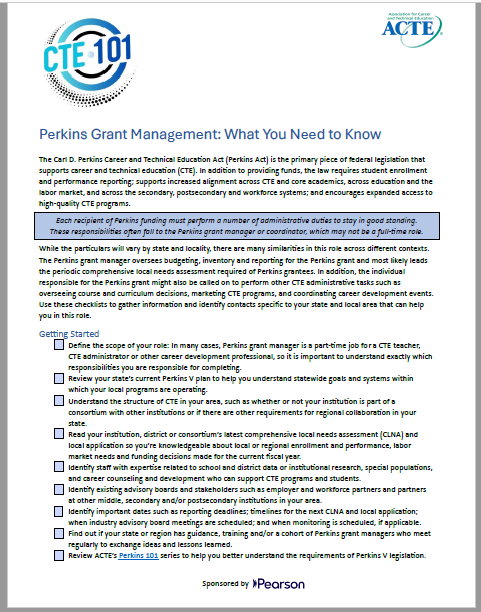
Download the “Perkins Grant Management: What You Need to Know” checklist
Perkins funding is distributed from the federal government to states and from states to local CTE providers. On the secondary level, those providers are usually school districts. However, there are some exceptions:
- Secondary-postsecondary consortia: A few states require, incentivize or encourage secondary and postsecondary CTE providers within a region of a state to form a consortium to foster CTE program alignment across secondary and postsecondary levels.
- Minimal allocation consortia: Local secondary recipients, usually in rural areas, that would receive less than $15,000 based on the formula must form a consortium with other secondary recipients to be eligible for funding. On the postsecondary level, the minimum is $50,000.
- Area technical centers: These institutions, which usually provide CTE programs for students across a region, may receive funding through the school district or directly from the state, depending on where they fit in the state structure and whether they serve secondary students, postsecondary and adult students, or both.
To be eligible to receive funds, a recipient must have submitted to the state a local application, usually once every four years, that aligns with the state Perkins plan. Local grantees must also submit updates, annual budgets or new applications as required by their state.
The local application describes how the recipient will use funds to respond to needs identified in their CLNA. The CLNA is a new requirement under Perkins V for each local recipient to evaluate CTE program quality, student performance and supports, and alignment to the labor market at least every two years.
In addition to meeting needs identified by the CLNA, local recipients must use Perkins funding for the following six required uses:
- Providing career exploration and career development activities
- Providing professional development for educators
- Providing the skills necessary to pursue high-skill, high-wage or in-demand occupations or sectors
- Supporting the integration of academics and CTE
- Supporting implementation of CTE program elements that result in increased student achievement (20 permissible activities are listed under this required use)
- Conducting evaluation activities
One key provision to remember is supplement-not-supplant, which requires that Perkins funds not be used to replace state and local sources of funding for CTE programs. For instance, you cannot use Perkins funds to pay the salary of a CTE instructor who was previously paid using district funds, unless there is a documented change in circumstances such as a reduction in funding from the state to the district.
As part of the local application and again at least once every two years, depending on the timeline set by each state, local funding recipients must conduct a CLNA. Recipients must describe how they will use funds to “develop, coordinate, implement, or improve career and technical education programs to meet the needs identified in the comprehensive needs assessment.”
This process evaluates – in collaboration with a wide variety of stakeholders such as educators, business and industry partners, parents and students – the following components:
- Student performance on Perkins V accountability indicators, disaggregated by a number of learner groups
- Alignment of programs to labor market needs
- Whether programs are of sufficient size, scope and quality to meet all students’ needs
- Progress toward implementing programs and programs of study
- Efforts to improve recruitment, retention and training of faculty and staff
- Progress toward improving student access
States are required to develop a CLNA template for local recipients to complete to meet this requirement. These templates usually include guiding questions; descriptions of relevant quantitative and qualitative data that will help answer those questions; and places to fill in responses.
Examples:
Many states support local recipients with additional resources for the CLNA, including by providing relevant labor market information and helping to facilitate stakeholder input.
If you are part of a secondary-postsecondary consortium, as in Minnesota, or a minimal allocation consortium, you will most likely need to complete the CLNA and local application with other institutions. In addition, some states like Colorado require partial or full regional collaboration on the CLNA but not on the local application.
State-specific Info: Find CLNA documents for your state with our State-by-State Resource List.
In addition to programming decisions made from the CLNA, your state likely has procedures for approval, review and monitoring of CTE programs and programs of study that receive Perkins funding to be aware of.
It’s also important to understand how requirements for any non-Perkins funding sources like state categorical CTE funding align with and differ from Perkins requirements.
Perkins V designates several learner groups as special populations. Enrollment and performance data must be disaggregated by these population groups and analyzed for access and success gaps.
Special Populations Defined in Perkins V
- Individuals with disabilities
- Individuals from economically disadvantaged families
- Individuals preparing for careers that are nontraditional for their gender
- Out-of-workforce individuals
- Single parents, including single pregnant women
- English learners
- Individuals experiencing homelessness
- Youth who are in, or have aged out of, the foster care system
- Youth with a parent who is a member of the armed forces and on active duty
Local grantees are also permitted, but not required, to use funds to support these learner groups. For instance, Perkins funds can be used for introductory courses or activities focused on career exploration and career awareness, including for non-traditional fields in which one gender predominates in the workforce, or for providing teachers, counselors and other staff with professional learning on how to provide accommodations for individuals with disabilities.

Reflection Questions
The following questions can help you think through both the information and resources you have and what you might need to help you understand Perkins grant management. These questions, among others, can also be found in the fillable reflection tool and are addressed with greater detail in the “Perkins Grant Management: What You Need to Know” checklist.
- Who is responsible for managing the Perkins grant in your school or district?
- How much funding does your district or institution receive from Perkins?
- What teacher salaries, equipment and other activities are funded by Perkins?
- What are the timelines and requirements for your four-year local application and local application revisions?
- What are the timelines and requirements for your CLNA?
- Is your institution part of a consortium or are there other requirements for regional collaboration in your state for the CLNA and/or local application?
- What are the timelines and requirements for state approval, review and monitoring of CTE programs and programs of study that receive Perkins funding?