
Partnerships and Advisory Boards
CTE relies on a variety of partnerships to deliver programs that meet the needs of learners and families, the workforce and the community. These stakeholders support programs and, in turn, reap benefits from ensuring CTE programs are rigorous, relevant and preparing learners for further education and careers.
One of the central roles that administrators play in CTE is connecting with partners to advocate for CTE and to leverage their input to inform program planning and improvement.
CTE partners, including employers, industry representatives, other education providers and community leaders, can benefit from engaging with CTE programs by helping to cultivate:
- Career-ready graduates with relevant technical, academic and employability skills
- Positive relationships with schools
- Connections with current and future students and employees
- Thriving learners, workers and communities
These benefits are backed up by data. For instance, about three-quarters of employers want to partner more with CTE, while 93% of employers recruiting from CTE programs find those programs beneficial to their bottom line. Education partners benefit, too: CTE dual enrollment partnerships among high schools and colleges increase the chance students will earn postsecondary credentials.
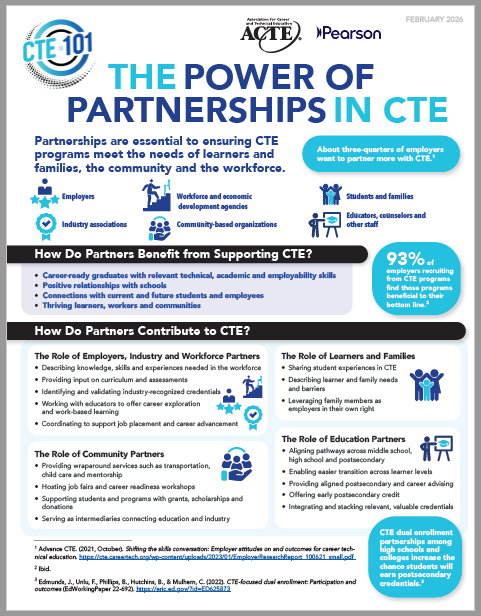
Download “The Power of Partnerships in CTE” fact sheet
CTE programs engage with a range of partners for a variety of purposes: to understand learner and family needs, to identify community supports, to ensure programs are aligned to workforce needs, to develop work-based learning opportunities and to advocate for CTE, among others.
- Employers: Local employers are key partners. They’re the ones hoping to hire your students in the near or distant future, so their input on your curriculum, credentials and other opportunities is invaluable. They may also have experiential learning experiences to offer your learners.
- Industry Associations and Organizations: Industry associations are already connected with a variety of employers. These groups are tuned into employment needs and forecasts across different industries or within one large industry, including new and emerging skill needs and sectors for future employment opportunities.
- Workforce and Economic Development Agencies: Local workforce boards that carry out activities under the Workforce Innovation and Opportunity Act (WIOA) and local economic development agencies can be important partners that ensure alignment of education and training programs with related workforce and economic development activities, as part of broader sector strategies or career pathway initiatives within a metropolitan area or region.
- Community-based Organizations: Community-based organizations help community members find employment, receive mental health resources, access child care and transportation, and connect with advisers or coaches – and can help bring these supports to your students. They may also represent underserved groups who could benefit from support to access and succeed in your programs.
- Education Representatives: Educators within the CTE program of study – administrators, instructors and faculty members, school counselors and advisers, work-based learning coordinators and others – can provide important information to other partners about program offerings. It is especially important that representatives from other institutions in the program of study are represented as they will have knowledge, resources and networks that educators in your institution or district may not have. In addition, staff such as special education teachers and paraprofessionals who support English learners can provide important perspectives on student needs.
- Students and Families: Students are the experts on their own experiences and challenges, so engaging them as partners in your programs is essential. Learners are the best sources to tell you about their experiences in your CTE programs and the supports they need. Parents and guardians may also be aware of their students’ barriers, challenges and goals and often work as employers in the community, so they can bring multiple lenses.
- Policymakers and Media: Local and state representatives are invested in making their communities more attractive for employers and workers, while news media is looking for human interest stories. Both can be important partners in communicating the value of your CTE programs.
To facilitate partnership development and engagement, CTE programs often have advisory boards or committees comprised of many of the above-named partners. These committees meet throughout the year to gather input and work on joint activities like offering career exploration experiences and updating the program’s list of industry credentials.
Larger schools and districts likely have different advisory boards for each CTE program area, while a small, rural school might have one overarching advisory committee for all its CTE programs.
Many states have guides or handbooks to support local CTE advisory boards. These guides often include requirements or suggestions on advisory board composition; tips on recruitment; descriptions of roles and responsibilities for participants; and ideas for how to recognize partners for their contributions.
In addition, these toolkits frequently include templates that local leaders can adjust to their own needs such as sample charters, mission statements, bylaws, rosters, agendas, meeting minutes and partner recruitment letters.
Examples:
- Michigan Program Advisory Committee Toolkit
- Connecticut CTE Advisory Committee Handbook
- Colorado Advisory Committee Handbook
Regardless of the exact processes, the most important thing about “advisory” boards is their advice! Meetings and activities should be structured in ways to maximize feedback from partners, not just to share activities with them, and to make the most efficient use of everyone’s time.
In addition to periodic advisory board meetings, this group should also contribute to the comprehensive local needs assessment (CLNA), which occurs at least once every two years, depending on the timeline set by each state, and is a requirement for receiving funding through the federal Perkins CTE Act. We’ll address this topic more thoroughly in the section on Perkins Grant Management.
State-specific Info: Find CTE advisory board resources for your state with our State-by-State Resource List.
Advisory board best practices call for continuous communication among members, along with periodic meetings for the group to collaborate on the following tasks. Not every one of these topics will be covered in each meeting, but these are the major responsibilities that an advisory board might work through on a two- or three-year cycle:
- Reviewing and offering input on the CTE program’s standards and curriculum, including vertical alignment across middle grades, high school and postsecondary institutions
- Verifying the list of industry credentials available through the program or suggesting new ones to incorporate
- Evaluating the CTE program’s facilities and equipment
- Identifying, providing and evaluating career exploration and work-based learning experiences
- Analyzing data on course enrollments and student performance to foster program improvement
- Identifying community supports that can help learners and families
In addition, partners may provide more tangible benefits to the program such as equipment donations as well as scholarships to cover costs like student participation and travel fees for CTSO events.
Tool: This ACTE table of WBL activities can help you organize partner interest in offering these experiences.
One of administrators’ most important roles is to serve as the liaison between CTE programs and the community, regularly interacting with local Chambers of Commerce, economic development boards, industry associations and community organizations.
This relationship-building serves several purposes:
- Keeping the CTE administrator up to date on industry and community needs
- Ensuring employers and community representatives are aware of CTE programs’ benefits and challenges
- Identifying individuals, companies and organizations who are interested in engaging more deeply by joining advisory boards or offering work-based learning
Following up on these leads will likely require more targeted, one-on-one communication to discuss the benefits and responsibilities associated with deeper engagement.
Administrators are perennially busy, but it’s important to protect this time to engage with the workforce and community in order to build reciprocal relationships.
Recognizing Partners
While the major benefit partners accrue from engaging with your CTE programs is supporting students and developing the local workforce, partners should also be recognized for their contributions. This recognition may include:
- Partner logos included in school and program materials
- Sharing relevant partner promotional materials such as employment opportunities
- Hosting a CTE Signing Day that recognizes graduates entering the local workforce and the employers hiring them
Henrico County Public Schools in Virginia has hosted such an event for several years with great success, generating a lot of attention for the program.
Advocating for CTE
While state and local policies vary as to the role that education staff are allowed to play in advocating to policymakers, many CTE leaders are empowered to meet with legislators to share about CTE success stories and the need for additional investments. They may speak at school board meetings, testify in front of legislatures and invite policymakers to tour their programs.
In addition, as a CTE leader, you may generate positive press for your programs by writing op-eds and letters to the editor and reaching out to local journalists and community leaders to invite them to visit.

Reflection Questions
The following questions can help you understand the scope of your CTE program partnerships and consider how to build more engagement. These questions, among others, can also be found in the fillable reflection tool.
- Who are your CTE program partners?
- Do you have partnerships across employers and industry, education and the community?
- How many advisory boards do your CTE programs of study have?
- When and how often do your advisory boards meet?
- What activities do your advisory boards engage in?
- What guides and templates exist to help you with advisory board logistics?
- How do your CTE programs interact with the community?
- How do your CTE programs recruit and recognize partners?
- How do your CTE programs interact with policymakers and the media?
In addition, to help you evaluate the state of your partnerships, you can consult the Business and Community Partnerships element of the ACTE Quality CTE Program of Study Framework® as well as online courses on the same subject through ACTE’s CTE Learn platform.