How CTE is Organized
CTE courses are organized and sequenced in ways that often differ from academic coursework. Understanding how CTE courses relate to and build on each other can help you with course scheduling and partnering across institutions providing CTE.
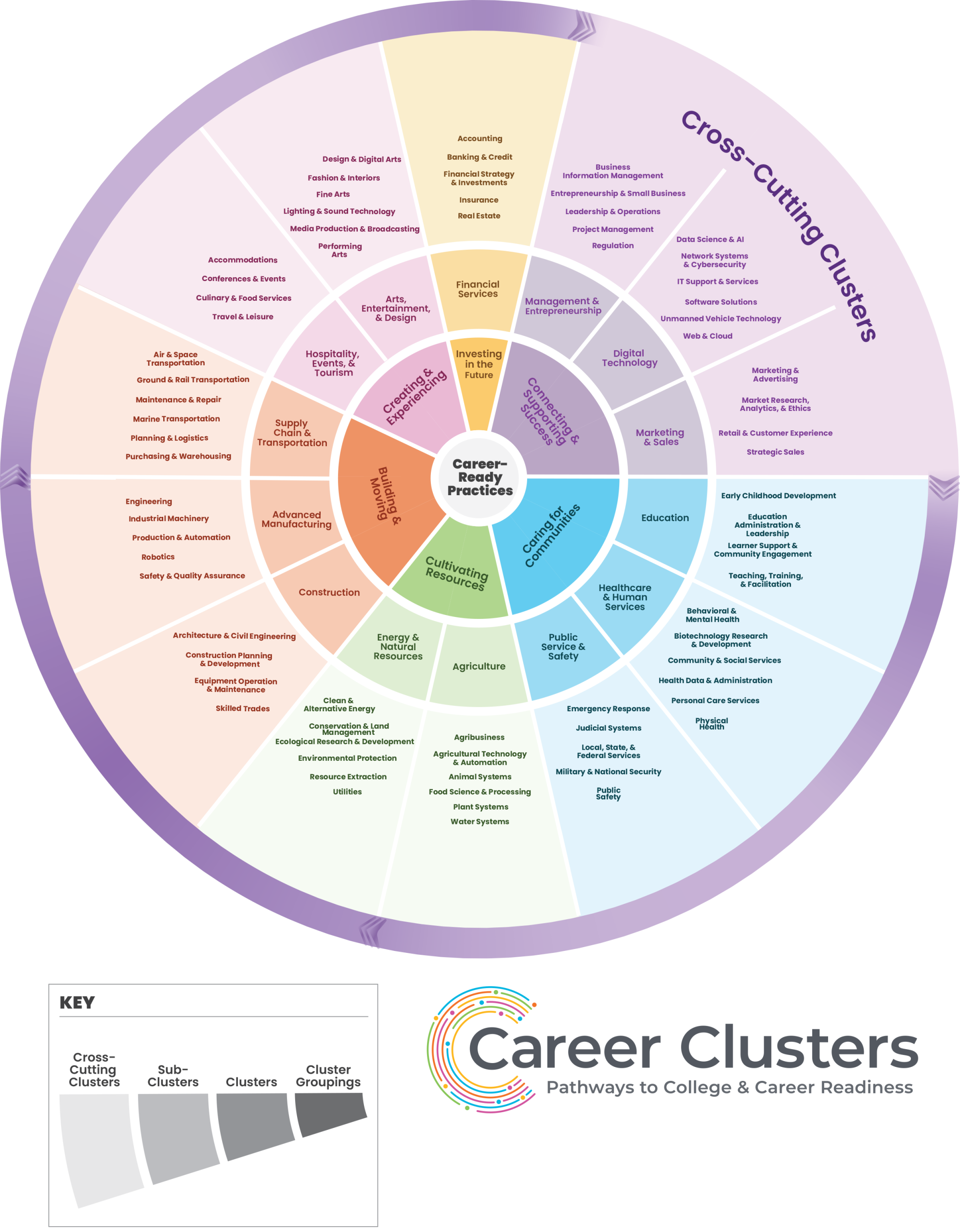
The National Career Clusters® Framework, developed by Advance CTE, serves as a guiding organizational structure for careers by knowledge, skills and interests.
In the most recent version, there are 14 Career Clusters such as Healthcare and Human Services; Hospitality, Events and Tourism; and Advanced Manufacturing.
Among the 14 Clusters, there are three Cross-Cutting Clusters that incorporate career areas in their own right AND skills that intersect with all the other Clusters. These Cross-Cutting Clusters are Digital Technology, Management and Entrepreneurship, and Marketing and Sales.
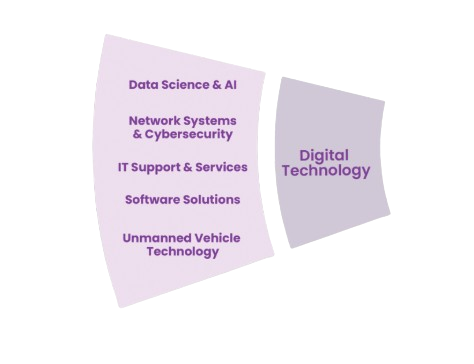
Within the Clusters are 72 Sub-Clusters. For instance, here is a zoom-in on the Digital Technology Cluster, which is one of the Cross-Cutting Clusters, and its five Sub-Clusters:
Many states use the Clusters Framework as a way of organizing their CTE programs and course offerings. It can also support hiring, particularly if teacher licensure areas in your state are grouped by Cluster, and it can help school counselors, teachers, work-based learning/career development coordinators and other staff in organizing career awareness and planning activities.
Even if your state organizes CTE programs in different ways, those state-defined content areas must crosswalk to the Career Clusters for required reporting under the federal Perkins CTE Act.
While Clusters are a way of grouping like programs and careers across CTE, a program of study is a method for vertically organizing CTE and academic courses and experiential learning experiences in a single career area. It is officially defined in federal Perkins CTE legislation as “a coordinated, nonduplicative sequence of academic and technical content at the secondary and postsecondary level.” While the term “program of study” is defined by Perkins, it may be used differently in your state or local context. (The same is true for the term “career pathway,” which is defined in the Workforce Innovation and Opportunity Act (WIOA) but is often used in other ways, too.)
Coursework
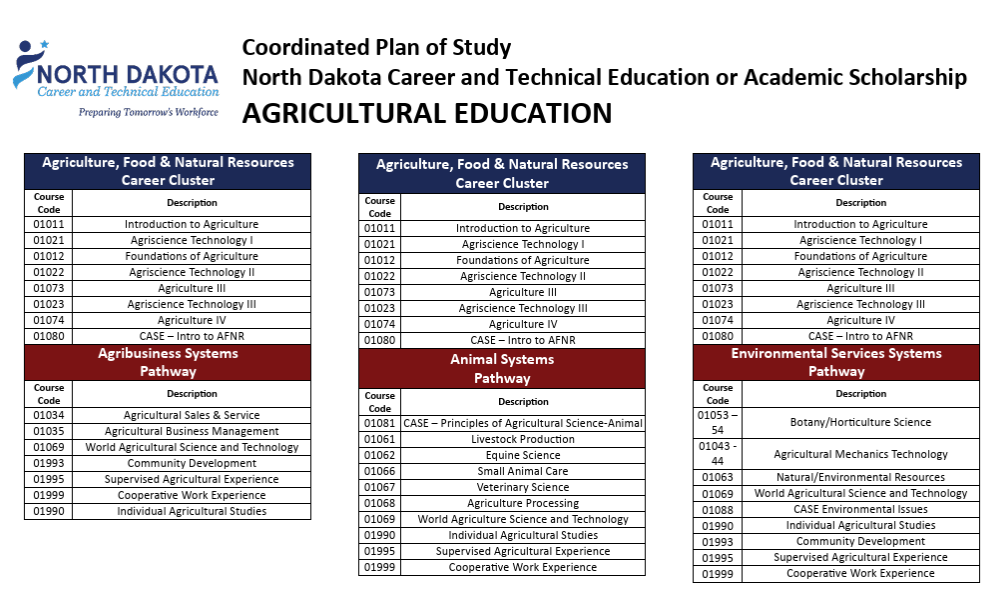
Most programs of study include a sequence of two to four credits worth of CTE coursework at the high school level, depending on the state. The CTE portion of a program of study typically begins with a broad introductory-level course and may end with a more specialized capstone experience. A three-course CTE sequence that increases in specificity is common in many states.
The program of study incorporates not only CTE courses but also academic courses that will help students reach their education and career goals. For example:
- A CTE student taking information technology courses might also enroll in Advanced Placement or IB computer science.
- A health care student may earn both CTE and academic credit in an anatomy course.
In addition to secondary courses, a CTE program of study must incorporate relevant postsecondary courses that become more occupationally specific so that a learner can bridge from high school to postsecondary without unnecessary repetition of courses and content. Within the program of study, there may also be options for high school students to earn early postsecondary credit in CTE at local community and technical colleges or area technical centers.
Credentials
The program of study must also incorporate and/or culminate in a recognized postsecondary credential, a term defined in WIOA that includes education and industry credentials. On the high school level, these credentials are most likely to be certifications from industry or postsecondary certificates awarded by a college.
Experiential Learning
Finally, the program of study may also include, as applicable and relevant, experiential learning components like the following:
- Work-based learning (WBL) opportunities such as job shadows, internships and apprenticeships
- Career and technical student organizations (CTSOs), which are intracurricular groups that incorporate leadership development, career exploration and competitive events
Many states map out programs of study at the state level for schools to use, while others leave program of study development to the local level, and still others use both strategies. As an administrator involved with CTE, your job may include helping to develop and map these programs of study, particularly in regard to where and when courses are offered so that locations and schedules can maximize learner access.
Examples:
CTE is delivered across multiple institutions:
- Middle schools: Institutions that serve 5th-8th grade students, where CTE experiences are primarily focused on career exploration. Federal Perkins CTE funding can be spent down to grade 5.
- Comprehensive high schools: Traditional high schools that offer academic courses along with CTE and other electives.
- CTE-focused high schools: Specialized or magnet high schools that include academics but emphasize CTE courses and experiences, sometimes organized around a specific career area such as health care or IT.
- Career academies: Schools-within-a-school that organize technical and academic coursework around a specific career area.
- Area technical centers: Shared-time institutions that serve students across a district or region.
- Community and technical colleges: Postsecondary institutions that offer for-credit certificate and associate degree programs as well as non-credit workforce programs in a variety of CTE fields. These institutions may work with schools and districts to provide dual and concurrent enrollment courses to high school students on the high school campus or at the college.
A specific CTE program of study may include introductory courses at a comprehensive high school, more advanced courses offered at an area technical center, and courses that are taught through dual or concurrent enrollment with a local postsecondary institution.
Part of the challenge of coordinating programs of study is scheduling course offerings in the appropriate sequence across institutions, taking into consideration geographic proximity, differing bell schedules, and availability of facilities, equipment and qualified instructors.
In addition, scheduling should aim to maximize access for all learners, including students with disabilities or English learners who may have other courses or pull-outs that conflict with elective class periods when CTE is usually offered.
The program of study maps and tools that describe courses, sequences and related credentials and experiences tend to be relatively technical documents. To describe CTE programs in an easy-to-understand way for students and families, many CTE programs also produce brochures, videos, informative websites and similar recruitment materials in languages common in those communities.
Your role as a CTE administrator may include developing or signing off on these marketing tools. Luckily, you don’t have to reinvent the wheel! Your school or district may already produce such materials. Another source is Advance CTE, which has created customizable templates in Canva to help CTE programs communicate with learners and families, including social media templates, postcards and more.
Examples:

Reflection Questions
The following questions can help you understand how CTE courses are organized in your school or district and the considerations you need to take into account when planning CTE course sequences. These questions, among others, can also be found in the fillable reflection tool.
- What program of study tools are available to help you understand the scope and sequence of your CTE programs?
- What partner institutions are involved in your CTE programs of study?
- What scheduling and transportation considerations should you keep in mind when planning course offerings across your CTE programs of study?
- What tools are available to help you market CTE programs to current and future students and families?
In addition, the ACTE Quality CTE Program of Study Framework®, an evidence-based set of standards for what defines a high-quality CTE program, can help you assess the state of your CTE programs when it comes to sequencing and articulation across learner levels and institutions within a program of study. In addition, you can access professional learning on these subjects through ACTE’s CTE Learn online course platform.