
Foundational Elements of CTE
CTE programs are based on standards and curriculum and incorporate assessments that recognize the importance of knowledge and skills across technical, academic and employability domains. They also require facilities and equipment that align with industry standards and enable hands-on practice through problem- and project-based instruction.
In your role as an administrator, it’s important to understand this complexity and the time and costs that go into developing and maintaining a high-quality, industry-relevant CTE program.
CTE programs are built on standards that may come from a variety of sources:
- Professional standards from industry associations in health care, welding, business and marketing, and many other fields.
- Standards developed by discipline-specific education organizations like Lead FCS Education and the National Consortium for Health Science Education.
- Cross-cutting and professional skills like those defined in Battelle for Kids’ 21st Century Skills, Advance CTE’s Career Ready Practices, the U.S. Department of Education Employability Skills Framework and Global Competence by the Asia Society.
- Standards in English language arts, mathematics and science.
Most states develop their own CTE program standards, using some or all of the above sources, and in collaboration with industry experts and CTE teachers. These standards are updated every few years to reflect industry innovations and emerging occupations and skills. CTE teachers in your institution or district might even be invited to contribute to this process!
Examples:
State-specific Info: Find CTE standards, curriculum and approved industry credential lists for your state with our State-by-State Resource List.
Along with standards, some states create curriculum resources for the local level. For instance, in Virginia, the CTE Resource Center through the Virginia Department of Education has developed more than 500 curriculum frameworks for use in the classroom, while the Arizona CTE Curriculum Consortium incorporates classroom and lab-based units, lessons and projects as well as formative, summative and performance-based assessments.
CTE educators can also turn to third-party developers, including education and industry associations and corporate partners, for curriculum to integrate into their courses. For instance, Pearson’s CTE programs include interactive, assignable digital and print resources that are aligned to industry and workforce demands and standards and prepare students for industry credentials.
In addition, local CTE educators may develop and update their own curriculum by leveraging educator and industry expertise, program partners and any state guidance or resources available. This process typically includes bringing industry experts and educators together to identify and validate knowledge, skills and dispositions needed for success in a particular job or career.
Learn more! ACTE’s Curriculum Development & Design in Career and Technical Education manual describes how to design and develop high-quality instruction for CTE courses. It’s an indispensable guide for pre-service teachers to veteran educators seeking to enhance their curriculum and maximize their learners’ skills acquisition.
State-specific Info: Find CTE standards, curriculum and approved industry credential lists for your state with our State-by-State Resource List.
CTE teachers use a variety of formative and summative assessments to evaluate students’ knowledge and skills before and after completing a lesson or unit. However, in comparison to core subject area classrooms, these assessments are less likely to be a written or verbal check for understanding. CTE assessments are more likely to incorporate a task, project or similar competency-, mastery- or performance-based assessment such as demonstrating a weld or designing a marketing brochure.
End-of-course assessments also frequently incorporate performance-based elements and, like CTE curriculum, may be developed on the state or local level or come from third-party providers.
In many cases, end-of-course assessments are aligned with and result in industry credentials. Most states have identified industry certifications relevant and appropriate for CTE programs at the secondary and/or postsecondary levels. For instance, the NC Workforce Credentials Advisory Council identifies priority non-degree credentials in four categories – Foundation, Essential, Career and Advanced – that are valued by employers and put students on a path to a sustainable wage career. Ohio has identified industry credentials and assigned them a point value based on relevance and demand.
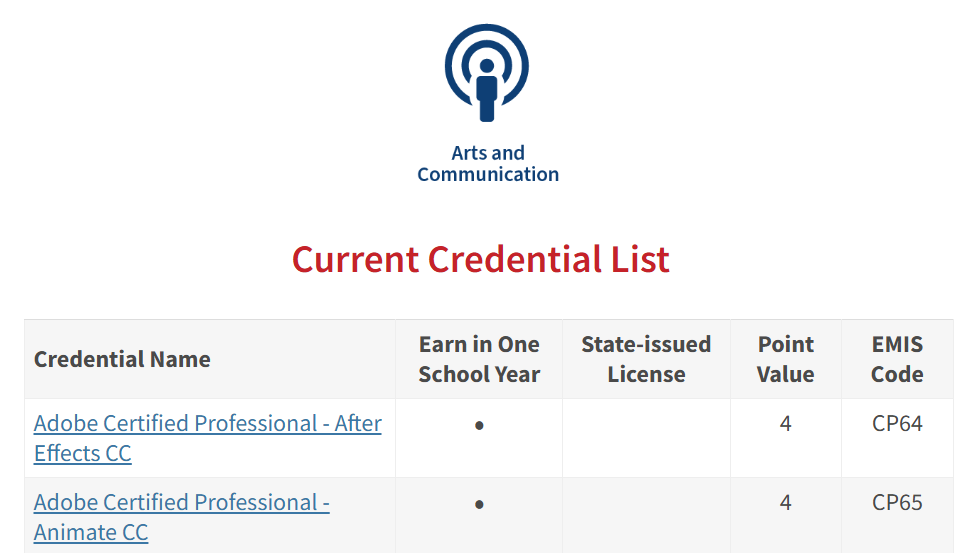
Recent state policy has prioritized industry credential attainment in a variety of ways, including through state accountability systems and by reimbursing schools and districts for the costs of industry credential exams. Reporting on student attainment of recognized postsecondary credentials is also mandatory for postsecondary institutions receiving funds under the Perkins CTE Act and optional for secondary grant recipients, as we’ll cover further in the Perkins Data and Reporting section.
To help integrate industry credentials, CTE programs may turn to partners like Certiport®, a Pearson VUE business, which provides certification exam development and delivery for a wide portfolio of certification programs. These include Microsoft and Adobe credentials; the Autodesk Certified User certification program; and certifications in agriscience, health sciences and hospitality and culinary arts, among other CTE fields.
Another provider of CTE end-of-course assessments is NOCTI. This organization produces Blueprints across discipline areas, developed with educator and industry expertise; incorporating competency lists, percentage breakdowns, sample questions and skill-based job examples; and leading to credentials. For instance, NOCTI’s HVAC Installer Basic Blueprint is a partner credential with the Home Builders Institute and National Association of Home Builders. It includes a written assessment and a performance assessment in which the test-taker performs start-up tests on a high-efficiency gas furnace.
Regardless of source, many CTE assessments incorporate a performance component in place of or in addition to a written exam so that learners may demonstrate their knowledge and skills. These assessments may need to be administered in a proctored environment.
State-specific Info: Find CTE standards, curriculum and approved industry credential lists for your state with our State-by-State Resource List.
Delivering CTE curriculum and assessments requires industry-relevant and safe equipment and appropriate facilities. Managing the equipment and environment for a CTE program includes purchasing, maintaining and updating equipment and facilities, keeping track of student liability release waivers, and ensuring students are learning and practicing safety. In your administrative role, you may play a part in purchasing, paperwork and conducting periodic safety walkthroughs.
While many CTE programs incorporate the same or similar equipment as used in the workplace, simulations are becoming increasingly popular to safely and cost-effectively enable students to practice technical skills and explore careers. These simulations may range from more traditional versions like anatomical models for health care programs to augmented and virtual reality systems that simulate a number of different worksite environments and activities.

Reflection Questions
The following questions can help you understand and make decisions about the standards, curriculum and assessments incorporated into your CTE programs and the facilities and equipment that support instruction. These questions, among others, can also be found in the fillable reflection tool.
- Where can you find relevant standards, curriculum and assessment resources for your CTE programs of study?
- What is the process and timeline for updating standards and curriculum? Is there a role for your teachers in that process?
- What industry credentials are embedded in your CTE programs?
- What procedures ensure that facilities and equipment are safe and industry relevant?
- Who is responsible for purchasing decisions for curriculum, assessments and equipment, among other costs?
In addition, the ACTE Quality CTE Program of Study Framework®, an evidence-based set of standards for what defines a high-quality CTE program, can help you assess the state of your CTE programs when it comes to curriculum, assessments, and facilities and equipment. In addition, you can take part in ACTE online professional learning on these topics through the CTE Learn online course platform.